da

mothers day complainer

Today on Toothpaste For Dinner: mothers day complainer


WE NEED YOUR HELP: Please chip in $1 or more on Patreon so I can continue to update Toothpaste For Dinner, Married To The Sea & The Worst Things For Sale online and updating daily. I can not do this without your support on Patreon.


da

found a damb virus

Today on Toothpaste For Dinner: found a damb virus


WE NEED YOUR HELP: Please chip in $1 or more on Patreon so I can continue to update Toothpaste For Dinner, Married To The Sea & The Worst Things For Sale online and updating daily. I can not do this without your support on Patreon.


da

Contest Caution: The Sunday Times Audible Short Story Award


Posted by Victoria Strauss for Writer Beware®

Founded in 2010, The Sunday Times Audible Short Story Award bills itself as "the richest prize for a single short story in the English language." And indeed, the prize is major: the winner receives a cool £30,000 (no, I did not add extra zeroes.)

With judges yet to be finalized, the selection process will include a 20-story longlist announced in May 2020, a six-story shortlist unveiled in June 2020, and the winner revealed on July 2. The shortlisted stories will be published in an Audible audiobook, with included writers receiving "an extra £1,000 fee, on top of a prize payment of £1,000". To be eligible, writers must previously have had at least one work published in the UK or Ireland by an "established print publisher or an established printed magazine" (the Terms and Conditions include an extensive list of the kinds of publishers and magazines that don't qualify). The contest is open for entries until 6:00 pm on December 13.

You can read more about the award, including the prestigious judges who've participated and the well-known writers who've submitted stories, here.

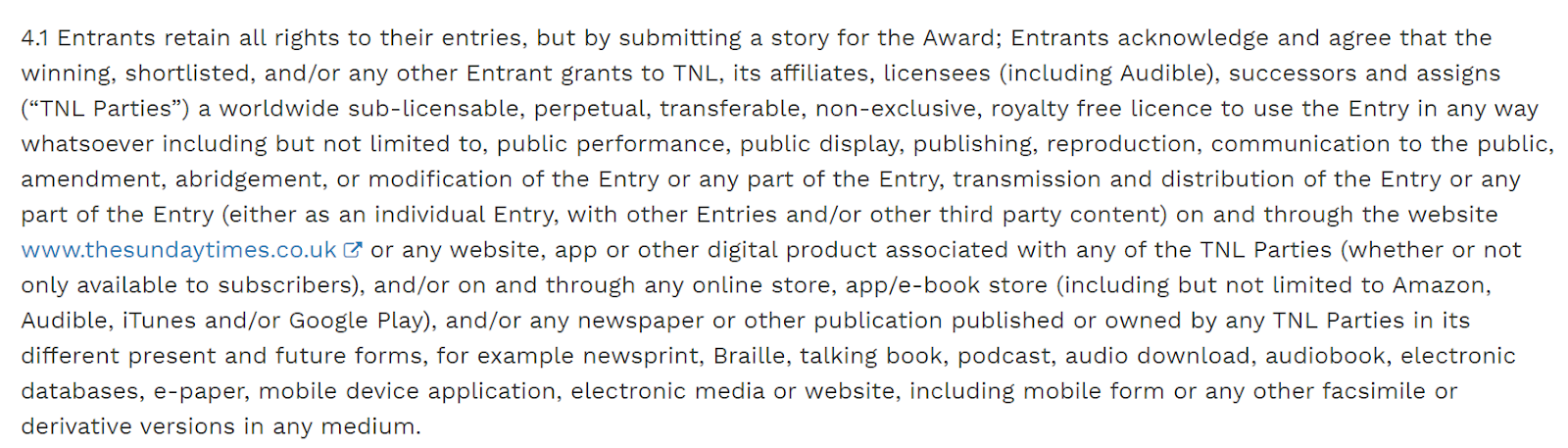
So what's the catch? -- because you know I wouldn't be writing this post if there weren't one. Well, as so often happens, it's in the Terms and Conditions. Specifically:


To summarize this dense paragraph: simply by entering the competition, you are granting a sweeping, non-expiring license not just to Times Newspapers Limited (The Sunday Times' parent company), but also to Audible and any other licensees of TNL, to use your story or any part of it in any way they want, anywhere in the world, without payment to or permission from you.

This is far from the first time I've written about "merely by entering you grant us rights forever" clauses in the guidelines of literary contests, some of them from major publishers or companies that should know better. Sure, in this case the license is non-exclusive, so you could sell your story elsewhere--but only as a reprint, because by granting non-exclusive rights to one company, you remove your ability to grant first rights to another, at least for as long as the initial rights grant is in force.

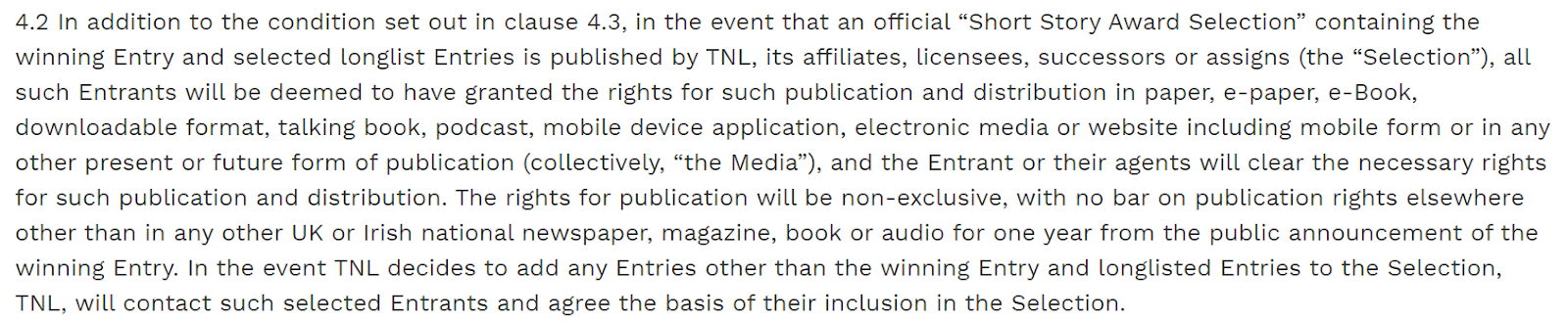
It's not uncommon for literary contests that involve publication to bind all entrants to a uniform license or grant of rights--so that, when winners are chosen, the license is already in place. But ideally, the license should immediately expire for entries that are removed from consideration--or, if the contest sponsor wants to retain the right to consider any entered story for publication (as TNL clearly does--see Clause 4.2, below), rights should be released within a reasonable period of time after the contest finishes--say, three or six months. There's simply no good reason to make a perpetual claim on rights just in case, at some unspecified point in the future, you might just possibly want to use them.

Not to mention--why should Audible get to make this same claim?

There's a couple of other things to be aware of. Shortlisted authors enter into a 12-month exclusive contract with Audible, for which they are given a "one-off" lump-sum payment (the £1,000 noted above). But thereafter, Audible retains the right "to record, distribute and market such audio version for at least ten (10) years." Again, this right is non-exclusive--but there's no indication that Audible has to pay these authors for potentially exploiting their work for a decade. (If you don't consent to these terms, you can't be shortlisted.)


Finally, although publication is guaranteed only for the shortlist, TNL reserves the right to publish longlist and non-listed entries as well. Great! Except...there's nothing to suggest these writers would be paid either.


There's no question that this is a prestigious--and, for the winner, rich--award. But sober evaluation is definitely in order here. Enter at your own risk.


da

Scandal Engulfs Independent Publisher ChiZine Publications


Posted by Victoria Strauss for Writer Beware®

If you're not part of the horror or speculative fiction community, you may not be aware of the scandal that over the past two weeks has engulfed ChiZine Publications, a (previously) highly-regarded Canadian independent publisher.

In September of last year, several authors, including Ed Kurtz, made a complaint to the Horror Writers Association about long-overdue royalties at ChiZine. On November 5 of this year, after the complaint became public knowledge, CZP posted a statement on its Facebook page, claiming that Kurtz's royalties were "currently paid in full" and that "Any other monies he might be due will be paid on his next royalty statement". Kurtz's response, posted by his partner on Facebook a day later, was blistering:
The statement from Chizine neglects a number of salient facts, such as the moment in July 2018, at Necon, when I explained to Brett Savory that my partner was facing a layoff, our cat was ill, we were in severe financial distress, and I had *never* been paid a single cent of royalties in what was at that time almost two years for a moderately successful book. He actually grinned and said, "Things are hard for everyone right now" before walking away. The following morning it was reported to me that Sandra was loudly complaining in the dealer room about me having asked about my royalties, and of course the two of them went on a whirlwind trip around the world a few weeks after that, showing us all that things weren't so rough for them, after all.

In fact, I'd asked after my royalties several times and was rebuffed or given excuses every single time (usually something wrong with their accounting software or something similar, which I later learned they’d been saying to authors for years). I only went to the HWA after several other frustrated CZP authors (one of whom hadn't been paid in five years!) strongly encouraged me to do so. I expressed fear of bullying and/or retaliation, and some of these authors promised me they'd have my back (they didn't). And yes, a lot of us got paid through my efforts, though it is untrue I'm paid in full. I was never paid royalties for the months of my first year of publication, 2016, though CZP continues to claim I was. I just gave up on this.
Kurtz's experience was not isolated.

******

Between 2010 and 2015, Writer Beware received a handful of complaints (fewer than five) about ChiZine from authors who cited months-late royalty payments or long waits for contracts. Because the complaints were so few, and also because the authors all did eventually receive their payments or their contracts (though in most cases only after persistent prodding), it wasn't clear to me whether the tardiness indicated a pattern of problems, or was the kind of occasional glitch that can afflict otherwise reputable small presses with small staff and tight finances.

As it turns out, those few complaints were just the tiniest bubbles drifting up from what appears to be a roiling ocean of dysfunction.

Following Kurtz's public response, CZP authors and staff began to come forward with their own experiences--a tsunami of serious allegations including non-payment (some staff say they were never paid for years of work), extremely late or missing royalty payments (years in arrears in some cases; many authors report having to fight for what payment was received), erratically-produced royalty statements (CZP breached at least some of its own contracts by sending out royalties once a year instead of bi-annually--more on that below), missed pub dates, broken marketing promises, and financial mismanagement--especially concerning, since a big chunk of CZP's budget comes from grants and subsidies. (Former CZP staff member Michael Matheson has written a pair of illuminating posts on CZP's finances, including its treatment of grant money and habitual financial distress.)

Staff and authors also--in multiple, strikingly similar posts and complaints, including some received by Writer Beware--cite a toxic work culture that featured bullying, intimidation, sexual harassment, racism, gaslighting, and more. Several of those who contacted me told me that they felt CZP operated "like a cult," with charismatic leaders at the top who were admired and feared in equal measure, and whom many dared not defy.

This account only scratches the surface. For much more:
On November 11, CZP's founders, Sandra Kasturi and Brett Savory, posted a statement on the CZP blog and Facebook page indicating that they have decided to "step down." Although the statement mentions financial issues ("we have taken a short-term personal loan to bring payments up to date"), it doesn't address the many other complaints that have been leveled against the company--and, notably, does not include an apology.

The response has not been kind.

******

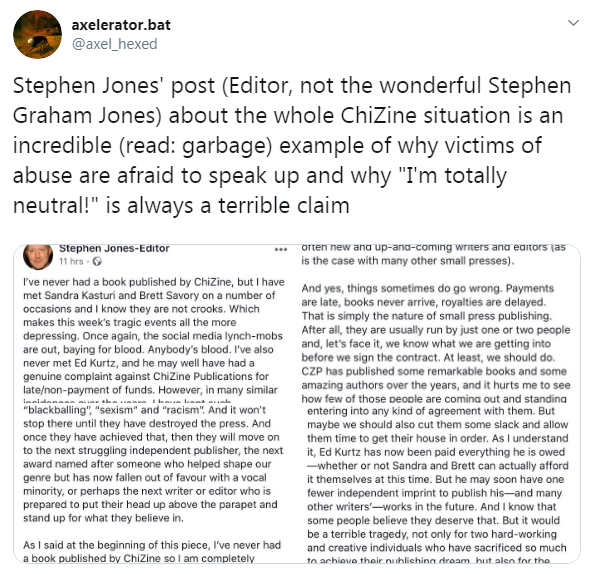
Despite all of the above, there are still those who continue to defend CZP, and to brush off the statements by writers and staff. For example, this, from editor Stephen Jones (Jones's post has been removed; this is a screenshot posted to Twitter):

What stands out for me here is not just the skepticism that whistleblowers always have to face (and which, even when the publisher doesn't try to intimidate or engage in reprisals, makes it so much harder for whistleblowers to come forward), but the defense of unprofessional business practice--not just by CZP but, apparently, by small press publishers in general. Small presses are doing something great for writers and readers, so we should "cut them some slack" when they fail to pay, or don't fill book orders, or miss a pub date, or engage in some other kind of behavior that has a negative impact on staff and authors. That's "simply the nature of small press publishing." Deal with it!

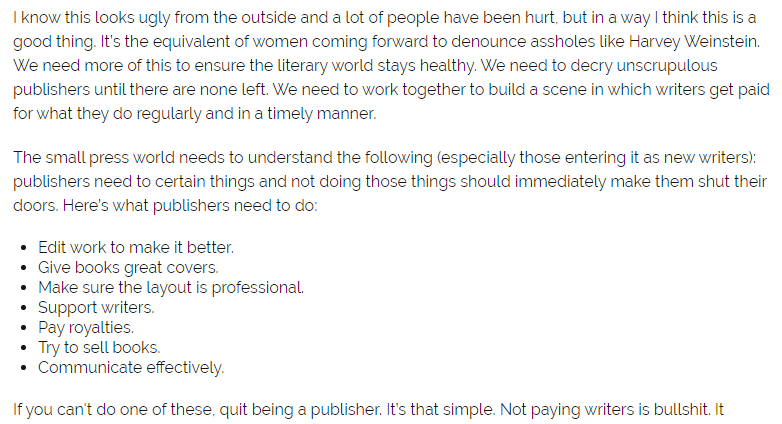
It's a really common argument. I can't tell you how often I've seen some version of it--not just from toxic or troubled publishers, but from the writers they are screwing over. But it is bullshit. Complete and utter bullshit.

No matter how "worthy" a publisher may be, that does not give it the right to abuse its writers or its staff--whether by accident or design. Publishers function in the realm of art, but they also need to function like businesses--not like cults of personality, not like sinecures, not like kitchen-table hobby projects where it doesn't really matter that they know little about publishing and have never run a business as long as they've got good intentions. You don't get a pass because you've got a noble goal. You don't get a pass because independent publishers are struggling and we need more of them. You don't even get a pass because you're putting out good books from disenfranchised authors. You need to run your business right, and treat your writers and your staff right, or you have no business calling yourself a publisher.

Which brings me to my next point. The scope and range of what has apparently been happening at ChiZine is bigger than usual (and having seen as many small press implosions as I have over the years, it's amazing to me that it took so long for the scandal to break). But it's important to emphasize that it is not an isolated occurrence. Contract breaches, financial malfeasance, even the kind of harassment and gaslighting and dictatorial behavior that CZP authors and staff describe--all are rampant in the small press world. Just go back through a few years of the entries on this blog, and you'll see plenty of examples.

I don't mean to tar all small presses with the same brush. There are, it's important to acknowledge, many small and indie publishers that operate with complete professionalism and do all they can to treat their authors right. But there is a huge, huge problem in the small press segment of the publishing industry, and we don't do writers--or readers--any favors in dismissing or downplaying or making excuses for it.

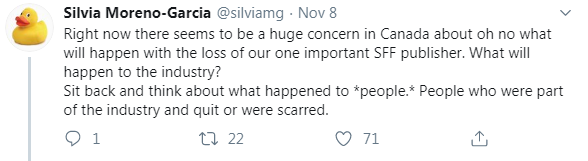
I'm not the only one who is making this point. Silvia Moreno-Garcia, who had payment issues with CZP and also has experience running a micro-press, addresses the issue in a Twitter thread:


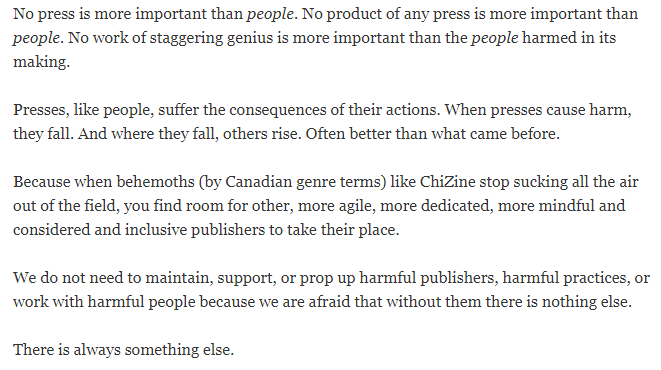
In a blog post, former CZP staffer Michael Matheson responds to those who would like to see publishers like CZP dealt with more kindly:

And, commenting on the Chizine situation, writer and reviewer Gabino Iglesias points out:


I agree 100%. But I'm not holding my breath.

******

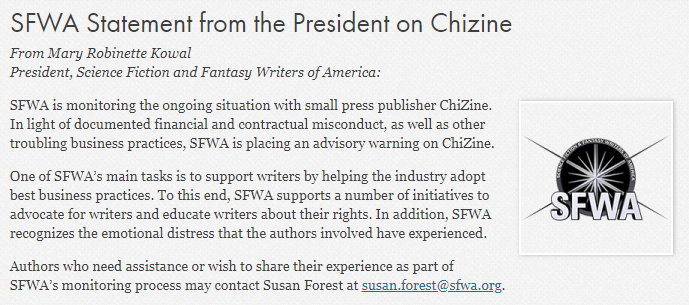
The scandal has unfolded very quickly but there've already been consequences. High Fever Books reports "a mass exodus" from CZP, with authors requesting rights reversions for their books, and withdrawing stories from CZP's forthcoming Christmas anthology. The Ontario Arts Council, one of CZP's funders, has recently removed CZP from its list of grant recommenders. And SFWA has issued a statement:


******

Finally, some semi-wonky publishing stuff.

There's been some discussion of irregularities with CZP's royalty statements. I've seen a number of these, kindly shared with me by CZP authors, and while they're somewhat of a chore to figure out and are missing some information that ideally should be present, the numbers do add up. However, a few things are sub-optimal.

- CZP's contract boilerplate empowers the publisher to set a "reasonable" reserve against returns. There are no specifics, so it's basically up to the publisher to decide what "reasonable" is.

For CZP, "reasonable" seems to mean 50%. This seemed high to me, so I did a mini-canvass of literary agents on Twitter. Most agreed that smaller is better--maybe 25-30%, though some felt that 50% was justifiable depending on the circumstances. They also pointed out that the reserve percentage should fall in subsequent reporting periods (CZP's remains at 50%, unless boilerplate has been negotiated otherwise), and that publishers should not hold reserves beyond two or three years, or four or five accounting periods (CZP has held reserves for some authors for much longer).

(If you're unclear on what a reserve against returns is, here's an explanation.)

- Per CZP's contract, royalties are paid "by the first royalty period falling one year after publication." What this means in practice (based on the royalty statements I saw) is that if your pub date is (hypothetically) April of 2016, you are not eligible for payment until the first royalty period that follows your one-year anniversary--which, since CZP pays royalties just once a year on a January-December schedule, would be the royalty period ending December 2017. Since publishers often take months to issue royalty statements and payments following the end of a royalty period, you'd get no royalty check until sometime in 2018--close to, or possibly more than, two full years after publication.

In effect, CZP is setting a 100% reserve against returns for at least a year following publication, and often much more. This gives it the use of the author's money for far too long, not to mention a financial cushion that lets it write smaller checks, since it doesn't have to pay anything out until after returns have come in (most sales and most returns occur during the first year of release).

I shouldn't need to say that this is non-standard. It's also, in my opinion, seriously exploitative.

- And...about that annual payment. It too is non-standard--even the big houses pay twice a year, and most small publishers pay quarterly or even more often. It's also extra-contractual--at least for the contracts I saw. According to CZP's boilerplate, payments are supposed to be bi-annual after that initial year-or-more embargo. The switch to annual payment appears to have been a unilateral decision by CZP owners for logistical and cost reasons, actual contract language be damned (I've seen documentation of this).

- A final wonky contract point: CZP's contract boilerplate mentions royalty payments (as in, they're bi-annual)--but does not, anywhere, mention royalty statements.

A publishing contract absolutely needs to bind a publisher not just to pay, but to account royalties on a regular basis (whether or not payments are due). If there's no contractual obligation for the publisher to provide royalty accounting, it may decline to do so--and that's not theoretical, I've gotten more than a few complaints about exactly this. Just one more reason to get knowledgeable advice on any publishing contract you're thinking of signing.


da

Publisher Alerts: Complaints at Month9 Books, Nonstandard Business Practices at Black Rose Writing


In mid-2016, I wrote about YA publisher Month9 Books' abrupt decision to scale back its list, reverting rights to as many as 50 authors across all its imprints. Explaining the culling, Month9 founder and CEO Georgia McBride cited her own health problems, along with staffing issues and the company's "substantial growing pains" over the past six to nine months.

McBride's announcement triggered a surge of complaints from Month9 authors, who described a host of serious problems at the company, including late or missing payments (for staff as well as authors), problems with royalty accounting, delayed pub dates, broken marketing promises, overcrowded publication schedules, communications breakdowns, and harsh treatment and bullying by McBride.

According to authors and staff, these problems were not new or even recent, but had been ongoing for a long time. Why had authors kept silent? Almost every writer who contacted me mentioned their fear of retaliation--along with the draconian NDA included in Month9's contracts. I've rarely encountered a situation where authors seemed so fearful of their publisher.

Things quieted down after the initial flood of revelations, as they often do. Month9 survived and kept on publishing, though its list continued to shrink: between a high point in 2016 and now, the number of titles appears to have fallen about 50%. Apart from a handful of additional complaints in late 2016 and early 2017 (similar to this one), I didn't hear much about Month9 in the years following.

Until now. Over the past few weeks, I've been contacted by multiple writers who say they are still suffering from the same problems that surfaced in 2016: primarily, late (sometimes very late) royalty and subrights advance payments and statements (in many cases received only after persistent prodding by authors and their agents), and allegations of irregularities in royalty reporting.

The intimidation level, too, seems not to have changed. Most of the authors told me that they feared reprisal for coming forward, and asked me specifically not to mention their names or book titles. (Writer Beware never reveals names or other unique identifying information, unless we receive specific permission from the individual. That disclaimer is included on our website and in our correspondence.)

If you've been following the recent ChiZine scandal, you may be feeling some deja vu--notably, in the alleged existence of a toxic culture within the publisher that makes authors fearful and and helps to keep them silent. It's disappointing to learn that even if the issues that thrust Month9 into the spotlight three years ago have gone quiet, they don't seem to have eased. Writers be warned.

******

I wrote about Black Rose Writing in 2009, in connection with its requirement that authors buy their own books. Writers who submitted were asked how many of their own books they planned to buy; their response was then written into their contracts. (Book purchase requirements are back-end vanity publishing: even if writers aren't being asked to pay for production and distribution, they still must hand over money in order to see their work in print.)

Black Rose got rid of the book purchase requirement a few years later, and claimed to be a completely fee-free publisher. I had my suspicions that money might still somehow be involved, though...and as it turns out, I wasn't wrong.

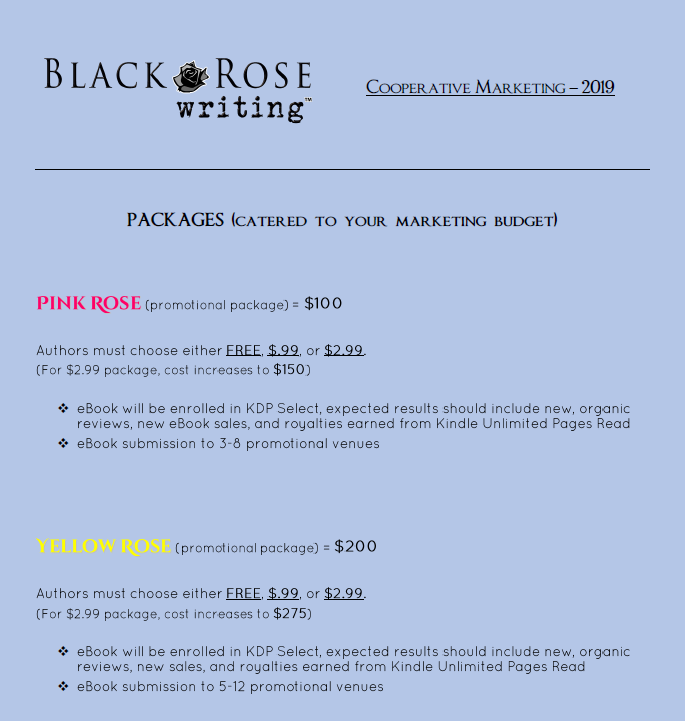
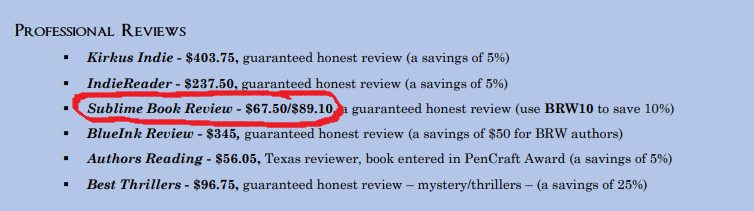
I've recently learned that new Black Rose authors receive a Cooperative Marketing Catalog that sells a range of pay-to-play marketing and promotional services, with costs ranging from a few hundred dollars to four figures. For instance:


It's true that purchase is optional (though I would guess that authors are heavily solicited to buy). But reputable publishers don't sell marketing services to their authors--and in any case, much of what's on offer are things that other publishers, even very small ones, do for their authors free of charge, as part of the publication process.

That's not the only way in which Black Rose authors are encouraged to pay their publisher. Owner Reagan Rothe is a self-described "financial partner" in two additional businesses: the Maxy Awards, a high entry fee book competition that donates "a large part of every entry" to a charity (how large? No idea; that information is not provided); and Sublime Book Review, a paid review service.

Though Mr. Rothe's financial interest in these businesses is not disclosed on the business's websites, both businesses are clearly energetically promoted to Black Rose authors. On Sublime's website, nineteen of the first 20 book reviews are for Black Rose books. There's also this, from the marketing catalog (note the lack of disclaimer):


As for the Maxys, thirteen of the 17 winners and runners-up for 2019 are Black Rose books.

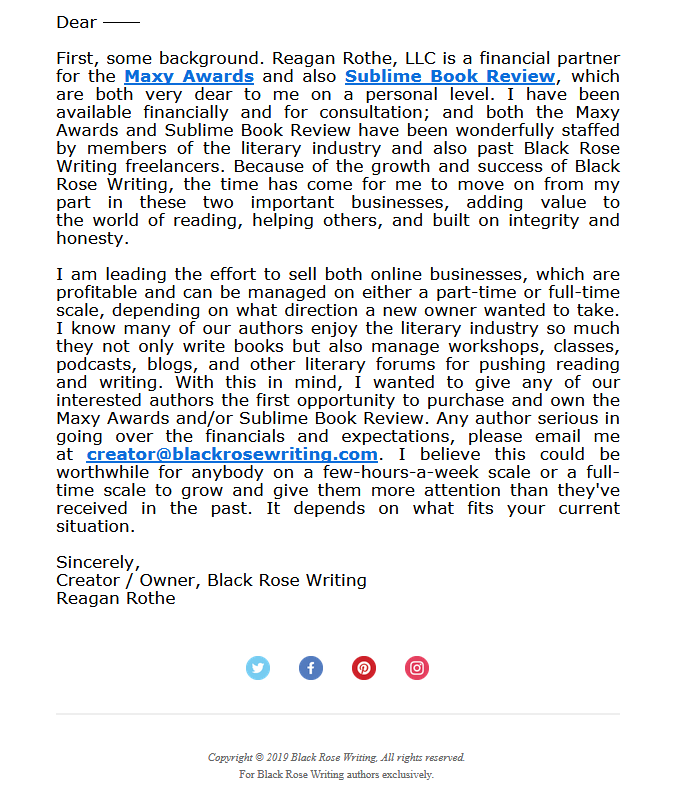
Mr. Rothe does admit his relationship with the businesses in this recent email to Black Rose authors--though only to afford them yet another opportunity to give him money:


da

How Predatory Companies Are Trying to Hijack Your Publisher Search, Part 3


Posted by Victoria Strauss for Writer Beware®

In my first post about the ways that predatory companies attempt to ensnare unwary writers who are searching for publishers, I discussed fake publisher-matching websites. In my second, I exposed the scammy Google ad tactics of vanity publisher Austin Macauley.

In this third post, I'll talk about an equally insidious practice: providing misinformation or even outright lies about traditional publishing, in order to make self- or vanity publishing appear superior.

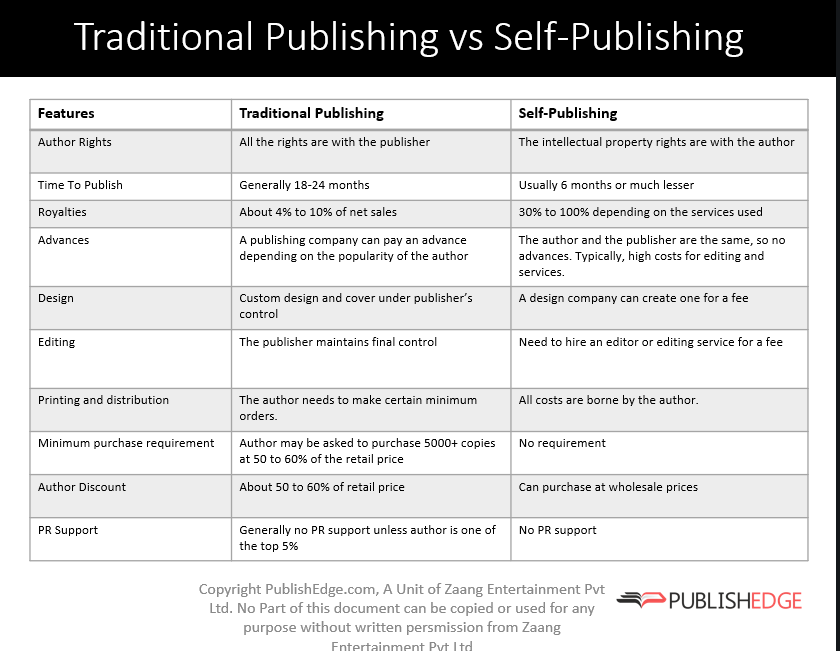
Yesterday on Twitter, someone tweeted this chart, which purportedly compares traditional publishing and self-publishing.


If you're even slightly savvy about publishing, the inaccuracies are easy to spot. Trad pubs often pay royalties on retail price (not "net sales"), or pay a higher percentage (higher royalties are especially common in the small press world). Trad pubs that pay advances don't withhold them from less popular authors, and they don't require authors to make "certain minimum orders" or to buy thousands of copies of their own books. And while it's often true that smaller traditional publishers don't provide much in the way of PR or marketing support, and larger houses invest more marketing in more popular books and authors, they don't simply ignore 95% of their output (this makes no sense; what business markets only 5% of its products?)

As for author rights...trad pubs do license exclusive rights from authors, sometimes for a period of years, sometimes for the life of copyright (with reversion usually happening well before then). But they don't gain ownership of them (as "all rights are with the publisher" implies), because the author retains copyright--plus, authors can often negotiate to keep some of their subsidiary rights. And although self-publishing is typically non-exclusive, allowing authors to publish on multiple platforms if they wish, they do still have to license publishing and distribution rights to whichever platform or service provider they choose--otherwise, the platform couldn't legally produce and sell their books.

The chart comes from this how-to-self-publish article, which is really just a long ad for PublishEdge, which is (surprise!) a paid publishing services provider.


PublishEdge is a "division" of Zaang Entertainment Pvt Ltd, which, unlike the Philippines-based scams I've been covering so much lately, is based in India. The range of services it sells aren't priced as high as some of the scammers', but there are still plenty of warning signs: no information about who is providing the services on offer (so you have no idea who they are or if they're qualified); no cover or website design samples (so you have no idea what you'd be getting for your money); and this pitch for ghostwriting services, which invites you to "Discover the simple secret to how celebrities and busy professionals get their books published without actually writing", courtesy of "our book writing experts", who (judging from the description of the service) basically type up a Skype interview into a chapter book. Most likely these unnamed "experts" are hired on Upwork or Fiverr or a similar jobs site (holy plagiarism scandal, Batman!).

PublishEdge isn't alone in misrepresenting traditional publishing in order to make itself look more attractive. Among other alternative facts, this chart from Morgan James, a vanity publisher with an author purchase requirement, claims that "many major houses" require authors to buy 5,000 copies or more of their own books (doesn't that make MJ's 2,500 purchase requirement seem appealing?), and that trad pubs provide no PR or marketing support for 94% of their books and authors. (Hmmm. Could PublishEdge have borrowed a little something there?)

Here's another misleading comparison, from Union Square Publishing, a self-styled hybrid (read: vanity) publisher. It too borrows heavily from Morgan James's chart, with several of the same dubious claims. Here's another one--this time from Success Publishing, which sells Chicken Soup-style anthology slots.

This one, from "custom" publisher Momosa Publishing (packages start at $5,900), doesn't tell quite so many fibs, but encourages you to believe that trad pubs cap their royalties at 6%, and don't market their books to libraries. And then there's this from Atmosphere Press, another so-called hybrid, which wants to convince writers that a $5,000 publishing fee will save them from the "raw end of the deal" they'd get from a trad pub, "losing not just their royalties but also the rights to their material and to their control over their art." Not addressed: the likelihood of ever making that $5,000 back.

These are just a few examples; there are many more. If you use the internet as part of your publisher search, you're very likely to encounter them (in some cases, disseminated by self-styled experts who ought to know better). It's a great argument for a step that many writers skip: learning about publishing before diving into the quest for publication. As with all aspects of publishing, knowledge is your greatest ally and your best defense: the more you know about the way things really work, the better protected you will be against the disinformation described above.

Final note: I know that many writers have had bad experiences with traditional publishers--I've had some myself. Especially in the small press world, many traditional (at least in the sense that they don't charge fees) publishers engage in nonstandard and author-unfriendly business practices. There's plenty of discussion of that on this blog. I'm not trying to paint trad pub as perfect, or argue that it's necessarily a better choice for any given writer.

But deliberate distortions like those described above don't help anyone, even if you don't take into account their obvious self-serving agenda. Tarring an entire segment of the publishing market with a broad negative brush--especially where some of the supposed negatives are demonstrably false--is as irresponsible as arguing (as some people still do) that only traditional publishing is a worthwhile path. 


da

Update on cards, books, calendars, and more!

Here’s a new holiday card design for this year! I have only a limited supply of them, but the choices on offer for Wondermark holiday cards are myriad. This year, I am not making a printed 2020 calendar. What I have done, though, is re-issued four of my previous calendars (from 2013, 2014, 2015, and […]


  • Blog
  • blog: product announcements

da

#1505; A Dash of Holiday Magic


da

Make your own 2020 calendar from past calendars! PLUS: Progressive calendar free download

Although there is no 2020 Wondermark calendar per se, observant Marksman Gary T. let me know that dedicated calendar fans can make a 2020 calendar at home with the aid of: • January–February: The 2014 Wondermark calendar • March–December: Either the 2009 or 2015 Wondermark calendar It’s Leap Day this year that throws things off. SO, […]

  • Blog
  • blog: stuff I made