be

Vanity Radio: Why You Should Think Twice Before Paying For an Interview


Posted by Victoria Strauss for Writer Beware®

In a super-crowded, hyper-competitive marketplace, one of the main challenges for book authors is to stand out. And where there's a need, there are always unscrupulous operators waiting to take advantage. The internet is awash in worthless schemes and outright scams designed to profit from authors' hunger for publicity and exposure.

I've written about a number of these--Hollywood book-to-screen packages, the hugely marked-up PR options offered by Author Solutions, the plague of marketing scams originating in the Philippines. Others to watch out for include book fair display packages (publishing industry expert Jane Friedman has a good article on why these are not worth your money), pay-to-play book review services, and what I'm going to talk about in this post: vanity radio.

What's vanity radio? In the "writer beware" context, it's radio air time that you, the program guest, have to pay for. Such schemes have been around forever in various forms, aimed at experts and creatives of all kinds, from services that explicitly sell pay-to-play interviews, to show hosts that charge interview fees to defray the fees they themselves have to pay their platforms.

The main selling point is the promise that your interview will be heard by a large and eager audience, giving wide exposure to you and your book (see the pitches that I've pasted in below). But vanity radio is primarily online radio, delivered via platforms like Blog Talk Radio and Spreaker, and streaming services like iTunes, iHeart Radio, and SoundCloud. Online radio listenership is steadily rising, but unless there are subscriber lists (as on YouTube, for instance), there's usually no way to determine the audience for any given host or show--or to authenticate any listenership claims the show may make. Lots of people may be tuning in...or no one at all.

As a result, the only verifiable benefit authors may receive for their money is an audio or audio-and-video clip that they can post to their websites and social media accounts. Whether that's worth it when it costs $99 or $150 or $200 is debatable enough. But when the price tag is four figures?

As always in the realm of junk marketing aimed at writers, Author Solutions has been both the pioneer and the primary practitioner. All its imprints sell vanity radio in some form: here's AuthorHouse's offering, for instance (just $1,099!). iUniverse's is identical. Xlibris and Trafford currently sell teasers rather than interviews (for significantly more money), but through 2017 they too hawked interviews.

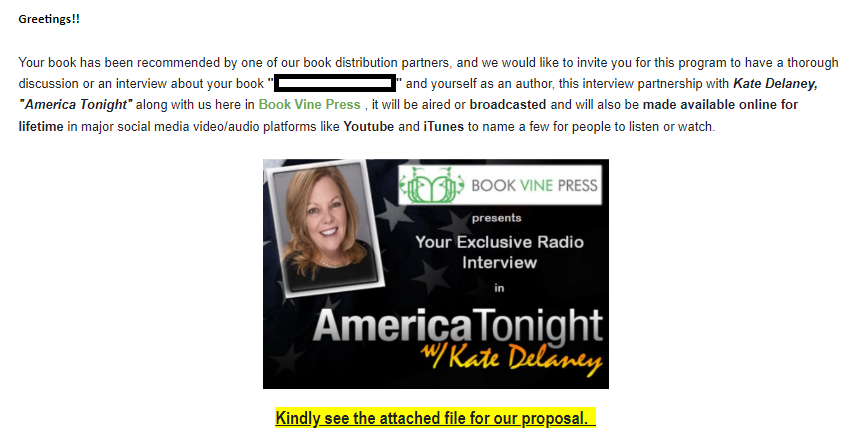
Recently, however, AS's leadership in the realm of predatory marketing services has been challenged by a flood of scammy imitators. These copycat ripoff factories have adopted vanity radio in a big way, and they aggressively hawk it to authors, both on its own and as part of costly publishing and marketing packages. Here, for instance, is an offer from Book Vine Press (cost: $1,500):

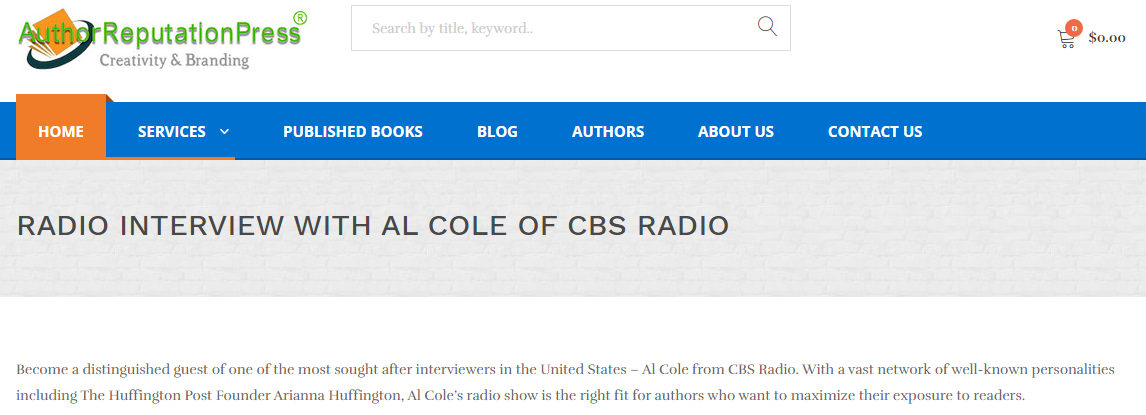
From Author Reputation Press (cost: £1,500):


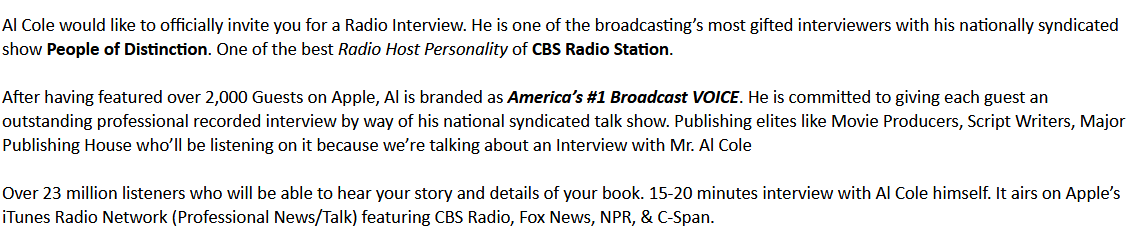
From Parchment Global Publishing (cost: $1,499):


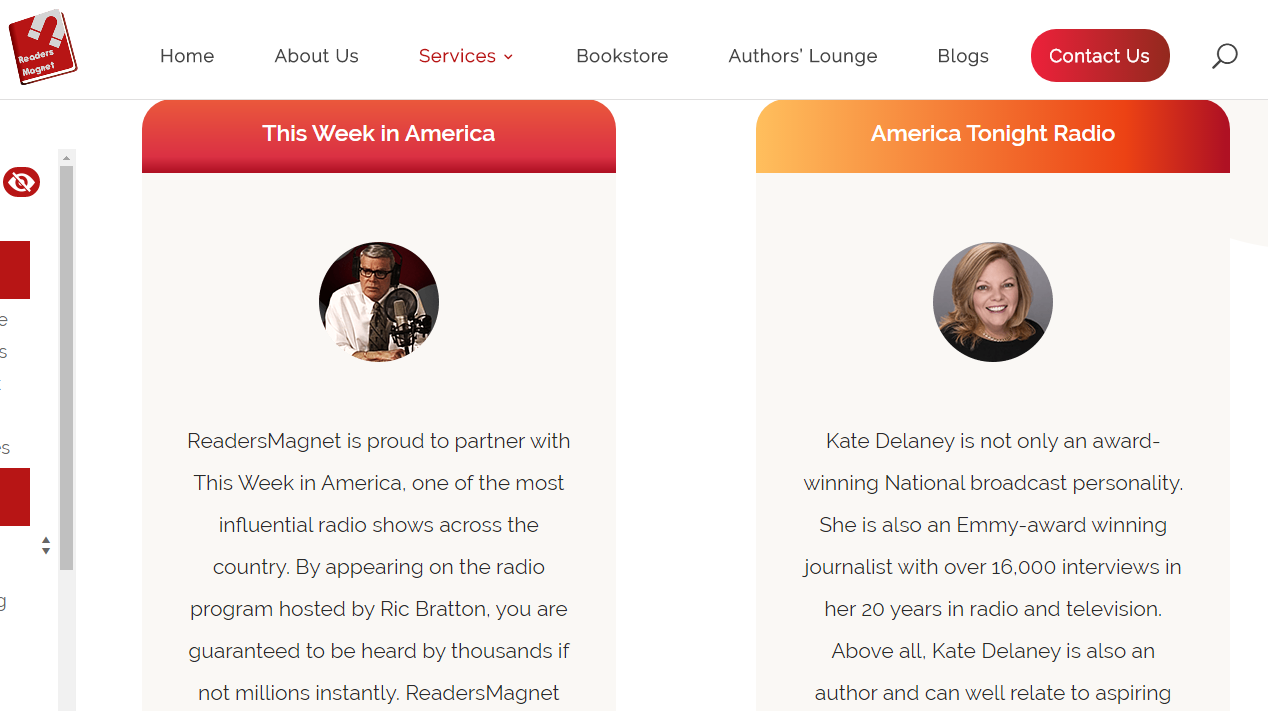
The copycats re-sell the services of a number of show hosts (there's a list below), but the three personalities noted above--Kate Delaney with America Tonight Radio, Ric Bratton with This Week in America, and Al Cole with People of Distinction--make the most frequent appearances on the copycats' websites and in their email solicitations. Delaney and Bratton have substantial, legit resumes in TV and radio; Cole is a bit harder to research, but he too seems to have a sizeable track record as a talk show host.

What, if anything, do they know of the reputation and tactics of the copycats that are re-selling their services? I contacted all three for comment last week. Cole's assistant responded in email that "Al Cole knew nothing about this....Our office will certainly look into this." As of this writing, I haven't heard back from Delaney or Bratton.

Given that the copycats routinely charge an enormous markup on products they re-sell (see, for instance, this warning from the Combined Book Exhibit, whose book fair exhibit packages many of the copycats re-sell for hugely inflated prices; the copycats also seriously jack up the fees for paid book reviews such as Kirkus Indie and BlueInk Reviews), it seems a fair bet that the interviews' hefty price tags are substantially inflated as well.

Apart from the question of such interviews' value for book promotion, that seems like reason enough to avoid them.

******

Author Solutions copycats that sell interviews from the individuals mentioned above:

BookVenture, ReadersMagnet, Maple Leaf Publishing, Parchment Global Publishing, Rustic Haws, Branding Nemo, Creative Titles Media, Paradigm Print, Stampa Global, Books Scribe, Matchstick Literary, PageTurner Press, EC Publishing, WestPoint Print and Media: Ric Bratton

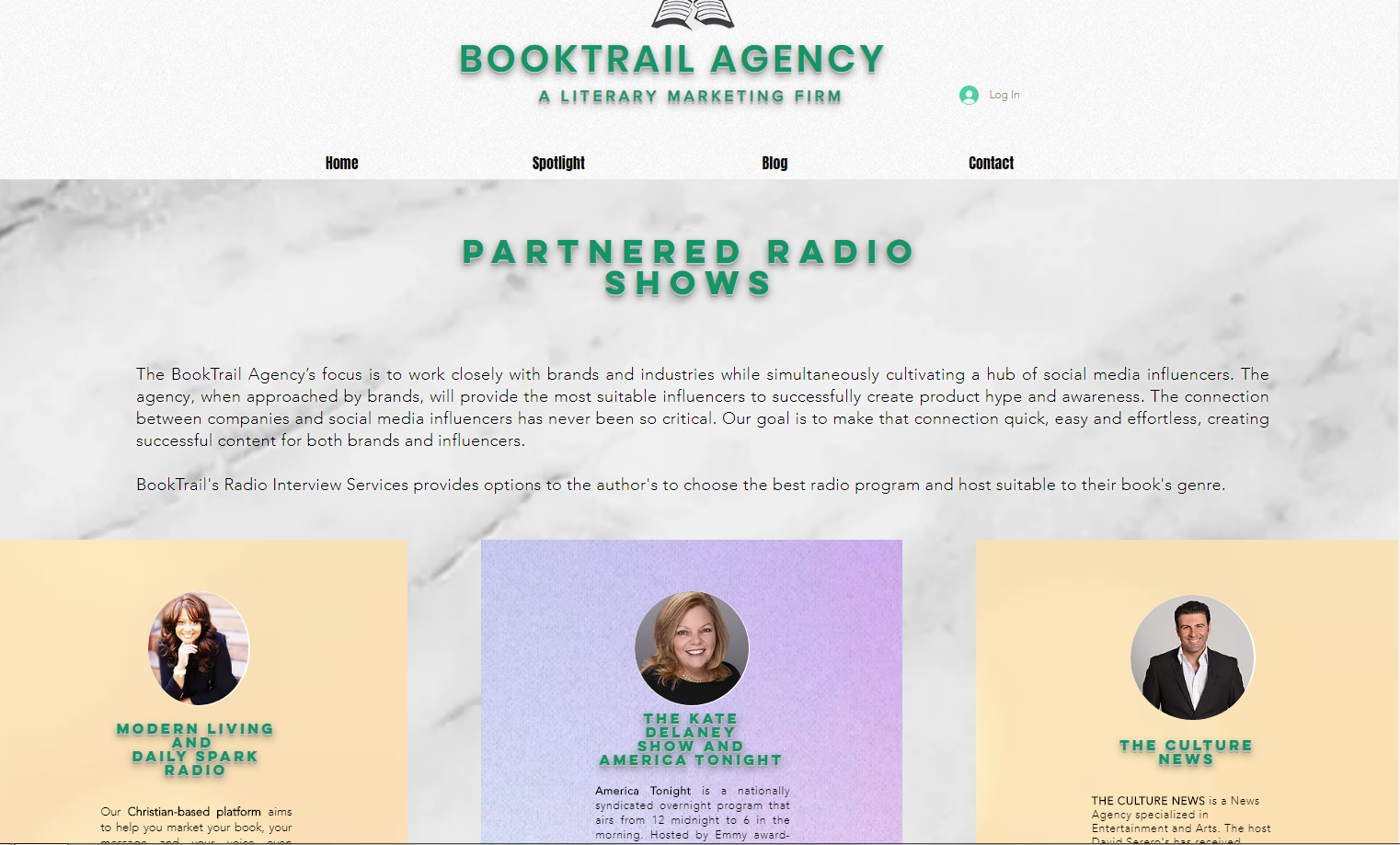
LitFire Publishing, Author Reputation Press, ReadersMagnet, BookTrail Agency, Book-Art Press, Box Office Media Creatives, IdeoPage Press, Book Agency Plus: Kate Delaney


ReadersMagnetAuthor Reputation Press, Rustik Haws, URLink Print & Media, Workbook PressParchment Global Publishing, BookWhip: Al Cole


BookTrail Agency: David Serero

BookTrail Agency, Book Agency Plus: Angela Chester


UPDATE 1/9/19: Parchment Global has added the disclaimer in red to its solicitations for Al Cole interviews (it might want to do some proofreading):


I don't know if this was at Mr. Cole's behest (remember, he's the only vanity radio host who responded--if not very expansively--to my request for comment) or is just CYA by Parchment Global itself, but hey--it lets me know that the scammers are still reading my blog.

Do I believe Parchment Global has stopped taking a cut? What do you think?


be

Writing Contest Beware: Pressfuls


Posted by Victoria Strauss for Writer Beware®

On Sunday morning, I woke up (late, I admit) to a flurry of emails about an website I'd never heard of before: Pressfuls.

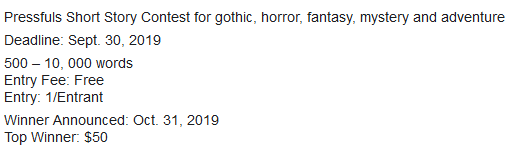
The writers who contacted me reported that they'd entered a free short story contest this past September.


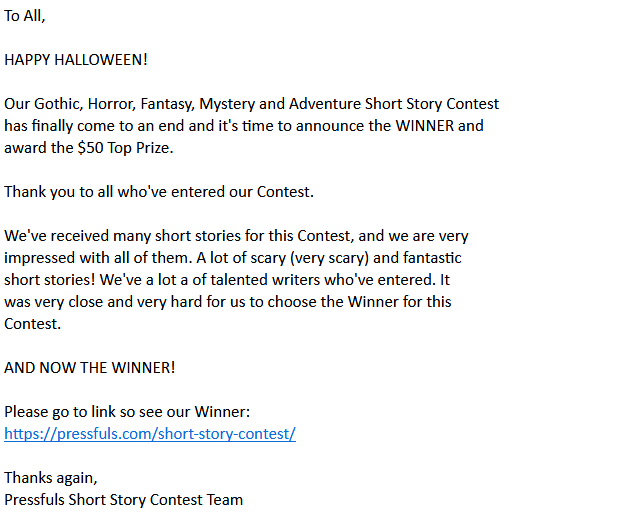
As you can see, pretty minimal information. At the end of October, they received a mass email (which, curiously, cc'd all the recipients instead of bcc'ing them, so that all email addresses were visible to everyone), announcing the winner:


Although the contest entry info hadn't mentioned that the winner would be published, the writers thought they were done and moved on. Some submitted their contest stories elsewhere. Some of those stories got accepted.

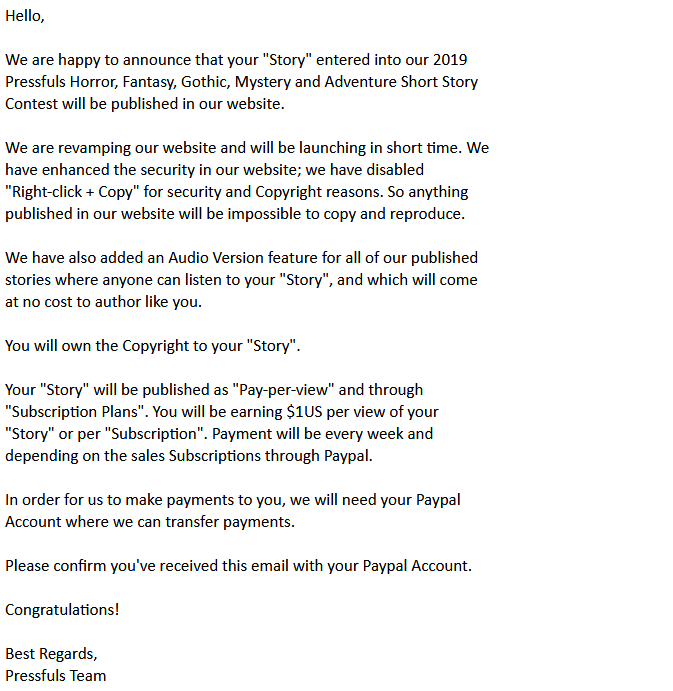
Then, just a few days ago, on December 19--surprise!


Writers were shocked. As far as they knew, they had never granted permission for their stories to be published or turned into audio versions--much less made part of some sort of pay-per-view subscription service. As for the request for PayPal information, that sounded really scammy. Writers who emailed Pressfuls to ask questions or emphasize that they hadn't granted publication rights received a non-responsive response reiterating that their story was going to be published, and that "We will give you more details about it in short time [sic]."

So what is Pressfuls? With a web domain registered just six months ago, its current website (which writers tell me has been overhauled since the contest) presents as a short fiction subscription service, with a bizarrely large variety of paid subscription plans. There is no information whatever about staff, owners, the company, or, on the submission page, payment structure and publishing rights.

There's also a couple of new short story contests with 2020 entry deadlines. And that brings me to my main reason for writing this post. Beyond the questionable happenings in this particular case, Pressfuls is like an archetypal object lesson on the kinds of contests you want to avoid.

Count the red flags:

- No rules or guidelines. The page for the September contest is gone, but writers who contacted me say that there were no posted rules or guidelines--and certainly there are none for the current contests. Bad contest rules are a red flag...but no rules at all is a giant, klaxon-blaring, run-away-now warning sign. Pressfuls' attempt to monetize entries it was never authorized to publish in the first place illustrates why.

Never, never, NEVER enter a contest if you can't find, read, and/or understand the rules.

- No information about rights or payment. Plenty of contests have unfriendly rights demands. For instance, you may have to grant publication rights simply by entering, and the contest sponsor may never release them. At least when that info is present on the sponsor's website, you can't say you weren't warned. But if there's no rights or payment information whatsoever, you are really setting yourself up for the possibility of a nasty surprise...like finding out your entry has been included in a subscription service with a sketchy payment plan.

- No information about the company. Do you seriously want to enter a contest whose organizers or sponsors you know absolutely nothing about--not even where they're located or how long they've been around? I'll give you a hint: No. If you can't confirm who's running the contest, don't enter.

- No information about judges. Part of the prestige of a contest (if it has any--and most contests don't) depends on who is doing the judging. Reputable contests disclose their judges.Otherwise, you have no guarantee the contest isn't just pulling names out of a hat.

- English-language errors. Sure, anyone can make mistakes or typos (although you have to wonder about the professionalism of a contest sponsor that isn't capable of proofing its own website). But if it's an English-language contest, and you see errors or odd syntax that suggest the website has been created by people whose first language is not English, be wary. A lot of scams these days are coming from overseas. The Pressfuls website isn't as bad as many I've seen, but there are enough lapses (dropped plurals, missing articles, mis-spellings--for instance, in several locations "Fantasy" is spelled "Fanstasy") to prompt caution. (Pressfuls' emails provide much clearer examples.)

So what is Pressfuls, really? A phishing scheme? A sleazy way to acquire and monetize content? A clueless would-be publisher with no idea how things should be done? I really can't tell. But none of these possibilities are good ones.

A couple of the writers who contacted me told me that Pressfuls complied (though without any acknowledgment) when they demanded that their stories be taken down. However, another writer said that they tried several times and their story is still online.

Since Pressfuls has no real "contact us" option on its website, my suggestion is to send a DMCA takedown notice to its email address (shortstorycontest@pressfuls.com) or, if that yields no response, to the email address of its web host (abuse@in2net.com). You can find out more about DMCA notices (which are legal notices demanding removal of infringed material from the internet) here. SFWA offers a handy DMCA notice generator.

For more information and cautions about contests, see Writer Beware's Contests and Awards page. I've also written a blog post that covers some of the same ground: Some Tips on Evaluating Writing Contests.

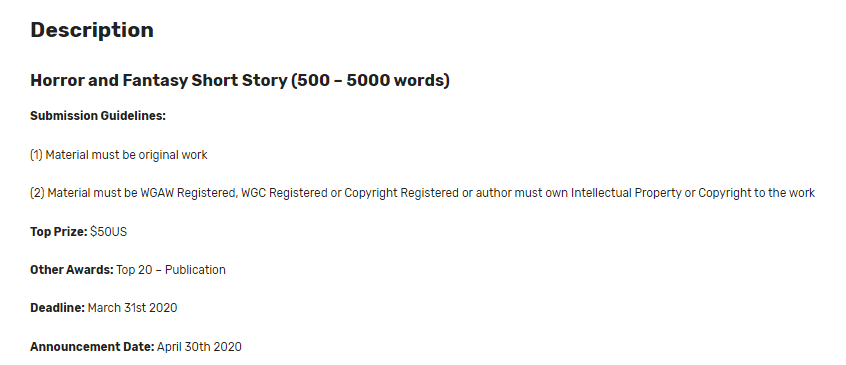
UPDATE 12/24/19: Since I put this post online yesterday, Pressfuls has amended the descriptions on its contests. Originally they looked like the description for the original contest (see above). Now they look like this:


This is not an improvement, since there's still nothing about publication or rights. Also, the copyright info is ignorant on multiple levels. WGA and WGC registrations (which are primarily for screenwriters) are not legally equivalent to US copyright registration--and they don't prove anything anyway, since the author already owns copyright, by law, as soon as the words are written down.

I shouldn't need to say that you really want your publisher to have an accurate understanding of copyright.

Writers tell me that Pressfuls sent out another mass email with instructions on how to have content removed, so it seems they're paying attention. We shall see.


be

Beware: Wid Bastian a.k.a. Widtsoe T. Bastian / Genius Media Inc. / Kairos Phoenix Company


Posted by Victoria Strauss for Writer Beware®

Scroll down for updates

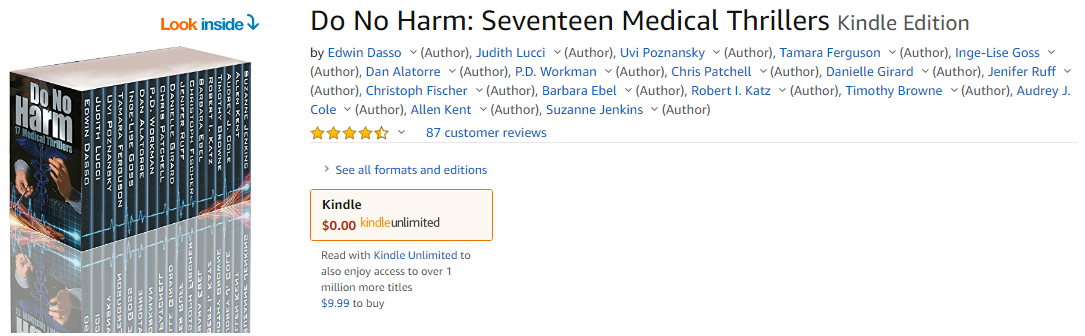
Early in 2019, seventeen writers were recruited to participate in a box set of medical thrillers, called (with unforeseen irony) Do No Harm.

The buy-in: $750, with net income from sales going to two designated charities, and participating writers receiving a pro-rated share of any net income above those contributions. The goal: through cooperative marketing efforts, to get the set on the USA Today bestseller list.

Here's how the opportunity was presented to potential participants (this is from an email that was shared with me):


In other words, right off the bat, authors were being primed not to expect to make money.

Helming the endeavor was a five-year-old PR company called Genius Media Inc., owned by a man called Wid Bastian (full name: Widtsoe T. Bastian). Per this long 2017 discussion on KBoards, one of Genius Media's not-so-genius MOs was to cold-contact writers by form email and offer glowingly-described Kindle Unlimited promotions. "For you, my estimate on an eBook promo is 10,000 plus downloads and 700 plus sales, positive ROI right out of the gate and huge page read income."

The cost: $2,000.

KBoards members urged caution, especially after expert analysis of Genius's claims indicated that its promotions weren't as successful as it advertised, and information offered by a writer who'd paid for a promo suggested that Genius was violating the TOS of the advertising platforms it used. Also noteworthy: this post from a writer who bought two promos from Genius, and lost money on each one. "That is what Genius Media told me to expect, that the first promo would not show a profit, but that by the second or third promo, they would show a profit." (The writer bought a third promo.)

As it turns out, these concerns were a sign of things to come.

Do No Harm was published, as promised, and made the USA Today bestseller list, also as promised. On October 3 (or possibly October 4), it was unpublished--three (or possibly four) days after the contractually-stipulated end date of September 30.

Per the contract (which you can see here), final reporting and payment was due to authors "no later than December 1". December 1 came...and went. Bastian promised anxious authors they'd get everything by December 15.

One day past that deadline, they did receive a report...but not from Genius Media. Between early December and December 16, with no notice or warning, a company called Kairos Phoenix had purportedly acquired Genius. Other than its business registration--in Wyoming, just like Genius's--and hometown--Logan, Utah, again just like Genius's--Kairos was a black box, with zero web presence. It had incorporated less than a month earlier, on November 22. (You can see the report here.)

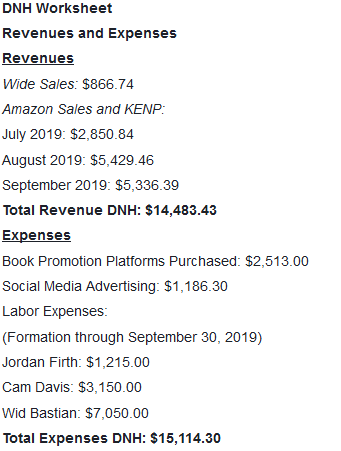
That wasn't all that was suspicious. Here's Kairos's financial breakdown:


In other words, USA Today bestselling box set Do No Harm hadn't just failed to make a profit, it had lost money. But...where was the revenue from the $750 buy-in fees--which, with 17 authors, totaled $12,750? (Kairos's explanation: it wasn't included because it was "ordinary income" for Genius Media. "As stated in the contract, the fee was paid to 'participate' in DNH Collab by the author and for no other purpose".) Where were revenues for the days the set had been on sale past the unpublish deadline? (Kairos: "The contractual period for DNH Collab was strictly defined in the contract" as September 30, so any revenue past that date was "irrelevant".)

Equally troubling, why were there more than $15,000 in expenses--three-quarters of which were for "labor"--when the contract stipulated that expenses were not to exceed the total of the buy-in fees? According to Kairos, this wasn't really an expense cap: "This provision was specifically and intentionally included in the contract language to avoid the possibility of a 'cash call' – Genius Media asking authors to contribute more to DNH Collab to achieve the goal of making USA Today Bestseller status. No 'cash call' was ever made in the DNH Collab."

Here's the actual contract wording, though (my bolding):
For the purposes of the USA Today Bestseller Medical Thriller Author Publishing Collaborative Boxed Set program, Genius Media shall not incur any publication and promotion expenses of any nature in excess of the fees paid under the terms of its author agreements and shall have no power to obligate [redacted] or any other author for any publication and promotion expense above author fees paid whatsoever.
There's a "cash call" prohibition and an expense cap. But Kairos wanted writers to believe otherwise, so it could inflate expenses and ensure a loss.

It was obvious to Do No Harm participants that Kairos was taking the money and running--avoiding the substantial payouts it would otherwise have to make by retroactively interpreting contract language, and also enabling Bastian himself to claim he was blameless because of Genius's supposed takeover by an unrelated company. (No one was under any illusion that Kairos Phoenix was anything other than Bastian in a different guise.)

Authors were furious. On December 22, two of them, Christoph Fischer and Dan Alatorre, went public with their experience. Others posted warnings on Kairos's corporate business listing.

Do No Harm isn't the first time Bastian has run this scheme, either.


The box set in question appears to be Tales From Big Country, which was published around the same time as Do No Harm. A third set, Galaxia, was pubbed in September, with profits supposedly going to the Well Aware clean water charity. I've been told that Bastian is recruiting for other sets, including a collection of thrillers.

So who is Wid Bastian, a.k.a. Widtsoe T. Bastian?

His LinkedIn profile ("EXPOSE your new book to develop your author brand and sell more books!") identifies him as the owner of Genius Media, and also of an ebook promotion program called Book Dynamite. In an earlier profile on a freelancers' job site, he describes himself as a "published novelist and screenwriter" (more on that below) who "makes most of my daily bread as a ghostwriter." He also has an IMDB profile, presumably because of his efforts to make a film of the life of Greek Orthodox priest Fr. Themi Adamopoulos.

Genius Media's website has been taken offline, but traces remain in the form of cached pages, and here's how it looked in January 2016, courtesy of the Internet Archive (more recent versions haven't been archived). The company has a D+ rating from the BBB. Bastian also owned or was an officer with at least three other companies during the early to mid-1990s: Off & Flying, Prospex Interntaional [sic] (yes, it really was registered with a typo in the name), and Nevada Pension Investment Fund. Both Off & Flying and Prospex had their statuses "permanently revoked" a few years after incorporating. All three are long dead.

There is also a Widtsoe T. Bastian who pleaded guilty to 13 felony counts including embezzlement, money laundering, and bankruptcy fraud in US District Court in North Carolina, and in 2005 was sentenced to one hundred and forty-four months in prison and restitution of more than $3,000,000. Nothing I can find online directly connects Widtsoe T. Bastian of Genius Media to Widtsoe T. Bastian of North Carolina, so it may be a different person. But Widtsoe T. Bastian is quite an unusual name, as a websearch will make clear.

Finally...I can't say "what goes around comes around", since this pre-dates the ripoff that's the subject of this post, but it certainly seems like a case of advance karma: Bastian's own 2010 novel, Solomon's Porch, was published by none other than Tate Publishing & Enterprises, a notorious vanity publisher that scammed thousands of authors and a multitude of staff, and whose owners pleaded guilty in 2017 to an array of felony charges very similar to the ones described in the previous paragraph.

Tate authors suffered terribly at the hands of their unscrupulous publisher, but Wid Bastian is one Tate author I can't feel all that sorry for.

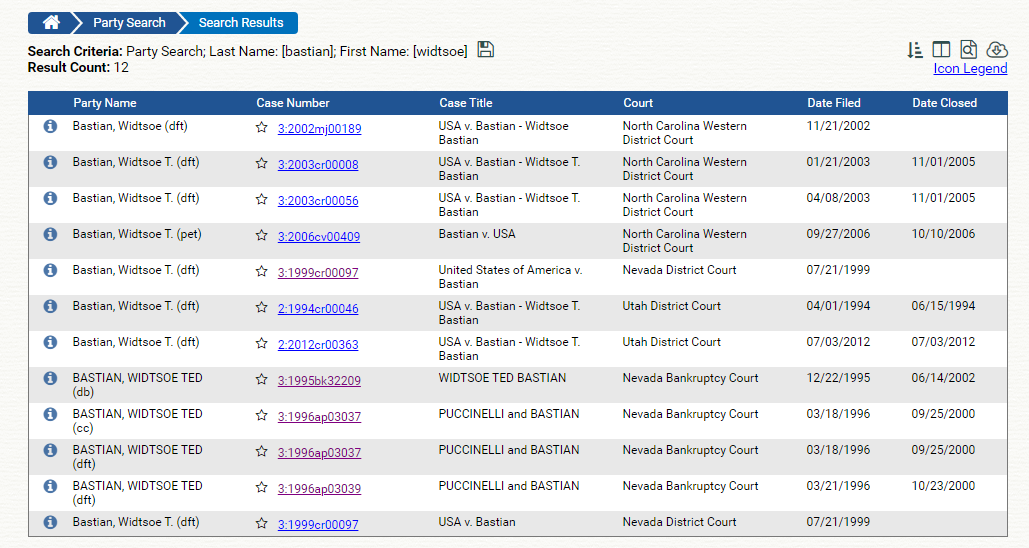
UPDATE 12/31/19: PACER was down yesterday, so I wasn't able to do a case search. I did so this morning, and here's what's there for Widtsoe T. Bastian:


Some of the listings are redundant, and several cite court documents without any links to those documents. But there's enough available to paint a tangled picture of a 1995 Chapter 11 bankruptcy in Nevada involving several companies in addition to the three mentioned above (the case was finally closed in 2002); a 1999 indictment in Nevada "on charges related to the operation of [Bastian's] venture capital firm"; failure to appear in a Nevada court in 2001; and a 2002 arrest in North Carolina, leading to the plea of guilty on 13 felony counts referenced above.

In 2012, Bastian was placed on probation or supervised release, and jurisdiction over his case was transferred to US District Court for Utah. His probation ended on May 4, 2015.

UPDATE 2/21/19: I'm featuring this comment from yesterday, as it's more indication of a pattern (the commenter has shared documentation with me that confirms what they say below):
In 2013-15, I hired Mr. Bastian as a ghost writer and later co-author of a novel we wrote together called Henry and Tom, sold through Amazon/Kindle Direct Publishing (KDP).

In mid 2015, Mr. Bastian embezzled money from a joint bank account we opened to pay for marketing campaigns for Henry and Tom. Rather than pursue embezzlement charges, I hired an expensive lawyer in Washington DC to transfer all rights for Henry and Tom to me in exchange for a $4K payment to Wid and a non-disparagement clause for both of us. This seemed at the time like the most expedient and cost effective way to deal with all the problems Mr. Bastian had caused.

I thought this matter was concluded until recently when Amazon/KDP informed me that a debt collection firm had placed a lien on Henry and Tom due to a bankruptcy filed by Wid Bastian/Genius Media Inc. KDP is currently sending my royalties to the collector per the lien. I have filed formal complaints with Attorneys General in Connecticut, New Jersey, and New York in an attempt to have the lien removed in states where the debt collectors are registered. I have also filed formal complaints against Wid and Genius Media Inc. with the Attorney General of Utah and the County Attorneys Office in Providence, Utah.

I think blogs like this are creating awareness of the depth and extent of Wid’s continuing criminal activities so we can all work together to stop him from doing this to others and get him to face justice.
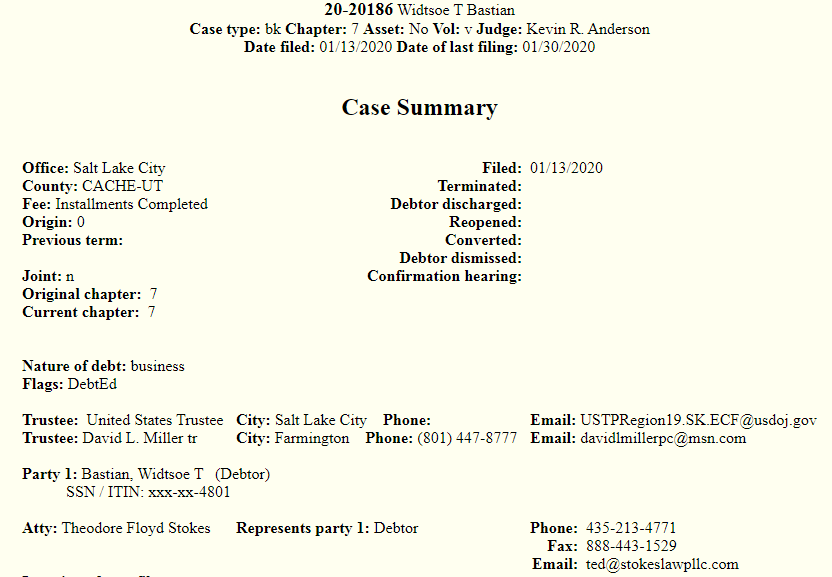
You'll note a reference to a bankruptcy. Wid Bastian filed a Chapter 7 bankruptcy petition on January 13, 2020.


A number of victims of his box set schemes are listed as unsecured creditors; if you're one of them, you should have received a snail mail notice, but if you haven't, and are wondering if you're included, here's the Certificate of Notice, with all Bastian's claimed creditors.

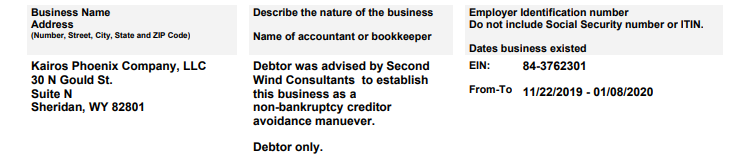
The bankruptcy filings also confirm what everybody already knew: Kairos Phoenix was Wid Bastian. The reason he set up this company probably won't surprise you, either.


be

Writer Beware: 2019 in Review

Posted by Victoria Strauss for Writer Beware®

Happy New Year! It's that time again--time for a look back at the schemes, scams, and issues Writer Beware covered in 2019.

PUBLISHER TROUBLES

Sadly, there's never a shortage of stories like these.

Scandal Engulfs Independent Publisher ChiZine PublicationsArguably the biggest small press story of the year, the spectacular collapse of Canadian indie ChiZine Publications--amid allegations of non-payment, financial mismanagement, and a horrifically toxic work culture rife with bullying, sexual harassment, racism, and more--posed thorny questions for the small press community about cultures of silence, the treatment of whistleblowers, and the tacit enabling of unprofessional behavior.

Authors' Concern Grows Over Late Royalty Payments At Dreamspinner Press: Multiple author complaints of nonpayment and other problems, for which Dreamspinner has provided confusing and conflicting explanations. (Dreamspinner has become part of the implosion of Romance Writers of America, with RWA accused of failing to assist Dreamspinner authors who requested help.)

Fireside Press Cancels Multiple Contracts: Mass contract cancellations don't generally bode well for publisher health.

Complaints At Month9Books, Nonstandard Business Practices at Black Rose Writing: Long-standing issues, including late payments and bullying, appear to be ongoing at Month9. As for Black Rose, it presents as a "traditional" publisher but, vanity publisher-style, sells a large menu of marketing services to its authors.

Trouble at Dog Ear Publishing: Multiple, long-standing author complaints of nonpayment by this assisted self-publishing company (this publishing model is in trouble generally).

AWARDS TO AVOID

If you've been reading here for a while, you'll know that I'm no fan of contests and awards--not just because they often involve big entry fees (even the legit ones), but because they so often have author-unfriendly rules and guidelines. Here are a few I encountered in 2019.

Can We Get a Do-Over? What do you do when you get caught with predatory language in your contest guidelines? You hastily switch it out, of course. That's what Harper's Bazaar did when the copyright grab in its annual short story competition was outed on Twitter.

Rights Grabs by the Sunday Times Audible Short Story Award: Another prestigious (and rich: the winner gets £30,000) contest with a predatory rights grab.

The Pressfuls Short Story Contest: Why not to enter a contest that doesn't post rules and guidelines: you may discover, as writers who entered this contest did, that your work has been published without your permission.

SAVE YOUR CASH

The shady underbelly of the publishing world is chock-a-block with those who scheme to take authors' money, by fair means or foul. Here are some especially foul examples.

Seven Prolific Vanity Publishers: A look at the vanity publishers about which I get the most questions, including Austin Macauley, Page Publishing, and Christian Faith Publishing.

Anatomy of a Book-To-Screen Scam: One of the most unlikely outcomes of publishing a book is selling film rights. Book-to-screen scammers--who purport to turn your book into a screenplay, shop it to Hollywood, and more--don't want you to know that.

Vanity Radio: Why You Should Think Twice: Should you ever pay for a radio interview? Like paid book reviews, this is an iffy proposition--even if you're not being solicited by a scammer.

A Pack of Scammer Lies: Dissecting the highly deceptive pitch by one especially egregious publishing and marketing ripoff.

ADVICE YOU CAN USE

When a Publisher Claims Copyright on Edits: This predatory practice is a big publishing contract red flag.

How Predatory Companies Are Trying to Hijack Your Publisher Search: Among other sneaky techniques: fake publisher matching sites that purport to guide you to appropriate publishers but steer you to vanities and self-publishing companies; deceptive use of Google ads to do the same thing; fake facts and statistics about traditional publishing designed to make the vanity model seem preferable.

Awards Profiteers: How Writers Can Recognize Them and Why They Should be Avoided: Profiteering awards programs have a secret agenda: making money for the sponsor with huge entry fees. They're not about honoring writers.

GENERAL BEWARES

Be careful out there!

From the Philippines, Not With Love: A Plague of Publishing and Marketing Scams: This is one of the biggest new scam trends threatening self-pubbed and small press authors. Some background on how the scams came to be, plus a list of the nearly 70 scammers I've discovered so far.

Issues at Audible's ACX: Including attempted rights fraud and inexplicably withdrawn promo codes.

Caution: Turkish Publisher Mavifil Publishing (Mavifil Yayinlari): Old scammers never die; they just change their names. A non-paying publisher that stalked writers in 2011 returns to stalk them in 2019.

AMS Literary Agency: Approach With Caution: Old scammers never die; they just change their names. Whoops, didn't I just say that? The owner of one of the most notorious vanity publisher scams ever returns in the guise of a literary agent.

Beware: Wid Bastian aka Widtsoe T. Bastian/Genius Media Inc./Kairos Phoenix Company: A convicted felon, an ebook promo and box set scheme. What could go wrong?

Publishizer: Do Authors Really Need a Crowdfunding Literary Agency? Yet another of those reinvent-the-wheel attempts that are so common in publishing: a crowdfunding site for writers that claims to represent manuscripts to publishers, but is mostly used by vanities and other fee-chargers (some of them seriously questionable).


be

Beware: Pigeon House Literary / Druella Burhan


Posted by Victoria Strauss for Writer Beware®

The internet and social media have transformed writer/agent/publisher interactions in many ways, one of which is the proliferation of Twitter pitch events, such as #PitMad, #DVPit, and others.

While no online innovation has (so far) managed to supplant the traditional query-and request route, these events do attract plenty of reputable agents and publishers--unlike other purported shortcuts (*cough*Publishizer*cough*). However, inevitably, they are also stalked by marginals, amateurs, and even scammers.

For instance, Eliezer Tristan Publishing, which charged a $500 fee and went out of business just months after opening up, haunted #PitMad. Ditto for GenZ publishing, which charges authors $2,500. Burchette and Ferguson, a brand-new publisher staffed by people with zero relevant experience, participated in pitch events before they even launched (and went out of business shortly thereafter).

Then there's this:


I've gotten many, many other questions about approaches by dubious companies and individuals as a result of pitch events. All in all, therefore, it pays to be careful, and if you haven't heard of an individual or publisher who approaches you, to research them before responding. (You can contact me; I may have heard something.)

Which leads me to the subject of today's post. I might not normally devote an entire blog post to one marginal agent, but this one is such an egregious example, and seems to be so active on social media--including #PitMad--that I think she's worth a special feature.

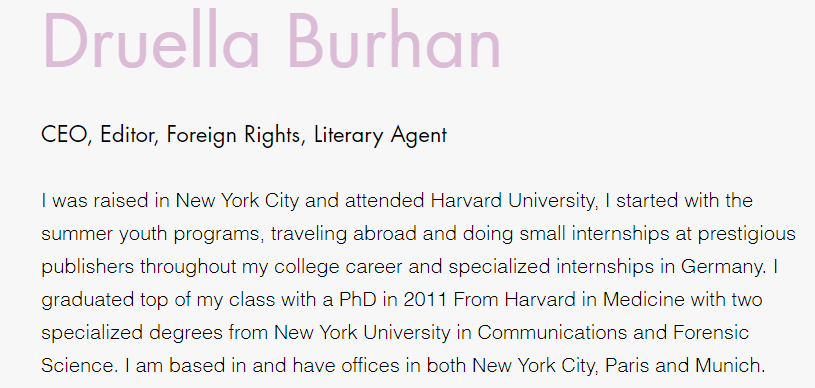
Pigeon House Literary Agency launched just this past February. It's run by Druella Burhan, whose resume includes none (zero, zip) of the relevant background experience you typically want to see from a new literary agent--such as a professional writing resume, or having previously worked for a reputable agency or publisher.


The lofty claims Burhan does make are either unverifiable, or provably false. For instance, here's Harvard Medical's publication on its 2011 MD-PhD graduates. Surprise! There's no mention of Druella Burhan.

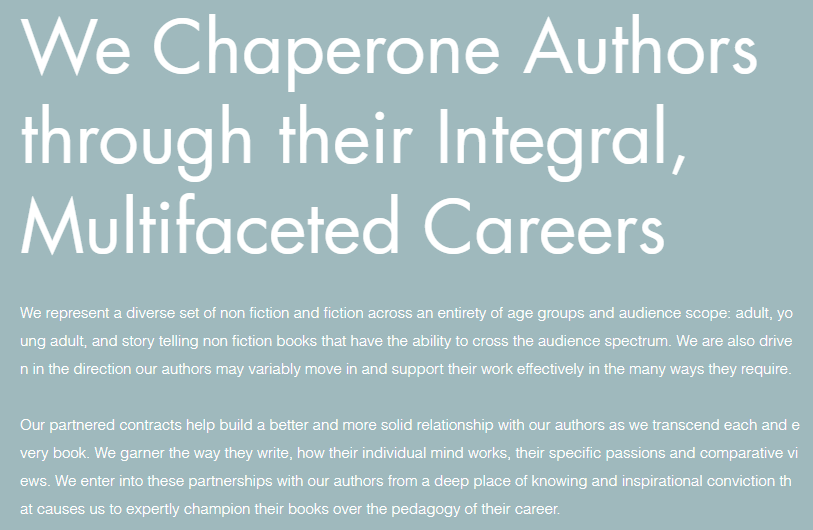
Here's some of Burhan's agenting philosophy:


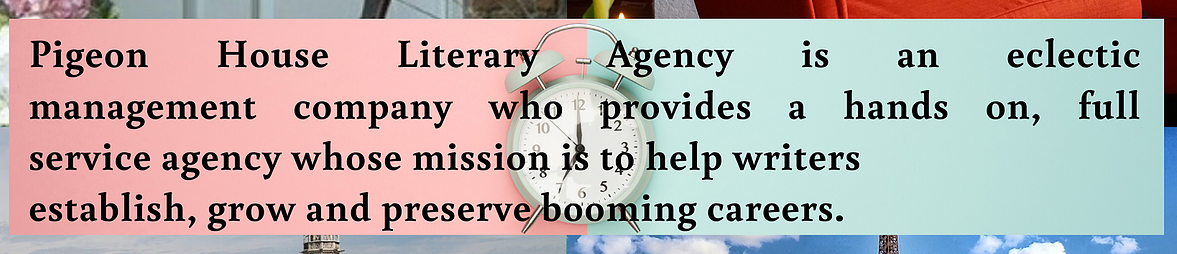
The logo (for lack of a better word) at the top of this post provides a preview of the rest of the Pigeon House site (a Wix freebie), which is amateurishly formatted and clearly not proofread (several pages have fully-justified text, with words cut off at the end of lines--I mean, it's a Wix freebie, it's not like you have to be an expert to get it right) and rife with typos, grammatical errors, and bizarre word use. For instance,


That's bad, but here's what it originally looked like. Burhan changed it shortly after I tweeted about it:


There's more: the Who We Are page, which bafflingly proclaims that the agency will "strive to bring a supreme appealingness and picturesque style of books from darkness to life"; the Foreign Rights page, which erroneously cautions writers that "If a literary agent does not agree to take you on as an international client/author, you will not be able to sell books overseas"; the Referrals page, where Burhan bizarrely invites other agents to send her clients. And here's the contract she is sending out, which includes the same formatting/proofreading errors as her website, and is really just an embarrassment.

It's a perfect carnival of amateurism.

Am I being mean here? Maybe, but before you whip out the "everyone has to start somewhere" argument, consider Burhan's false claims about herself and her aggressive use of social media to recruit clients despite her obvious ignorance and complete lack of relevant qualifications (I first heard of her because she was trolling on Reddit, and she is actively inviting queries on her Twitter feed).

The damage an amateur agent can do is considerable--squandering clients' chances with substandard submissions, submitting to disreputable or incompetent publishers, inadequately understanding publishing contract language and therefore not capable of effectively negotiating it. An amateur agent may not drain a writer's bank account the way a scammer would, but the bottom line isn't that different: no sale, and lots of wasted time.

Writer Beware.


be

Writer Beware in the Time of Coronavirus

My home office, with feline assistant.
Posted by Victoria Strauss for Writer Beware®

I rarely make personal posts on this blog. But, as I don't need to remind anyone, these are scary times.

My husband and I are physically fit and in general good health, but we are both 64 and he has an underlying health condition. Based on everything we're seeing and reading, we've concluded that our best covid-19 strategy is either a) not to get sick, or b) to delay getting sick as long as possible in hopes of more treatment options or at least less hospital crush.

Our social distancing began last weekend. We've completely withdrawn from face-to-face social interaction, and are ordering non-perishables and household items online. No more routine doctor or dentist visits. No more stores, library, restaurants, or gym (we're in Massachusetts, where a lot of things are shut down anyway). I'm still on the fence about careful, non-peak hour grocery shopping for fresh produce--but I certainly won't be going while shelves are bare from people's absurd panic buying (some of the same people, probably, who are still having parties and crowding into bars *eyeroll*).

Sarah, my other assistant. Kittehs are a comfort.
We're acutely aware that this is MUCH easier for us than it is for most. We both already work from home. We have decent financial resources. We don't have kids. Elderly relatives are all dead. Family and many friends are geographically distant, so we're already socially distanced there. We can still go out for walks and runs. I can still garden (one of my major passions).

So the changes to our routine are relatively small, compared to many. It's tougher for my husband than for me--the majority of my social life is online, but he is a gregarious person with a wide circle of friends, colleagues, and peers. But there's always Zoom and Skype, and he's making use of both.

For us as for many, stress and fear are daily companions. This is not the zombie apocalypse; there will be a vaccine eventually, and civilization will survive, as it survived the flu pandemic of 1918. But...how bad will it get? How long will it last--will we have to live this way for a year? More? What will happen to friends and family? What will happen to the people who are thrown out of work by widespread (and, I'm guessing, soon nationwide) business closures? The people who have no insurance? The people in prisons and ICE jails, the immigrants packed together at the border? And what about the election? I didn't think, back in innocent December, that that could become more crucial. But, as I stand in horror before the shitshow happening in Washington, it's clear to me that it has.

These and other questions haunt me on a daily, sometimes an hourly, basis. I suffer from depression--have done since childhood--and one of my fears is that I'll sink into a clinical episode. I can feel that possibility stalking around the edges of everything now. I am doing my best to resist. My husband, thank goodness, is more resilient. We work to keep each other's spirits up.

At a time like this, ordinary activities--like maintaining this blog--start to feel irrelevant. But they're not. Life goes on, even in the face of catastrophe. I seriously doubt that covid-19 will put a dent in the volume of schemes and scams that target writers who will still be writing, still seeking agents, still publishing. And one of the most important strategies for resisting helplessness and depression is work, for those of us who are still lucky enough to be able to do it.

Emily: Why are you taking my picture _again_?
So Writer Beware will go on. I'll continue to be active on Facebook and Twitter. As much as possible, I'll post here as I usually do--not always weekly, but as often as I find things to write about. And I urge you to continue to email me with your questions, concerns, reports, and complaints. Please, keep the emails coming.

And: wash your hands.

Don't touch your face.

Cough or sneeze into your elbow,.

Keep your distance: 6 feet is optimal.

Stay home if you can, especially if you're sick (I know this is tough for many to do).

Check on your elderly neighbors (from a distance).

Resist panic buying.

Don't share health information unless you're sure it comes from a reputable source (Facebook, oh my God).

Be safe.

I'll be seeing you.


be

Right Before We Cross The Line

Cleo Sol “When I’m In Your Arms” Cleo Sol made her new record with the producer Inflo, who also produced the two Sault albums from last year. There’s a very similar aesthetic to this music – classic soul rendered with warm, foregrounded bass and ample negative space that highlights the precision of all other instruments […]


be

Jangan Lakukan Hal Ini Ketika Berada Di Rusia

Jika kalian memiliki niatan untuk mengunjungi Negara Rusia sebagai salah satu Negara dalam destinasi kalian. Maka, kalian harus mengetahui negaranya tersebut sebelum kalian melakukan sebuah kecerobohan di sana. Misalnya kalian harus mengetahui peraturan disana, harus tahu akan etika saat berkunjung ke Negara tersebut, dan harus paham juga mengenai apa saja yang bisa kalian lakukan dan […]

The post Jangan Lakukan Hal Ini Ketika Berada Di Rusia appeared first on anni-sanni.com.


be

Why Should Feminists Be Against the Sex Offender Registry?

In October, the Supreme Court heard a case that was painfully ironic, considering the Kavanaugh hearings the nation had just been subjected to: a challenge to the United States’ extremely restrictive sex offender registry laws. While opinions on the case Gundy v. United States, which challenges the Attorney General’s ability to retroactively impose registry requirements, have yet […]


be

New York Times Number One Best Selling Audiobook Narrator Releases Free Audiobooks During Stay At Home

It occurs to me that, if I were better at marketing myself, I’d be writing and sending out press releases titled, “New York Times Number One Best Selling Audiobook Narrator […]


be

When public health becomes a casualty of the right-wing culture war, innocent people will die.

As we watch right-wing agitators, Fascists, media personalities, and the impeached president howl about ending Stay at Home before the public health experts say we should, remember that, as a […]


be

Grin And Bear It

I will be at Gencon next weekend! You Should ComE Say Hi


be

THE WORLD WILL NEVER BE READY


be

You Be The Judge

feeeet


be

Let's Not Be Hasty

I'm sure he's fine


be

OMG Turkeys 2019: Premium Subscriber Content

Happy Buttsgiving! Regular comics resume tomorrow.