em
cant remember mad
Today on Toothpaste For Dinner: cant remember mad
The Worst Things For Sale is Drew's blog. It updates every day. Subscribe to the Worst Things For Sale RSS!

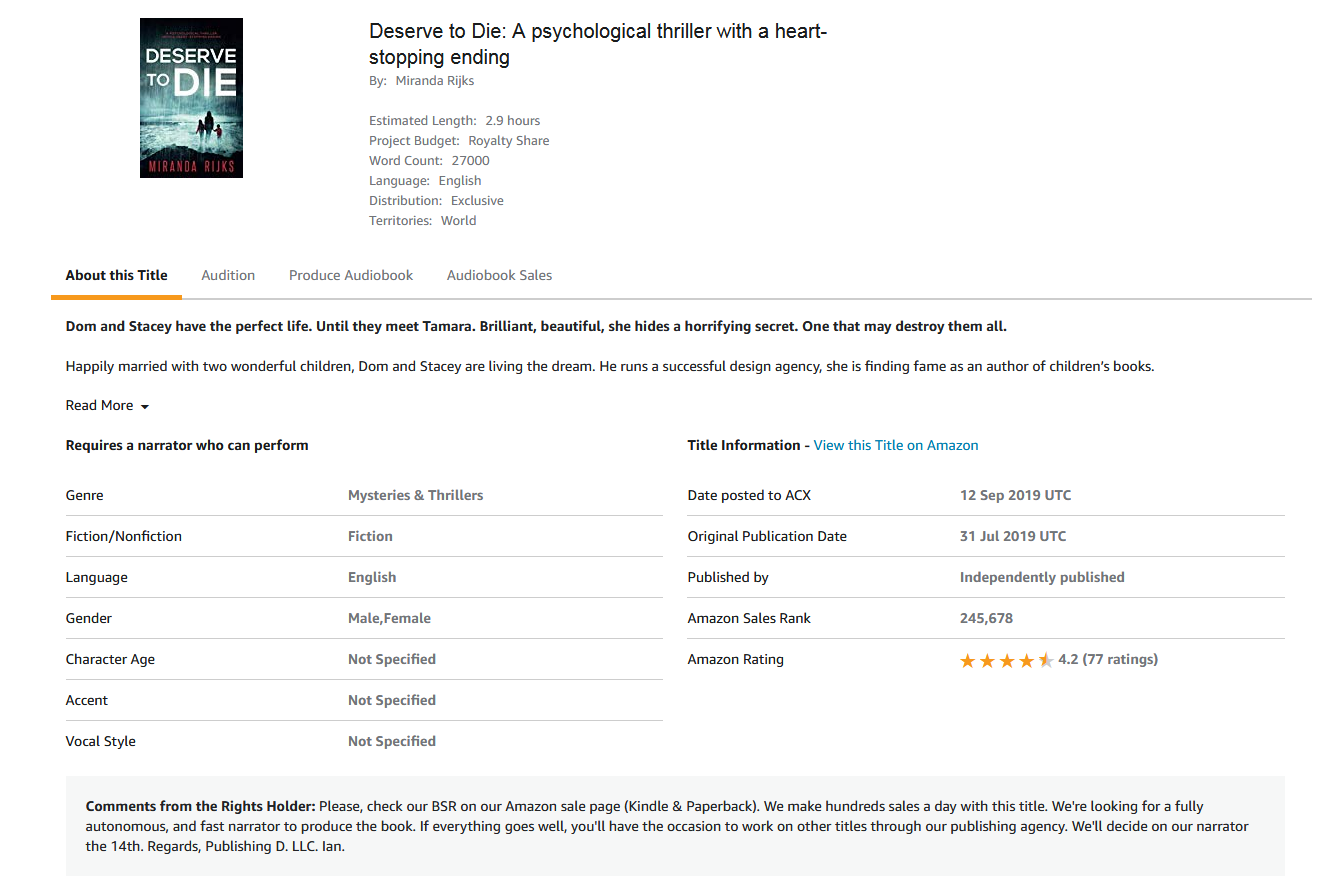
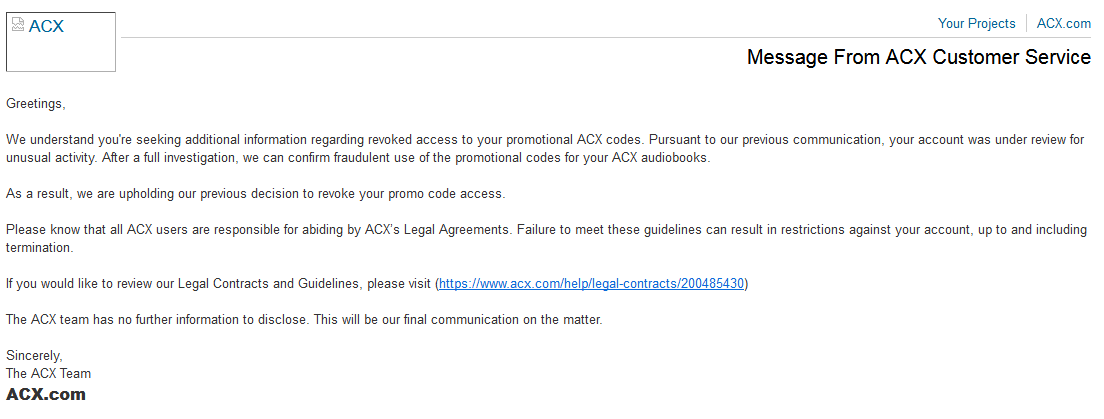
About the ACX thing...I was contacted by ACX to narrate three books, however, the person who offered the contracts kept emailing and frantically telling me to send them my book codes. I got leary and called ACX. They said unfortunately there are many scams taking place where if a book is "unclaimed" in their system, someone may grab it and offer it as an audiobook contract. Then they keep the codes and blackmarket sell them. They do not pay the narrators. Many other authors are experiencing it, they said, but they have no way to regulate it.
I declined the offers and got a nasty note from the contract holder. I was also told that since I corresponded with them, they had my email that is associated with Amazon..the same one. So, ACX said I had to go change my email on Amazon or they would have access there too. Geez.
CDL relies on an incorrect interpretation of copyright’s “fair use” doctrine to give legal cover to Open Library and potentially other CDL users’ outright piracy—scanning books without permission and lending those copies via the internet. By restricting access to one user at a time for each copy that the library owns, the proponents analogize scanning and creating digital copies to physically lending a legally purchased book. Although it sounds like an appealing argument, the CDL concept is based on a faulty legal argument that has already been rejected by the U.S. courts.For a more detailed deconstruction of CDL's arguments, see this statement from the Association of American Publishers.
In Capitol Records v. ReDigi, the Second Circuit held that reselling a digital file without the copyright holder’s permission is not fair use because the resales competed with the legitimate copyright holder’s sales. It found that market harm was likely because the lower-priced resales were sold to the same customers who would have otherwise purchased new licenses. In this regard, the court emphasized a crucial distinction between resales of physical media and resales of digital content, noting that unlike physical copies, digital content does not deteriorate from use and thus directly substitutes new licensed digital copies.
The same rationale applies to the unauthorized resale or lending of ebooks. Allowing libraries to digitize and circulate copies made from physical books in their collection without authorization, when the same books are available or potentially available on the market, directly competes with the market for legitimate ebook licenses, ultimately usurping a valuable piece of the market from authors and copyright holders.
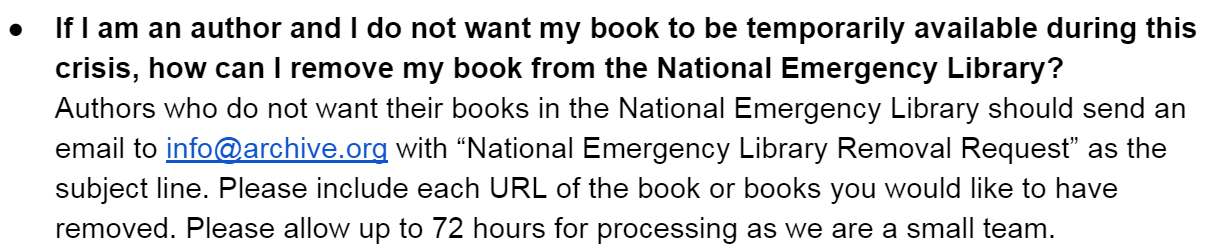
To address our unprecedented global and immediate need for access to reading and research materials, as of today, March 24, 2020, the Internet Archive will suspend waitlists for the 1.4 million (and growing) books in our lending library by creating a National Emergency Library to serve the nation’s displaced learners. This suspension will run through June 30, 2020, or the end of the US national emergency, whichever is later.What this boils down to, under all the high-flying verbiage: the IA is ditching the one-user-at-a-time restriction that is one of the key justifications for the theory of controlled digital lending, and allowing unlimited numbers of users to access any digitized book in its collection.
During the waitlist suspension, users will be able to borrow books from the National Emergency Library without joining a waitlist, ensuring that students will have access to assigned readings and library materials that the Internet Archive has digitized for the remainder of the US academic calendar, and that people who cannot physically access their local libraries because of closure or self-quarantine can continue to read and thrive during this time of crisis, keeping themselves and others safe.
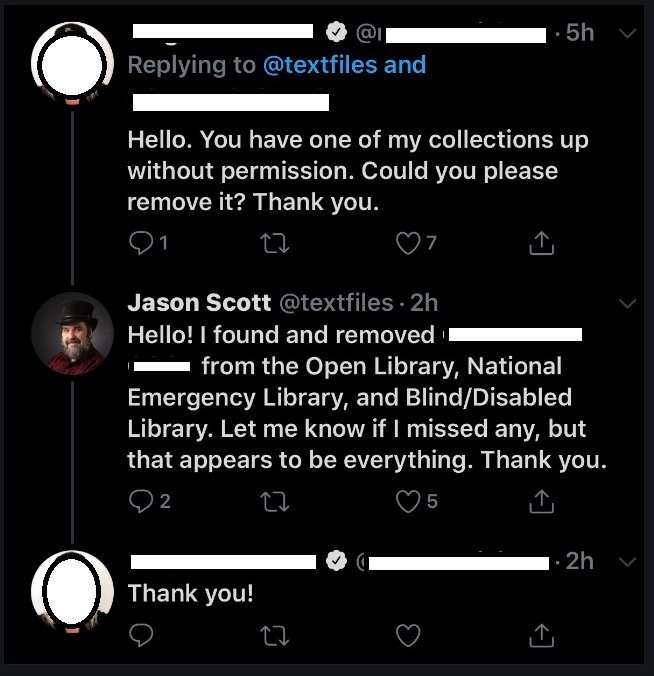
IA is using a global crisis to advance a copyright ideology that violates current federal law and hurts most authors. It has misrepresented the nature and legality of the project through a deceptive publicity campaign. Despite giving off the impression that it is expanding access to older and public domain books, a large proportion of the books on Open Library are in fact recent in-copyright books that publishers and authors rely on for critical revenue. Acting as a piracy site—of which there already are too many—the Internet Archive tramples on authors’ rights by giving away their books to the world.Here's just one concrete example. Katherine Harbour's Nettle King is available for borrowing in the National Emergency Library as a scan, an EPUB, and a PDF (the IA's EPUB versions are OCR conversions full of errors). Published in 2016, it's also "in print" and available on Amazon and other online retailers as an ebook, in addition to other formats. The IA, which never bought a digital license to Ms. Harbour's book and scanned and uploaded it without permission, now is proposing to allow unlimited numbers of users to access it, potentially impacting her sales. How is this any different from a pirate site?
[U]sing the Coronavirus pandemic as an excuse, the Archive has created the “National Emergency Library” and removed virtually all controls from the digital copies so that they can be viewed and downloaded by an infinite number of readers. The uncontrolled distribution of copyrighted material is an additional blow to authors who are already facing long-term disruption of their income because of the pandemic. Uncontrolled Digital Lending lacks any legal argument or justification.UPDATE 4/9/20: The Chairman of the US Senate Subcommittee on Intellectual Property, Thom Tillis, has sent a letter to the Internet Archive, pointing out the many voluntary initiatives by authors, publishers, and libraries to expand access to copyrighted materials, and expressing concern that this be done within the law.
I am not aware of any measure under copyright law that permits a user of copyrighted works to unilaterally create an emergency copyright act. Indeed, I am deeply concerned that your "Library" is operating outside the boundaries of the copyright law that Congress has enacted and alone has the jurisdiction to amend.The letter ends by punting "discussion" until "some point when the global pandemic is behind us." So, basically, carry on and maybe at some point we'll talk.
In an early analysis of the use we are seeing what we expected: 90% of the books borrowed were published more than ten years ago, two-thirds were published during the twentieth century. The number of books being checked out and read is comparable to that of a town of about 30,000 people. Further, about 90% of people borrowing the book only looked at it for 30 minutes. These usage patterns suggest that perhaps that patrons may be using the checked-out book for fact checking or research, but we suspect a large number of people are browsing the book in a way similar to browsing library shelves.But this is hardly a compelling argument. Large numbers of these books are certainly still in copyright, and many are likely still "in print" and commercially available (in digital form as well as hardcopy). Just because a book was published more than ten years ago or prior to 2000 doesn't magically cause it to become so hard to find it must be digitized without permission in order to save it. "But they're older books" sidesteps, rather than addresses, the thorny copyright issues raised by the IA's unpermissioned scanning and digitizing.
Locate S,1 “After the Final Rose” The first time I heard this song was the first time I saw Christina Schneider and Locate S,1 perform live last year, when they were opening for Of Montreal at the Bell House. I was immediately blown away by the verse melody – “women in love, women in airplanes […]
Pokus “Pokus Two” The best way I can describe Pokus aesthetic is that it’s like if the rhythm section of Fugazi was playing with a keyboard player who sometimes sounded a bit like Sun Ra when he was messing around synthesizers and overdriven electric organs in the late ’70s and other times was more along […]
Earlier this month, the Ohio state House passed a bill that would ban abortion with virtually zero exceptions when the fetus develops a heartbeat at about six weeks, which is before many women realize they’re pregnant. And as of last week, Ohio’s state House is considering another bill, HB 565, which would confer personhood upon […]
In October, the Supreme Court heard a case that was painfully ironic, considering the Kavanaugh hearings the nation had just been subjected to: a challenge to the United States’ extremely restrictive sex offender registry laws. While opinions on the case Gundy v. United States, which challenges the Attorney General’s ability to retroactively impose registry requirements, have yet […]
After 15 incredible years, Feministing is shutting down. From the bottom of our hearts, thank you to the readers who joined us for this journey. As digital media has become corporatized, many independent news sites and blogs have been forced to shutter. As the New York Times reports today, unfortunately, we find ourselves among these. […]
"Mad Mike" Hughes, a self-styled explorer and daredevil bent on proving that the earth is flat was killed over the weekend when his homemade rocket crashed in the California desert over the weekend.
Pagan healthcare providers discuss how they are coping with the stresses of the pandemic and how the power of their spiritual practices sustains them.
NASA added the name of the goddess Artemis to new missions. TWH examines some possible implications of the secretive "Artemis Accords" and how they relate to previous treaties and agreements that pertain to space and celestial bodies.
One virus; 18 ways of seeing the world. Covid Latam is a collective project documenting the coronavirus pandemic as it unfolds across Latin America. Photographers – 9 men and 9 women – are working in 13 countries: Colombia, Brazil, Peru, Bolivia, Ecuador, Argentina, Chile, Uruguay, Venezuela, Guatemala, Costa Rica, Cuba and Mexico to document the unfolding story of the pandemic through the Covid Latam instagram account
Continue reading...We would like you to share your tributes for friends and family who have died
Covid-19 has now claimed the lives of thousands of people in the UK.
Older people and those with underlying health conditions are much more vulnerable to the coronavirus, but it can affect people who are otherwise fit and healthy.
Continue reading...About 2m Britons have paused payments in the coronavirus crisis. Readers share their concerns
Almost one in five UK mortgage holders have now been granted a payment holiday, it was estimated this week – but people’s experiences of the process have been very different. Some struggled to get a holiday while others say it was almost too easy. And while for some it will add just a few pounds to their monthly mortgage bill, others say their outlay will rise by a lot more.
The Guardian asked readers who had applied for a mortgage payment holiday, or help with other debts, how they got on. Almost 200 people contacted us to tell us their stories.
Continue reading...for Cait
The Brimstone is back
in the woken hills of Vallombrosa,
passing the word
from speedwell to violet
wood anemone to celandine.
I could walk to you now
with Spring just ahead of me,
north over flat ground
at two miles an hour,
the sap moving with me,
under the rising
grass of the field
like a dragged magnet,
the lights of the flowers
coming on in waves
as I walked with the budburst
and the flushing of trees.
If I started now,
I could bring you the Spring
for your birthday.
The wildly popular game gives players a place to socialize with others or simply escape while on lockdown for coronavirus
As shelter in place orders around the world have left many people trapped at home indefinitely, some have found a new place to meet up: inside the digital world of wildly popular Nintendo game Animal Crossing.
Released in late March, Animal Crossing: New Horizons quickly became the top game in the US. In it, users explore a carefree pastel environment, growing fruits and flowers, catching bugs or fish to sell, and making friends with other characters in an open-ended simulation.
Continue reading...Russian media pours scorn on Europe, but the only progressive way forward for our common continent is together
In the early 1990s Russia used to have a strong sense of belonging in Europe. This began to change: the post-Soviet shock therapy reforms were a punishing transition to a free-market society, when a kilogram of sausage cost about the same as a monthly pension and many families experienced malnutrition and hunger. The sudden shift to a more “westernised” way of running the economy left many impoverished, which was eventually capitalised on – after the oligarchic power wars – by a new political leader who embraced a conservative, nationalist rhetoric: Vladimir Putin.
Today, Russian television presenters feed us stories about a European continent in decay, where “aggressive migrants” run amok, where social services take children away from their parents for being “slapped”, where “sexual minorities” destroy traditional families.
Continue reading...For a while supper and wine were sufficient; now I’m watching every adaptation that is better than its source material
I suspect I’m not alone in this but, at some point in the past two weeks, I hit my lockdown wall. Not literally, although apparently the “banging one’s head against the kitchen wall” phase kicks in on the eighth week, so that’s something to put in the diary. But last week I felt really, really over it. Enough with every day being the bloody same; enough with watching my children become increasingly fretful because they haven’t seen their friends in over a month, the equivalent of five years to a pair of four-year-olds. But unless you want to be one of those delightful people protesting the lockdown in the US, clothed in stars and stripes, AK-47s across their backs, what choice do we have? So, like Bill Murray, we grind out the same day, again and again and again.
The trick is to invent things to look forward to. For a while, “supper” and “wine” were sufficient, but repetition has dulled their efficacy. So I set myself challenges, driven on by the thrill of completion. Some people hear the word “challenge” and think, “Fitness!” Those people are not me. “Rewatch the entirety of 30 Rock” is more my speed. It is so soothing to watch a show about a luxuriantly bouffanted New York tycoon who isn’t a moron. In a just world, Jack Donaghy would be the US president instead of, well, you get the point. Then, sparked by his brilliant turn as Chris Tarrant on the ITV drama, Quiz, my next challenge was, “Watch every Michael Sheen performance in which he plays a real person”. This was deeply enjoyable, even if, in my lockdown-confused mind, I now think Brian Clough interviewed Richard Nixon on TV and Kenneth Williams was prime minister when Diana died.
Continue reading...Resuming the season is absurd and the ‘safety’ ideas are terrible, but whatever football decides it must decide together
“You eat alone, you choke.” During the years of plenty it became a habit to compare the Premier League’s wielding of power – always with a note of admiration – to the structures of a mafia family.
It isn’t hard to see why: the hierarchy of captains, the beautifully ruthless sense of unity, of a cartel of self-propelling interests. And yet the thing about mafia families is that now and then those interests start pulling in different ways. In mob lore breaking ranks is sometimes referred to as “eating alone”, with a certainty that bad things follow – and worst of all that bad business follows.
Continue reading...Lewis Hamilton believes returning to grand prix racing without fans will be an “empty” experience as Formula One prepares to launch the new season behind closed doors.
F1 expects to hold its first race on 5 July in Austria as a double header followed by two meetings at Silverstone, all without spectators. However, there remains the possibility that government quarantine restrictions may make travel for F1 teams unfeasible.
Continue reading...