el

The Body Electric

“Excuse me,” I said to the lithe twenty-something after she uncoiled out of her improbable yoga pose.  “Yes?” the girl said, her creep detection radar blasting enough wattage to boil my blood away.  “Are you using this box for your workout?”  “Oh, no I’m not. Sorry.” After removing her keys, phone, earbuds, towel, water bottle, and […]

The post The Body Electric appeared first on Waiter Rant.


el

Fireside Press Cancels Multiple Contracts

Posted by Victoria Strauss for Writer Beware®

Last week, the SFWA Contracts Committee issued this advisory.
SFWA Contracts Committee Advisory on No-advance Contracts

Recently, SFWA's Contracts Committee was made aware of a situation in which a well-liked publisher canceled the publication of a number of books it had contracted to publish. The publisher said the decision was made because of "unexpected changes" at the company. The Committee has reviewed the contract in use, which lacked a provision for such a cancellation. The Committee believes that canceling a contracted book that satisfies the author’s obligations is at odds with the spirit of the contract. Making this situation worse is the fact that these were no-advance contracts. Because no advance was paid, the publisher could make this decision without financial penalties. The authors' books, were, in effect, put in limbo for many months and the authors received nothing but an apology. Besides depriving the authors of the ability to sell the books elsewhere during this delay and putting off any income from the books into the indefinite future, the authors careers suffer as a result.

Publishers of all sizes may find themselves unable to live up to their contractual commitments for a wide variety of reasons, some of which could not have been reasonably anticipated. Hence, the Contracts Committee urges writers to think carefully about signing a contract that provides no advance, or only a nominal advance, while tying up their work for a lengthy period of time. Critically, payment of an advance gives an indication the publisher actually has the financial resources to meet its obligations. Publishers who do not pay advances or pay only nominal advances should include language in their contracts specifying how they can cancel a book and what happens if they should cancel a book, including a specified amount of compensation to the author.

SFWA Contracts Committee
October 25, 2019

Legal Disclaimer: The contract alert should not be understood to be legal advice. The issues presented by contract law are complex. Authors should consult a competent attorney familiar with the business of publishing as well as contract law before signing any contract.
The publisher in question is Fireside Press.

The cancellations were first reported on October 8 by Jason Sanford in his Genre Grapevine column, and discussed on October 9 in Mike Glyer's File 770. Fireside publisher Pablo Defendini issued a statement on October 8, in which he revealed that the five canceled contracts were for manuscripts that were "unpublished and unannounced", and attributed the cancellations to disruptions caused by editorial departures.

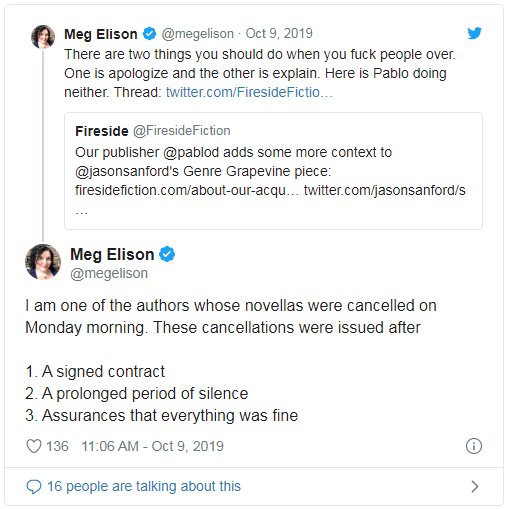
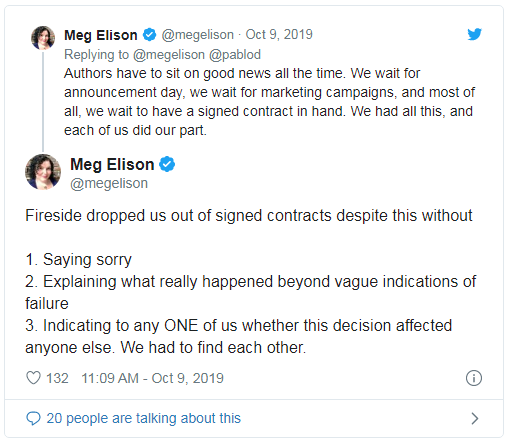
Author Meg Elison, one of the canceled authors, did not find this to be a sufficient explanation...and she was livid.


A few days later, Defendini issued an apology. "I can see now how [the cancellation emails] read as callous, uncaring, and dismissive of the authors’ feelings," he wrote. "I’m very sorry for that....My behavior was not consistent with Fireside’s values, and I deeply regret it."

Beyond the Contracts Committee's general warning about no-advance contracts (and if you're part of the small press world, you know how common these are): multiple simultaneous contract cancellations are not frequent or normal, and can signal trouble beyond whatever the publisher offers as an explanation (if it explains at all). Ditto for a publisher that suddenly starts offering to revert rights on request.

Fireside's situation also highlights the risks of signing with a publisher that's essentially a one-person operation (as Defendini admits in his apology). With the best will in the world, the publisher can be sidelined by a single bad event (personal or professional), leading to glitches, errors, and delays in scheduling, payment, and more. Writer Beware's files are stuffed with such stories.

Troubled publishers do recover, or at least hang on. Month9, which canceled dozens of contracts in 2016, is still publishing, as is Permuted Press, which axed an undisclosed number of titles in 2015 (both publishers cited overstocked lists, though in both cases there were other issues as well). In the short term, though, if a publisher is or has been actively shedding writers, it's best to hold off on submitting until it's clearer what's going on.


el

Mass Contract Cancellations at Mystery Publisher Henery Press


Posted by Victoria Strauss for Writer Beware®

Beginning on Friday, February 8, dozens of authors with mystery publisher Henery Press received some version of this email.
Dear ________,

Before entering 2020, we felt it prudent to review future projections for _______ series, taking into consideration recent releases and overall performance. To provide an unbiased professional opinion and guidance in our 3-year strategic plan, we hired a consulting firm with experience in the industry. This allowed us to analyze not only your specific series, but also the competitive landscape and industry as a whole.

Unfortunately the sales of _______ series do not justify the publication of future titles beyond 2020. We know this is disappointing. The market has become beyond saturated (especially in mystery fiction), with all leading indicators pointing to even more intense competition for consumer dollars in the next cycle and beyond....

Although we don’t have a pathway forward with your new titles, we will continue to sell and support your backlist titles as usual under the terms of our original publishing agreement. To be clear, we will not be reverting the rights on any of your already published title(s), only future titles specifically outlined in the addendum to follow in the next week.

A number of the cancellations affected books that had been completed, turned in, and scheduled for publication, with some authors having already made promotional plans. Others interrupted series whose first installment hadn't yet been published--with Henery holding on to the yet-to-be-published book and reverting rights to the rest. Cancellation of a series before it's completed can be tough--another publisher may not want to buy into a series mid-stream, and while followup titles can be self-published, it's difficult to promote a series when it's split up like this.

The cancellations came out of the blue (nothing had been said about any strategic plan or consulting firm). But while some writers were blindsided, others weren't hugely surprised. Although they have praise for the company's early days, Henery authors say that problems have been increasing for some time, with staff departures (interns are reportedly used to do a lot of the editing, with sometimes substandard results), late royalty checks and reports (several authors told me that they feel there are discrepancies in their sales figures), diminishing marketing (according to multiple writers, virtually no promotional support is provided), ordering problems (writers cite non-returnability and nonstandard discounts), and difficulty with communications.

"Over time," one author told me, "Henery Press’s business model started to look more like a company that assists with self-publishing and less like a real publisher." (In fact, Henery uses CreateSpace for printing, and Barnes & Noble lists Henery ebooks as "indie".)

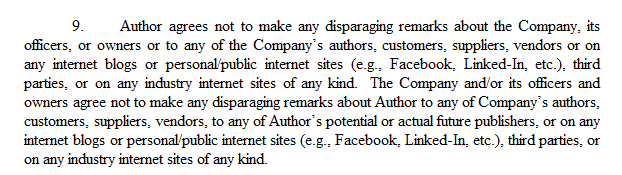
I've gotten a variety of additional complaints, which I'm not able to share here because they could compromise confidentiality. There seems to be considerable fear among Henery authors that they will be penalized for speaking out--which may be why almost no word of the cancellations has escaped. There's also the gag clause in the rights reversion addendum that authors are receiving:


One writer told me, "HP payback tactics (they're so vindictive) are hell. [Authors are] afraid if HP even suspects they've contributed, the books they have will go down." I truly wish this weren't such a common component of publisher implosions.

So is Henery imploding? Mass cancellations are never a good sign, and often indicate financial distress. Some Henery authors don't feel that's the issue, though, or not the only issue: they speculate that the owners intend to retire, and are keeping the company alive in order to retain the income stream from existing titles.

I emailed Henery's owner, Art Molinares, for comment. As of this writing, he hasn't responded.

Mystery Writers of America (where Henery is listed as an Approved Publisher) is aware of the situation, and is monitoring it. If you've been affected, you can contact MWA here. Be sure to put "Henery Press" in the subject line. All communications are confidential.

I will post updates as I receive them.


el

Beware: Pigeon House Literary / Druella Burhan


Posted by Victoria Strauss for Writer Beware®

The internet and social media have transformed writer/agent/publisher interactions in many ways, one of which is the proliferation of Twitter pitch events, such as #PitMad, #DVPit, and others.

While no online innovation has (so far) managed to supplant the traditional query-and request route, these events do attract plenty of reputable agents and publishers--unlike other purported shortcuts (*cough*Publishizer*cough*). However, inevitably, they are also stalked by marginals, amateurs, and even scammers.

For instance, Eliezer Tristan Publishing, which charged a $500 fee and went out of business just months after opening up, haunted #PitMad. Ditto for GenZ publishing, which charges authors $2,500. Burchette and Ferguson, a brand-new publisher staffed by people with zero relevant experience, participated in pitch events before they even launched (and went out of business shortly thereafter).

Then there's this:


I've gotten many, many other questions about approaches by dubious companies and individuals as a result of pitch events. All in all, therefore, it pays to be careful, and if you haven't heard of an individual or publisher who approaches you, to research them before responding. (You can contact me; I may have heard something.)

Which leads me to the subject of today's post. I might not normally devote an entire blog post to one marginal agent, but this one is such an egregious example, and seems to be so active on social media--including #PitMad--that I think she's worth a special feature.

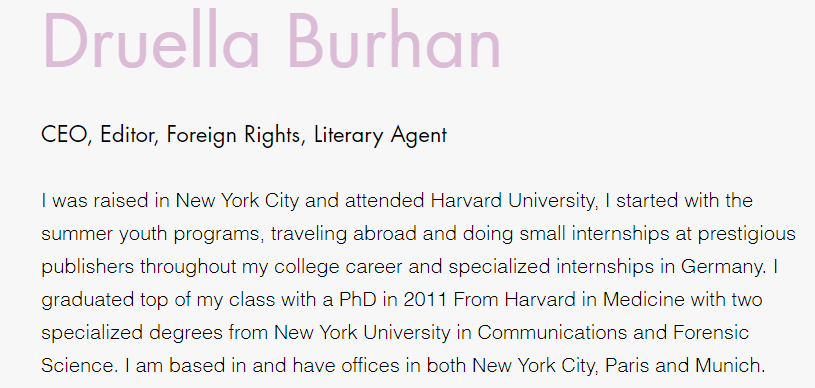
Pigeon House Literary Agency launched just this past February. It's run by Druella Burhan, whose resume includes none (zero, zip) of the relevant background experience you typically want to see from a new literary agent--such as a professional writing resume, or having previously worked for a reputable agency or publisher.


The lofty claims Burhan does make are either unverifiable, or provably false. For instance, here's Harvard Medical's publication on its 2011 MD-PhD graduates. Surprise! There's no mention of Druella Burhan.

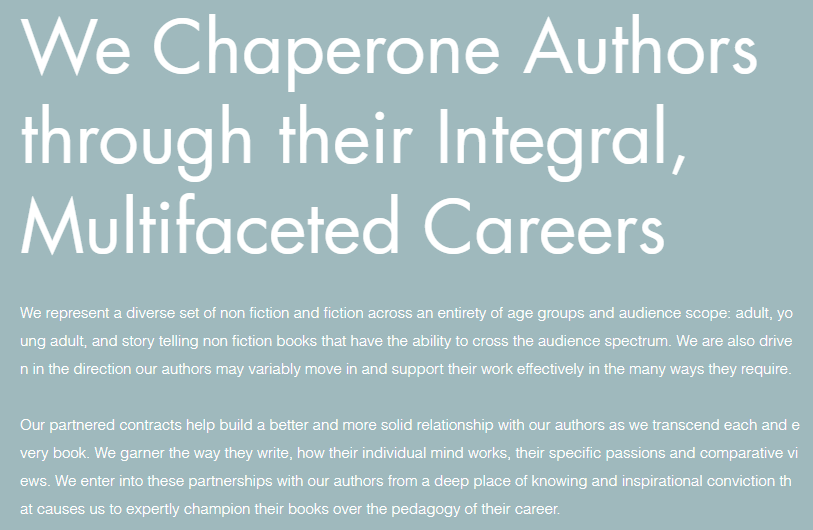
Here's some of Burhan's agenting philosophy:


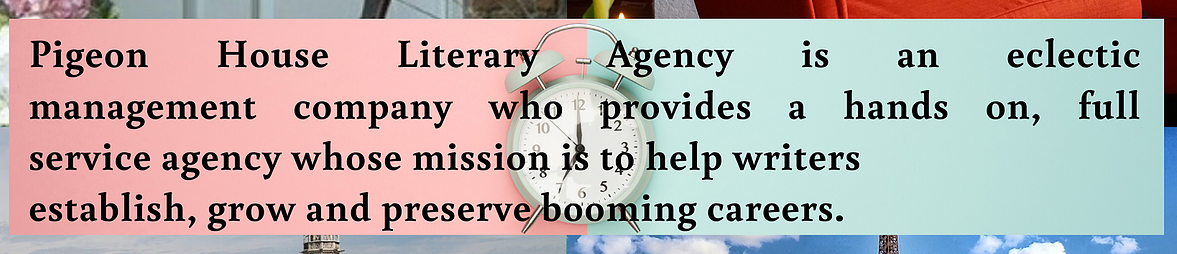
The logo (for lack of a better word) at the top of this post provides a preview of the rest of the Pigeon House site (a Wix freebie), which is amateurishly formatted and clearly not proofread (several pages have fully-justified text, with words cut off at the end of lines--I mean, it's a Wix freebie, it's not like you have to be an expert to get it right) and rife with typos, grammatical errors, and bizarre word use. For instance,


That's bad, but here's what it originally looked like. Burhan changed it shortly after I tweeted about it:


There's more: the Who We Are page, which bafflingly proclaims that the agency will "strive to bring a supreme appealingness and picturesque style of books from darkness to life"; the Foreign Rights page, which erroneously cautions writers that "If a literary agent does not agree to take you on as an international client/author, you will not be able to sell books overseas"; the Referrals page, where Burhan bizarrely invites other agents to send her clients. And here's the contract she is sending out, which includes the same formatting/proofreading errors as her website, and is really just an embarrassment.

It's a perfect carnival of amateurism.

Am I being mean here? Maybe, but before you whip out the "everyone has to start somewhere" argument, consider Burhan's false claims about herself and her aggressive use of social media to recruit clients despite her obvious ignorance and complete lack of relevant qualifications (I first heard of her because she was trolling on Reddit, and she is actively inviting queries on her Twitter feed).

The damage an amateur agent can do is considerable--squandering clients' chances with substandard submissions, submitting to disreputable or incompetent publishers, inadequately understanding publishing contract language and therefore not capable of effectively negotiating it. An amateur agent may not drain a writer's bank account the way a scammer would, but the bottom line isn't that different: no sale, and lots of wasted time.

Writer Beware.


el

#1500; The Master of Delusion


el

White Palace Grecotel Luxury Resort - Первомай встречали в Греции

В прошлом году Первое мая и все майские праздники были в отеле Источник: 100 Дорог


el

Corintia Art Hotel - начало мая, море и песок

Отдыхали с семьёй в начале мая 2019 Источник: 100 Дорог


el

Utopia World Hotel - Первомай в Турции встречай

Отель Utopia отличное соотношение цены и качества Источник: 100 Дорог


el

Atlas Hotel Golden Sands - Майские праздники в Болгарии

Отель расположен на возвышенности Источник: 100 Дорог