ca

From the Philippines, Not With Love: A Plague of Publishing and Marketing Scams


Posted by Victoria Strauss for Writer Beware®

I've been expending a lot of words and time lately warning about the latest scam phenomenon to hit the writing world: fake publishing and marketing companies that, through outrageous prices and worthless services, extract enormous amounts of money from unwary writers.

Based in the Philippines (despite their apparent US addresses, phone numbers, and telemarketer names) and focusing primarily on small press and self-published authors (particularly authors who've published with one of the Author Solutions imprints), these companies recruit writers with relentless--and highly deceptive--phone and email solicitations. Some do provide the services authors pay for, albeit at seriously inflated prices and often of poor quality. Others just take the money and run. I'm hearing from a growing number of writers who've paid five figures in fees to one--or, in some cases, more than one--of these scams, with next to nothing to show for it.

Given how fast the scams are proliferating (I learn about a new one every few weeks), I thought it would be helpful to gather all the information I've put together about them in one place.

My posts about the scams--where they come from, how they work, and how to recognize them:

- Army of Clones: Author Solutions Spawns a Legion of Copycats
- Army of Clones Part 2: Twenty-One (More) Publishing and Marketing "Services" to Beware Of
- Solicitation Alert: LitFire Publishing
- Amelia Publishing and Amelia Book Company: Sons of LitFire Publishing
- Solicitation Alert: Book-Art Press Solutions and Window Press Club
- Solicitation (and Plagiarism) Alert: Legaia Books / Paperclips Magazine

Here's a list of the scams themselves--at least, the nearly 100 I've identified so far (the list is also posted in the sidebar of this blog). You'll note that a number of them operate under more than one name--I suspect the interconnection is much greater than this, but I've only indicated the additional names where I've been able to reliably document them.

Some have perished since I began the list--I've noted this, but left their names, for the sake of authors who may have been scammed while they were operational.

- Access Media Group (aka Quill Space Media)
- Ace Media Creative Publication / Ace Media International / APM Media Production (aka Pearson Media Groups)
- ADBooks Media (aka Coffee Press / Okir Publishing, which is defunct)
- Alpha Books Solutions
- Alpha Books United
- Amelia Publishing / Amelia Book Company (aka LitFire Publishing / GoToPublish)
- AnalytIQ
- Ascribed LLC (defunct)
- Author Aide
- Author Codex (aka BookSpine Press)
- Author Media Express
- Author Pro Creatives and Marketing (defunct) (still doing business as Matchstick Literary)
- Author Reputation Press
- Author University
- AuthorCentrix (formerly BookBlastPro)
- AuthorLair
- Author's Note 360
- Authors Press (aka Westwood Books Publishing [formerly Greenberry] / Creative Books)
- Beacon Books Agency
- Black Lacquer Press & Marketing
- BooConn Marketing
- Book Agency Plus (aka BookTrail Agency)
- Book Art Press Solutions (aka Window Press Club / Booktimes)
- Book Avenue Publishing (aka Nivra Press, which is defunct)
- Book Magnets
- Book Reads Publishing (defunct)
- BookSpine Press (aka Author Codex)
- Booktimes (aka Book Art Press Solutions / Window Press Club)
- BookTrail Agency (aka Book Agency Plus)
- Book Vine Press
- Books Scribe
- BookVenture Publishing
- BookWhip (aka Carter Press / PRM Solutions)
- Box Office Media Creatives (aka Buzz Media Creatives)
- Bright Lights Distribution
- Buzz Media Creatives (aka Box Office Media Creatives)
- Capstone Media Services (defunct) (now doing business as Stampa / Stampa Global)
- Carter Press (aka BookWhip / PRM Solutions)
- Chapters Media & Advertising (aka Techbooks Media)
- Coffee Press (aka ADBooks Media) (formerly Okir Publishing)
- Creative Books (aka Westwood Books Publishing / Authors Press)
- Creative Titles Media  (aka TrueMedia Creatives)
- Crest Media Distribution
- Diamond Media Press
- Dream Books Distribution
- EC Publishing
- Editor's Creative Media (aka Editor's Press and Media)
- Editor's Press and Media (aka Editor's Creative Media)
- Global Summit House
- Gold Touch Press
- Golden Ink Media Services
- Goldman Agency
- GoToPublish (aka LitFire Publishing / Amelia Publishing / Amelia Book Company)
- Happy Media Consulting
- Haynes Media Group
- IdeoPage Press Solutions (aka The Writer Central)
- Legaia Books
- Lettra Press
- LitFire Publishing (aka Amelia Publishing / Amelia Book Company / GoToPublish)
- Maple Leaf Publishing
- MatchStick Literary (aka Author Pro Creatives and Marketing --defunct)
- McNaughton Books / McNaughton Publishing (website is currently dead)
- Netsfilm & Media Press
- New Leaf Media
- New Reader Media
- Nivra Press (defunct) (still doing business as Book Avenue Publishing)
- Okir Publishing (defunct) (still doing business as ADbook Press / Coffee Press)
- Outstrip (defunct)
- PRM Solutions LLC (aka Carter Press / Bookwhip)
- Pacific Books
- PageClapp Media
- PageTurner, Press and Media
- Parchment Global Publishing
- Paradigm Print
- Paramount Books Media
- Pearson Media Groups (aka Ace Media Creative Publication / Ace Media International)
- Press To Impress Publishing
- Pubkits.com
- Quill Space Media (aka Access Media Group)
- Readers Magnet
- Royale House (defunct)
- Rushmore Press
- Sherlock Press (defunct)
- Silver Fox Media
- Stampa / Stampa Global (formerly Capstone Media Services)
- Stonewall Press (aka Uirtus Solutions) (both defunct)
- Stratton Press
- Techbooks Media (aka Chapters Media & Advertising)
- Toplink Publishing
- TrueMedia Creatives (aka Creative Titles Media)
- Uirtus Solutions (aka Stonewall Press) (both defunct)
- Universal Book Solutions
- URLink Print and Media
- Vivlio (a.k.a. Vivlio Hill, Vivlio Hill Publishing, Vivlio Solutions, Vivlio Marketing Solutions)
- WestPoint Print and Media
- Westwood Books Publishing (formerly Greenberry) (aka Authors Press / Creative Books)
- Window Press Club (aka Book Art Press Solutions / Booktimes)
- WorkBook Press
- The Writer Central (aka IdeoPage Press Solutions)
- YourOnlinePublicist
- Zeta Publishing

(I'm continuously updating this list--adding new companies as I discover them, noting the ones that disappear.)

I know my warnings are having an effect, not just because I'm hearing from writers who've found my posts or my list and have been able to avoid being ripped off, but because some of the scams are getting...a little defensive. Book-Art Press now includes this in its solicitation emails:
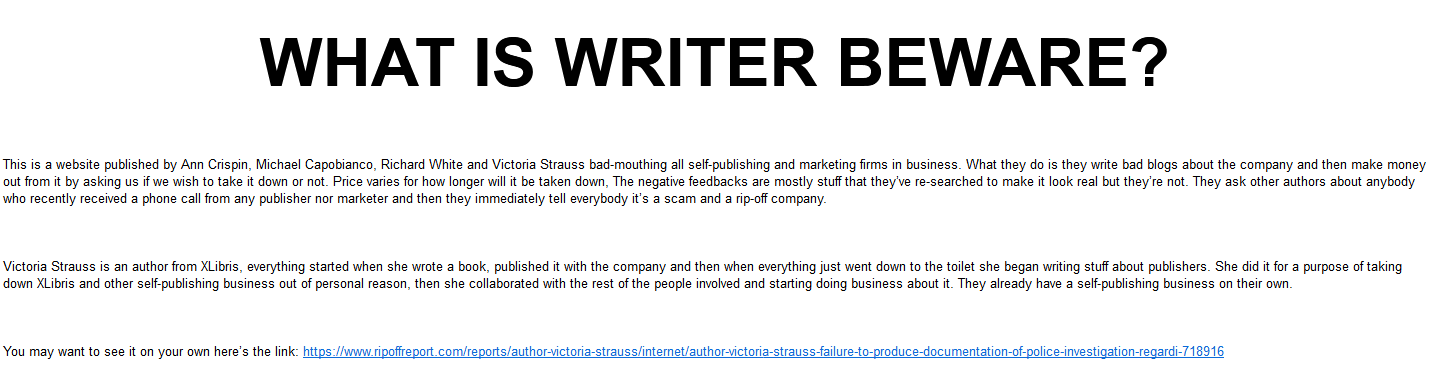
The links are to anti-Writer Beware screeds from people WB has exposed.

The grievance is definitely on display in this one, from MatchStick Literary (it also showcases the scams' trademark fractured English):

See ya at Writer Beware, scammers!

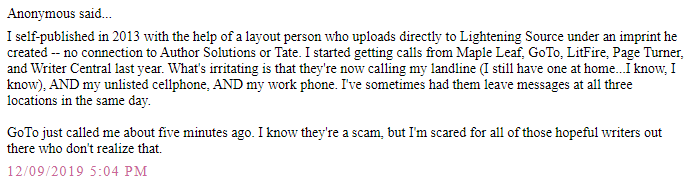
UPDATE 12/10/19: I want to highlight this recent comment, which illustrates how ubiquitous and persistent these scams are. Bottom line: if you self-publish, you can count on being solicited. Be on your guard. (By "GoTo", I'm assuming the commenter means GoToPublish.)


ca

Universal Book Solutions: Anatomy of a Book-to-Screen Scam


Posted by Victoria Strauss for Writer Beware®

Selling film rights to Hollywood is among writers' most fevered dreams. And where there is something that writers want or need, there are always sharks waiting to take advantage.

The Hollywood book-to-screen "marketing" package was pioneered by Author Solutions, way back in the early 2000s. All the Author Solutions imprints offer it, including the imprints AS runs for publishers. Here's what the package looks like, from AS imprint Xlibris:
  • Hollywood Ticket: coverage by a "professional reader." Cost: $999.00.
  • Hollywood First Act: a synopsis, "critical analysis", and "45- 60-second teaser Book Video" for "catching film executives' attention". Cost: $2,999.00.
  • Hollywood Director's Cut: an 8-10 page treatment by a "professional screenwriter", plus "consideration" by Author Solutions' "first-look Hollywood partner". Cost: $3,899.00
  • Hollywood Producer's Pick: this is the big kahuna, a full screenplay written by a screenwriter, plus consideration by AS's first-look partner. Cost: $16,299.00. Note that the screenplay is based on "your approved Hollywood Treatment", which you must previously have purchased--so the real cost of this option is $20,198.00.
Although a handful of other assisted self-publishing companies have offered similar packages over the years (here's the one from Bookstand Publishing, for instance; Outskirts Press also had one for a time, though it seems to have been discontinued), Author Solutions hasn't faced a lot of competition in the high-priced Hollywood dream exploitation business--primarily, I'm guessing, because of the cost and coordination involved in providing the coverage, critiques, treatments, and screenplays to the authors who buy them.

That's changed recently, though.

An explosion of book-to-screen "services" has hit the internet, courtesy of the Author Solutions copycat scams that I've been writing about so much lately (there's a complete list in the sidebar). Author Reputation Press, Coffee Press, Dream Books Distribution, Media City Publishers, Paramount Books Media, Book Art Press, New Reader Media, BookVenture, Pearson Media Groups, MatchStick Literary, and more all offer some version of the Author Solutions book-to-screen package, either on their websites or in their (extremely aggressive) phone and email solicitations.

The value of any book-to-screen package is highly debatable, regardless of who provides it. Vendors of such "services" play on authors' dreams of making it big, while failing to provide any kind of realistic information about the extreme unlikelihood of success. Most books never sell or option film rights (they're among the subsidiary rights least likely to be exploited, even for successful authors with top-flight agents), and it's far harder to sell a screenplay than it is a book manuscript. For most authors, the most probable result of buying a book-to-screen package is a smaller bank account.

And that's assuming that the vendor actually provides the advertised services, and doesn't just take the money and run. Author Solutions, at least, does seem to produce the coverage, etc., it sells, in a reasonably literate manner (you'll see some examples if you read on)--though of course, like paid reviews, the critiques and coverage are likely to be customer-friendly--that is, unrealistically positive.

The copycats, on the other hand...they don't exactly have the greatest track records for quality, reliability, or service. Or honesty.

An example: Universal Book Solutions, which styles itself "a Book-to-Screen Marketing Professional, with years of experience in working for motion picture projects for producers, agents, directors, and major studios in Hollywood." As usual with the Author Solutions copycat scams, there's no information that would allow you to verify any of these claims--no list of owners or staff, no company history, no examples of successful projects. That's no accident, of course.

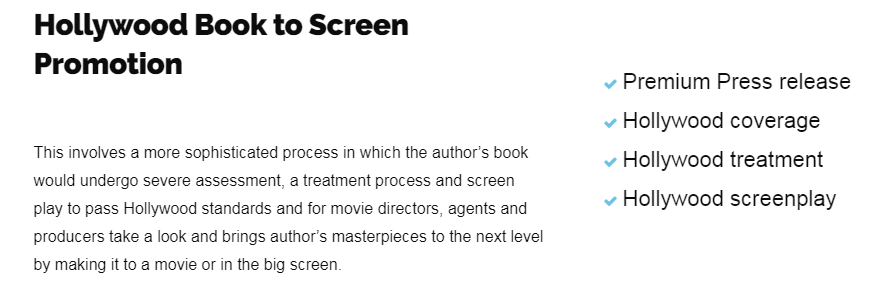
A sensible person might also wonder about the quality of written materials produced by a "Book-to-Screen Marketing Professional" that puts out website text like this (English-language lapses are one of the markers for the copycat scams):


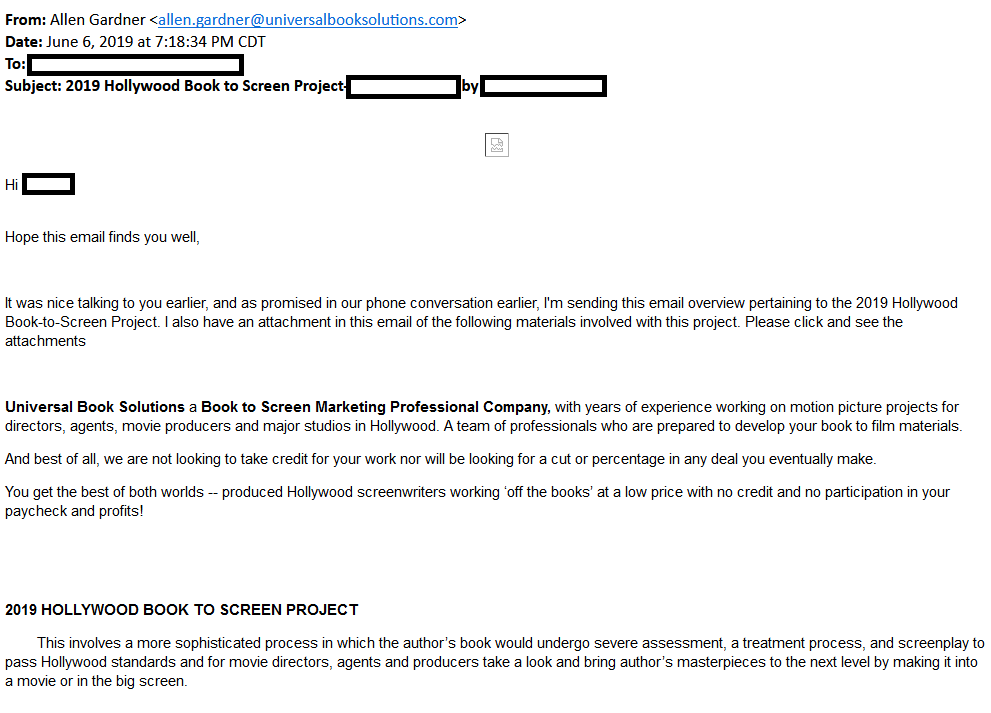
Here's how UBS's slightly more literate email pitch begins (I've seen two of these now, and they're identical):

The email goes on to detail the services on offer--news release, coverage, treatment, and screenplay--in language that has been lifted directly from the Xlibris (and other Author Solutions imprints) book-to-screen package. As further inducement, a bunch of glowing--and conveniently unverifiable--quotes are appended at the end. Turns out that these too have been lifted, though from a different (and, in its way, equally questionable) source.


Anonymous testimonials are the best kind, right?

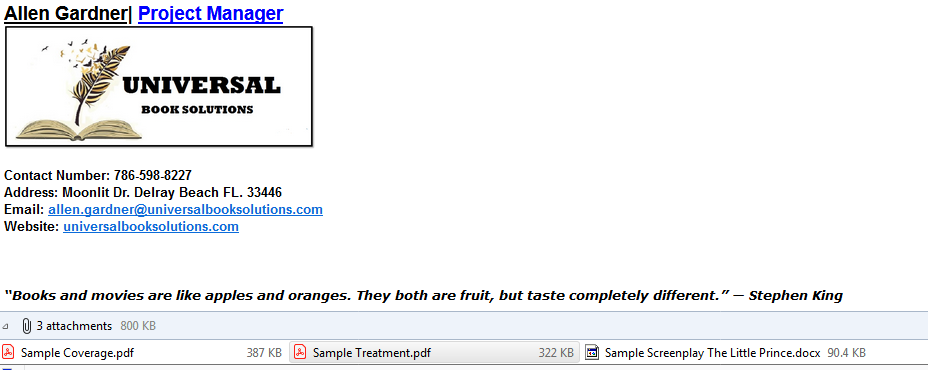
Last but not least, UBS includes several attachments--supposedly, examples of its work:


"Sample coverage" is this. Looks surprisingly literate and detailed, doesn't it? But wait. Here it is again...on the iUniverse website (the book was published by another Author Solutions imprint). Ditto for UBS's "sample treatment:" here's what UBS sent. Here it is at iUniverse (which also published the book in question).

(As for The Little Prince screenplay, I can't find any evidence of it online, but given all the other borrowing, it's sure to have been snitched from somewhere.)

So...a plagiarized book-to-screen package, promoted with plagiarized text, further promoted with plagiarized testimonials, and finished with sample documents produced by others and falsely presented as UBS's work. If you hand over your money to these folks (neither of the authors I heard from went far enough into the process to get a price), what do you think the odds are of getting any of the promised products?

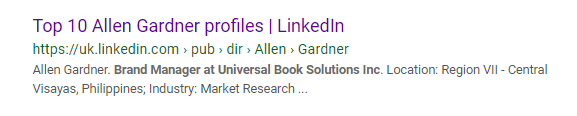
Universal Book Solutions claims a Florida address (per a Google search, it's a private residence in what looks like a condo community), but has no business registration in that state. Its web domain was registered just last February. As for Allen Gardner, Project Manager, guess where he's located.
UBS is an especially egregious example of this increasingly common scam. But as noted above, there are many others, and they are aggressively soliciting authors, especially those who have published with Author Solutions imprints, small presses, and pay-to-play companies like Christian Faith Publishing and Page Publishing. Be on your guard, and if you hear from a company that wants to take you to Hollywood--for a price--remember that if it sounds too good to be true, it probably is.

For a much more realistic discussion of the book-to-screen process, see Jane Friedman's excellent article, How a Book Becomes a Movie. Scroll down to the final comments to see one from a writer who was solicited by Universal Book Solutions.


ca

A Pack Of Scammer Lies


Posted by Victoria Strauss for Writer Beware®

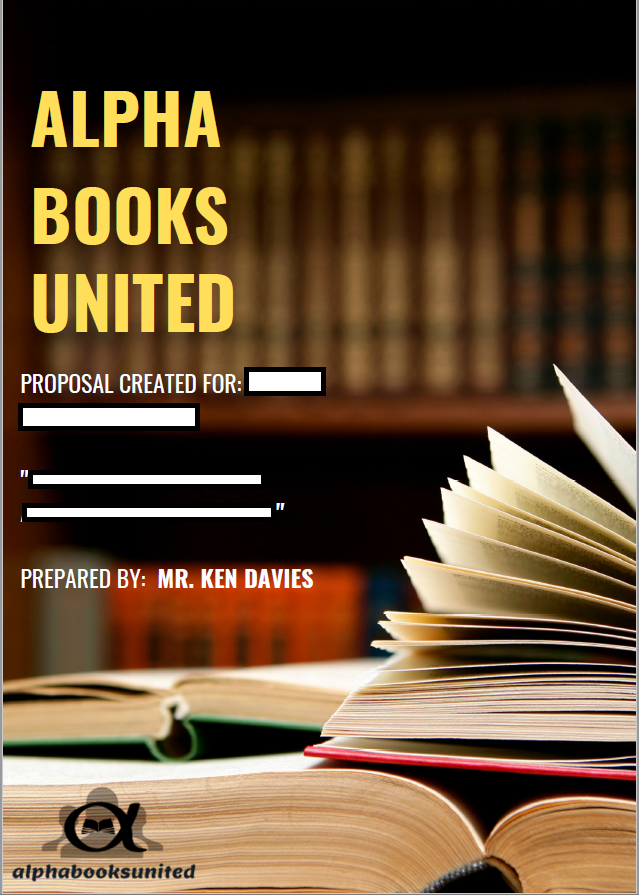
How do scammers entrap unwary writers? The other day, an especially egregious example came across my desk, in the form of this "proposal" shared with me by an author who really, really wanted to believe it was real (I've redacted the author's name and book title to protect their privacy).


Not to beat a horse, dead or otherwise, but if you'll glance at the sidebar, you'll see that Alpha Books United is on Writer Beware's big list of Philippines-based Author Solutions copycat publishing and marketing scams. (When I got hold of this proposal, on September 26, Alpha Books' website was working fine, but when I checked it today it refused to load. "Mr. Ken Davis", however, has not stopped emailing and calling the author who contacted me.)

(UPDATE: Just a few hours later, Alpha Books' website is back online. Check out its specifics-free About Us page, on which it tells the following lie: "Once you’re earmarked, we open the possibility for you to be eligible for a non-contributory agreement with us.")

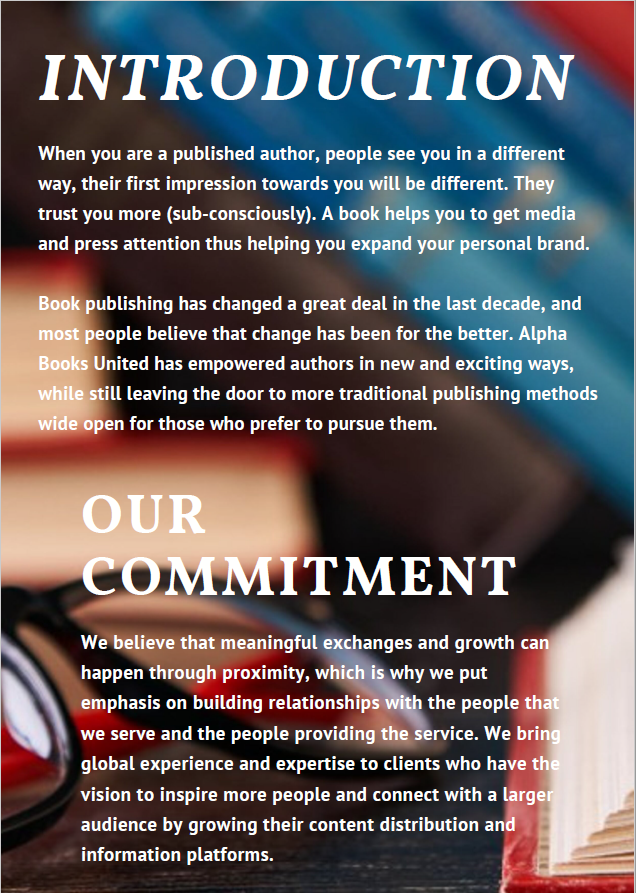
Here's the bait. Author empowerment! Amazing expertise! Commitment! Relationships! Sounds good, right? (Other than the complete lack of any verifiable specifics, of course.) Like most scammers, Alpha Books is counting on establishing a direct line to the author's deepest hopes, dreams, and ego.

Note that there's no mention of money. The initial phone calls and emails sent by "Ken Davis" didn't mention money, either.


Here are the "PUBLISHING Inclusions" supposedly on offer (only "if needed", of course!). Kind of bare bones basic, right? But for an author who isn't all that savvy about what goes into design and production, it hits the high spots: cover design, print and ebook format, and the all-important "content evaluation," which Alpha Books is hoping the author will wrongly interpret as "editing".

Again: no mention of money. That will come later, after the author has responded with interest to what they may believe is an amazing offer, especially if it's accompanied by flattery about how their book has been "discovered" or "recommended" by "book scouts" or "literary agents". These scams are successful in part because they solicit so relentlessly, but also because they have an acute grasp of author psychology. They know that it's easier to hook victims if you first get the victims to hook themselves.


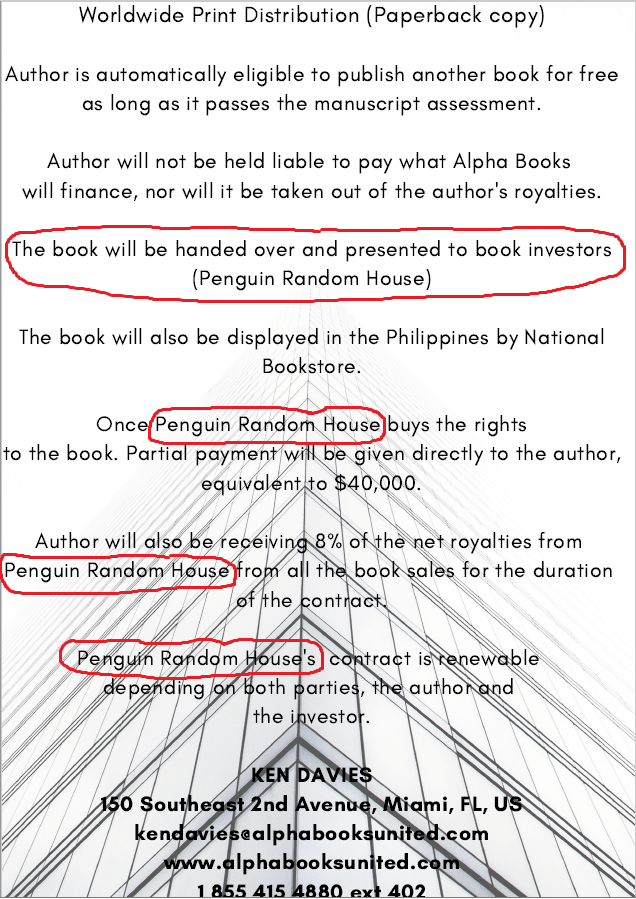
And here is the pack of lies. Well, pretty much everything the scammers offer is a lie, but these are mostly slant lies: they could be true (it's just that they aren't). Alpha Books, on the other hand, distinguishes itself by going well beyond the usual obfuscations and half-truths with a great big alternative fact: guess what, we have access to Penguin Random House! Which will pay you $40,000!

If Alpha Books' previous phone calls and emails haven't convinced the potential victim, this magic name surely will. It's an especially sneaky tactic because there really is an Alpha Books associated with PRH: it's under the umbrella of the DK imprint, and publishes, among other things, the popular Idiots Guides series.

Of course, to anyone who knows a little bit about publishing, Alpha Books' claims about PRH are laughable:


The author who received this pitch nearly fell for it. Only when "Ken Davis" told them they'd have to pay $7,000 for this wonderful opportunity (the "true" cost being $19,000, of which Alpha Books would supposedly defray the bulk) did they start to balk. At that point, this happened:


As brazen as most of these scams are, this is just about the worst I've seen.

Fortunately the author contacted me, and I was able to convince them they were being scammed. (It wasn't the first time: they'd originally published with one of the Author Solutions imprints, and had previously been solicited by scammers Bookwhip, Stonewall Press, and True Media Creatives.)

I'm guessing that at least a few of my readers will be thinking "Well, if someone is that naive/ignorant/unwary, they deserve what they get." Believe me, I get frustrated too with writers' gullibility, and in particular with how many writers fail to educate themselves about publishing and self-publishing before trying to publish. But no one, no matter what, deserves to be deceived and ripped off by a pack of con artists.

That's why I keep doing what I do. Suck it, scammers.


ca

Fireside Press Cancels Multiple Contracts

Posted by Victoria Strauss for Writer Beware®

Last week, the SFWA Contracts Committee issued this advisory.
SFWA Contracts Committee Advisory on No-advance Contracts

Recently, SFWA's Contracts Committee was made aware of a situation in which a well-liked publisher canceled the publication of a number of books it had contracted to publish. The publisher said the decision was made because of "unexpected changes" at the company. The Committee has reviewed the contract in use, which lacked a provision for such a cancellation. The Committee believes that canceling a contracted book that satisfies the author’s obligations is at odds with the spirit of the contract. Making this situation worse is the fact that these were no-advance contracts. Because no advance was paid, the publisher could make this decision without financial penalties. The authors' books, were, in effect, put in limbo for many months and the authors received nothing but an apology. Besides depriving the authors of the ability to sell the books elsewhere during this delay and putting off any income from the books into the indefinite future, the authors careers suffer as a result.

Publishers of all sizes may find themselves unable to live up to their contractual commitments for a wide variety of reasons, some of which could not have been reasonably anticipated. Hence, the Contracts Committee urges writers to think carefully about signing a contract that provides no advance, or only a nominal advance, while tying up their work for a lengthy period of time. Critically, payment of an advance gives an indication the publisher actually has the financial resources to meet its obligations. Publishers who do not pay advances or pay only nominal advances should include language in their contracts specifying how they can cancel a book and what happens if they should cancel a book, including a specified amount of compensation to the author.

SFWA Contracts Committee
October 25, 2019

Legal Disclaimer: The contract alert should not be understood to be legal advice. The issues presented by contract law are complex. Authors should consult a competent attorney familiar with the business of publishing as well as contract law before signing any contract.
The publisher in question is Fireside Press.

The cancellations were first reported on October 8 by Jason Sanford in his Genre Grapevine column, and discussed on October 9 in Mike Glyer's File 770. Fireside publisher Pablo Defendini issued a statement on October 8, in which he revealed that the five canceled contracts were for manuscripts that were "unpublished and unannounced", and attributed the cancellations to disruptions caused by editorial departures.

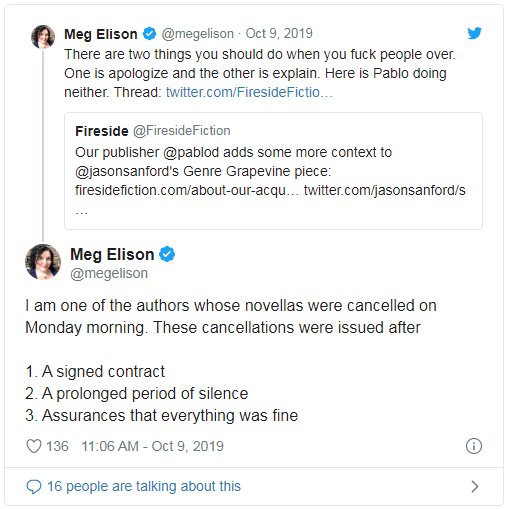
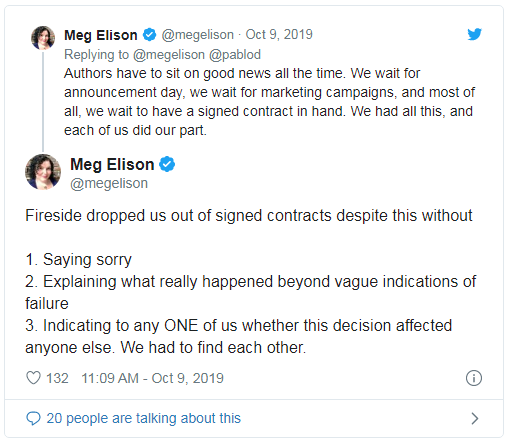
Author Meg Elison, one of the canceled authors, did not find this to be a sufficient explanation...and she was livid.


A few days later, Defendini issued an apology. "I can see now how [the cancellation emails] read as callous, uncaring, and dismissive of the authors’ feelings," he wrote. "I’m very sorry for that....My behavior was not consistent with Fireside’s values, and I deeply regret it."

Beyond the Contracts Committee's general warning about no-advance contracts (and if you're part of the small press world, you know how common these are): multiple simultaneous contract cancellations are not frequent or normal, and can signal trouble beyond whatever the publisher offers as an explanation (if it explains at all). Ditto for a publisher that suddenly starts offering to revert rights on request.

Fireside's situation also highlights the risks of signing with a publisher that's essentially a one-person operation (as Defendini admits in his apology). With the best will in the world, the publisher can be sidelined by a single bad event (personal or professional), leading to glitches, errors, and delays in scheduling, payment, and more. Writer Beware's files are stuffed with such stories.

Troubled publishers do recover, or at least hang on. Month9, which canceled dozens of contracts in 2016, is still publishing, as is Permuted Press, which axed an undisclosed number of titles in 2015 (both publishers cited overstocked lists, though in both cases there were other issues as well). In the short term, though, if a publisher is or has been actively shedding writers, it's best to hold off on submitting until it's clearer what's going on.


ca

Contest Caution: The Sunday Times Audible Short Story Award


Posted by Victoria Strauss for Writer Beware®

Founded in 2010, The Sunday Times Audible Short Story Award bills itself as "the richest prize for a single short story in the English language." And indeed, the prize is major: the winner receives a cool £30,000 (no, I did not add extra zeroes.)

With judges yet to be finalized, the selection process will include a 20-story longlist announced in May 2020, a six-story shortlist unveiled in June 2020, and the winner revealed on July 2. The shortlisted stories will be published in an Audible audiobook, with included writers receiving "an extra £1,000 fee, on top of a prize payment of £1,000". To be eligible, writers must previously have had at least one work published in the UK or Ireland by an "established print publisher or an established printed magazine" (the Terms and Conditions include an extensive list of the kinds of publishers and magazines that don't qualify). The contest is open for entries until 6:00 pm on December 13.

You can read more about the award, including the prestigious judges who've participated and the well-known writers who've submitted stories, here.

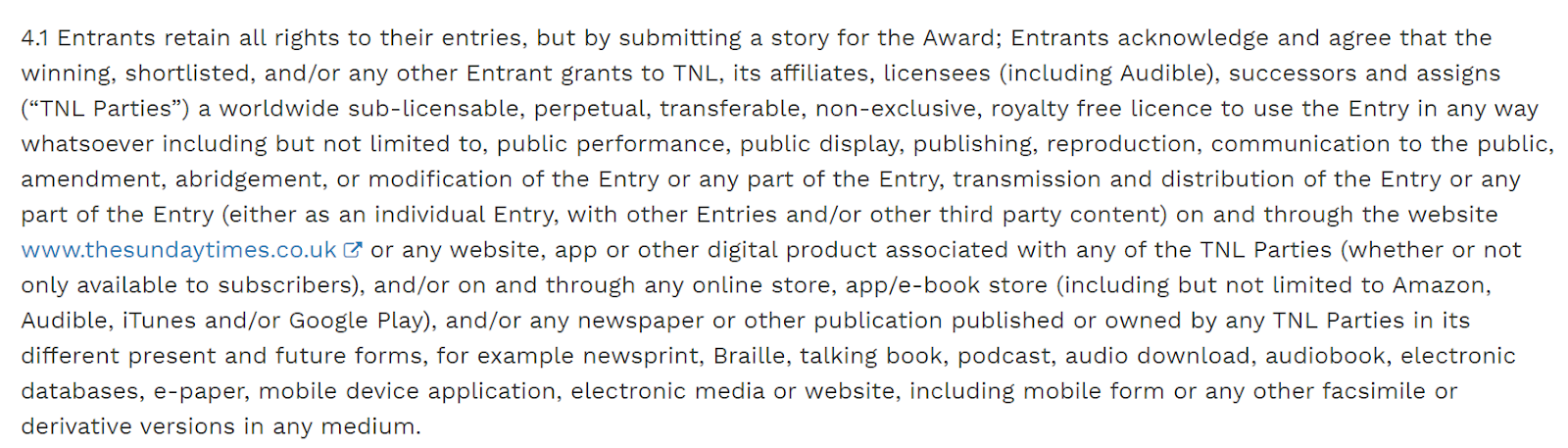
So what's the catch? -- because you know I wouldn't be writing this post if there weren't one. Well, as so often happens, it's in the Terms and Conditions. Specifically:


To summarize this dense paragraph: simply by entering the competition, you are granting a sweeping, non-expiring license not just to Times Newspapers Limited (The Sunday Times' parent company), but also to Audible and any other licensees of TNL, to use your story or any part of it in any way they want, anywhere in the world, without payment to or permission from you.

This is far from the first time I've written about "merely by entering you grant us rights forever" clauses in the guidelines of literary contests, some of them from major publishers or companies that should know better. Sure, in this case the license is non-exclusive, so you could sell your story elsewhere--but only as a reprint, because by granting non-exclusive rights to one company, you remove your ability to grant first rights to another, at least for as long as the initial rights grant is in force.

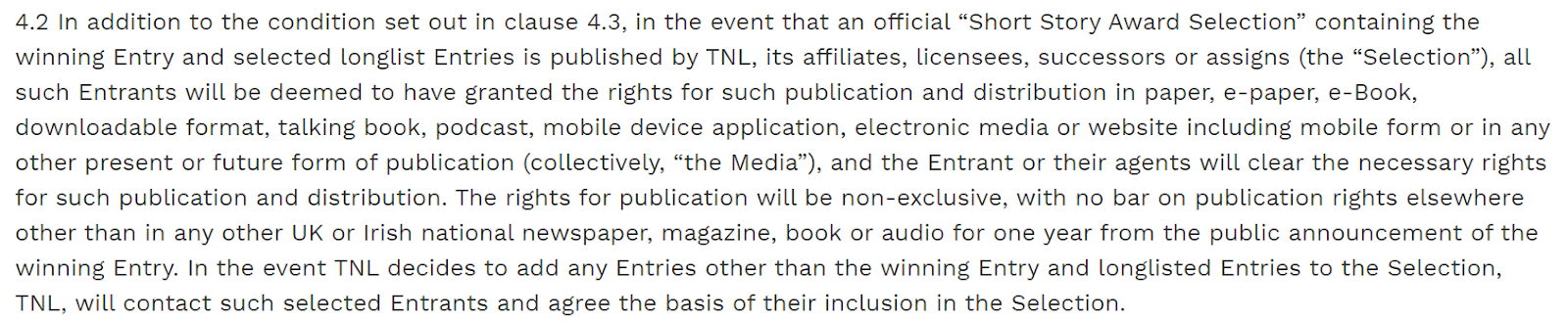
It's not uncommon for literary contests that involve publication to bind all entrants to a uniform license or grant of rights--so that, when winners are chosen, the license is already in place. But ideally, the license should immediately expire for entries that are removed from consideration--or, if the contest sponsor wants to retain the right to consider any entered story for publication (as TNL clearly does--see Clause 4.2, below), rights should be released within a reasonable period of time after the contest finishes--say, three or six months. There's simply no good reason to make a perpetual claim on rights just in case, at some unspecified point in the future, you might just possibly want to use them.

Not to mention--why should Audible get to make this same claim?

There's a couple of other things to be aware of. Shortlisted authors enter into a 12-month exclusive contract with Audible, for which they are given a "one-off" lump-sum payment (the £1,000 noted above). But thereafter, Audible retains the right "to record, distribute and market such audio version for at least ten (10) years." Again, this right is non-exclusive--but there's no indication that Audible has to pay these authors for potentially exploiting their work for a decade. (If you don't consent to these terms, you can't be shortlisted.)


Finally, although publication is guaranteed only for the shortlist, TNL reserves the right to publish longlist and non-listed entries as well. Great! Except...there's nothing to suggest these writers would be paid either.


There's no question that this is a prestigious--and, for the winner, rich--award. But sober evaluation is definitely in order here. Enter at your own risk.


ca

Scandal Engulfs Independent Publisher ChiZine Publications


Posted by Victoria Strauss for Writer Beware®

If you're not part of the horror or speculative fiction community, you may not be aware of the scandal that over the past two weeks has engulfed ChiZine Publications, a (previously) highly-regarded Canadian independent publisher.

In September of last year, several authors, including Ed Kurtz, made a complaint to the Horror Writers Association about long-overdue royalties at ChiZine. On November 5 of this year, after the complaint became public knowledge, CZP posted a statement on its Facebook page, claiming that Kurtz's royalties were "currently paid in full" and that "Any other monies he might be due will be paid on his next royalty statement". Kurtz's response, posted by his partner on Facebook a day later, was blistering:
The statement from Chizine neglects a number of salient facts, such as the moment in July 2018, at Necon, when I explained to Brett Savory that my partner was facing a layoff, our cat was ill, we were in severe financial distress, and I had *never* been paid a single cent of royalties in what was at that time almost two years for a moderately successful book. He actually grinned and said, "Things are hard for everyone right now" before walking away. The following morning it was reported to me that Sandra was loudly complaining in the dealer room about me having asked about my royalties, and of course the two of them went on a whirlwind trip around the world a few weeks after that, showing us all that things weren't so rough for them, after all.

In fact, I'd asked after my royalties several times and was rebuffed or given excuses every single time (usually something wrong with their accounting software or something similar, which I later learned they’d been saying to authors for years). I only went to the HWA after several other frustrated CZP authors (one of whom hadn't been paid in five years!) strongly encouraged me to do so. I expressed fear of bullying and/or retaliation, and some of these authors promised me they'd have my back (they didn't). And yes, a lot of us got paid through my efforts, though it is untrue I'm paid in full. I was never paid royalties for the months of my first year of publication, 2016, though CZP continues to claim I was. I just gave up on this.
Kurtz's experience was not isolated.

******

Between 2010 and 2015, Writer Beware received a handful of complaints (fewer than five) about ChiZine from authors who cited months-late royalty payments or long waits for contracts. Because the complaints were so few, and also because the authors all did eventually receive their payments or their contracts (though in most cases only after persistent prodding), it wasn't clear to me whether the tardiness indicated a pattern of problems, or was the kind of occasional glitch that can afflict otherwise reputable small presses with small staff and tight finances.

As it turns out, those few complaints were just the tiniest bubbles drifting up from what appears to be a roiling ocean of dysfunction.

Following Kurtz's public response, CZP authors and staff began to come forward with their own experiences--a tsunami of serious allegations including non-payment (some staff say they were never paid for years of work), extremely late or missing royalty payments (years in arrears in some cases; many authors report having to fight for what payment was received), erratically-produced royalty statements (CZP breached at least some of its own contracts by sending out royalties once a year instead of bi-annually--more on that below), missed pub dates, broken marketing promises, and financial mismanagement--especially concerning, since a big chunk of CZP's budget comes from grants and subsidies. (Former CZP staff member Michael Matheson has written a pair of illuminating posts on CZP's finances, including its treatment of grant money and habitual financial distress.)

Staff and authors also--in multiple, strikingly similar posts and complaints, including some received by Writer Beware--cite a toxic work culture that featured bullying, intimidation, sexual harassment, racism, gaslighting, and more. Several of those who contacted me told me that they felt CZP operated "like a cult," with charismatic leaders at the top who were admired and feared in equal measure, and whom many dared not defy.

This account only scratches the surface. For much more:
On November 11, CZP's founders, Sandra Kasturi and Brett Savory, posted a statement on the CZP blog and Facebook page indicating that they have decided to "step down." Although the statement mentions financial issues ("we have taken a short-term personal loan to bring payments up to date"), it doesn't address the many other complaints that have been leveled against the company--and, notably, does not include an apology.

The response has not been kind.

******

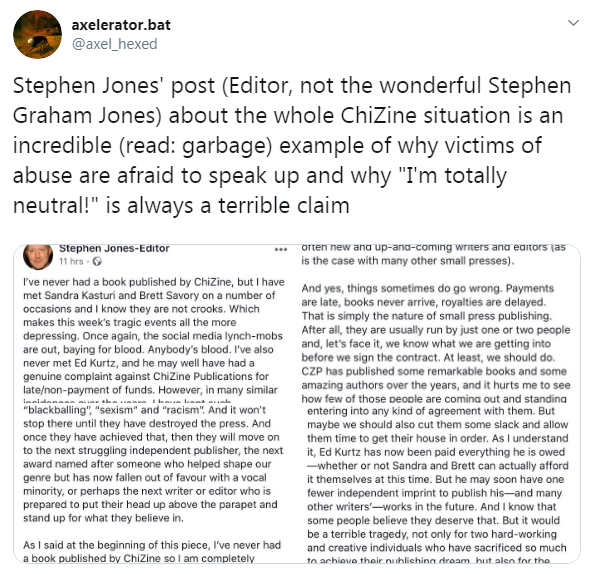
Despite all of the above, there are still those who continue to defend CZP, and to brush off the statements by writers and staff. For example, this, from editor Stephen Jones (Jones's post has been removed; this is a screenshot posted to Twitter):

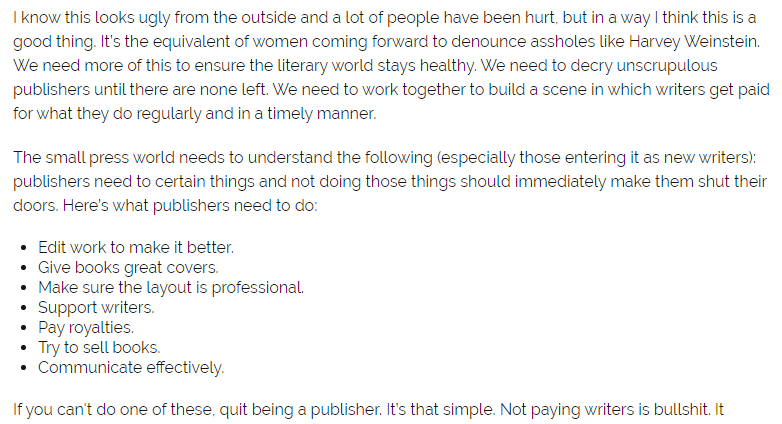
What stands out for me here is not just the skepticism that whistleblowers always have to face (and which, even when the publisher doesn't try to intimidate or engage in reprisals, makes it so much harder for whistleblowers to come forward), but the defense of unprofessional business practice--not just by CZP but, apparently, by small press publishers in general. Small presses are doing something great for writers and readers, so we should "cut them some slack" when they fail to pay, or don't fill book orders, or miss a pub date, or engage in some other kind of behavior that has a negative impact on staff and authors. That's "simply the nature of small press publishing." Deal with it!

It's a really common argument. I can't tell you how often I've seen some version of it--not just from toxic or troubled publishers, but from the writers they are screwing over. But it is bullshit. Complete and utter bullshit.

No matter how "worthy" a publisher may be, that does not give it the right to abuse its writers or its staff--whether by accident or design. Publishers function in the realm of art, but they also need to function like businesses--not like cults of personality, not like sinecures, not like kitchen-table hobby projects where it doesn't really matter that they know little about publishing and have never run a business as long as they've got good intentions. You don't get a pass because you've got a noble goal. You don't get a pass because independent publishers are struggling and we need more of them. You don't even get a pass because you're putting out good books from disenfranchised authors. You need to run your business right, and treat your writers and your staff right, or you have no business calling yourself a publisher.

Which brings me to my next point. The scope and range of what has apparently been happening at ChiZine is bigger than usual (and having seen as many small press implosions as I have over the years, it's amazing to me that it took so long for the scandal to break). But it's important to emphasize that it is not an isolated occurrence. Contract breaches, financial malfeasance, even the kind of harassment and gaslighting and dictatorial behavior that CZP authors and staff describe--all are rampant in the small press world. Just go back through a few years of the entries on this blog, and you'll see plenty of examples.

I don't mean to tar all small presses with the same brush. There are, it's important to acknowledge, many small and indie publishers that operate with complete professionalism and do all they can to treat their authors right. But there is a huge, huge problem in the small press segment of the publishing industry, and we don't do writers--or readers--any favors in dismissing or downplaying or making excuses for it.

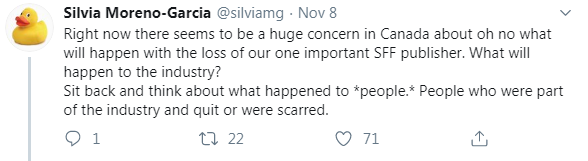
I'm not the only one who is making this point. Silvia Moreno-Garcia, who had payment issues with CZP and also has experience running a micro-press, addresses the issue in a Twitter thread:


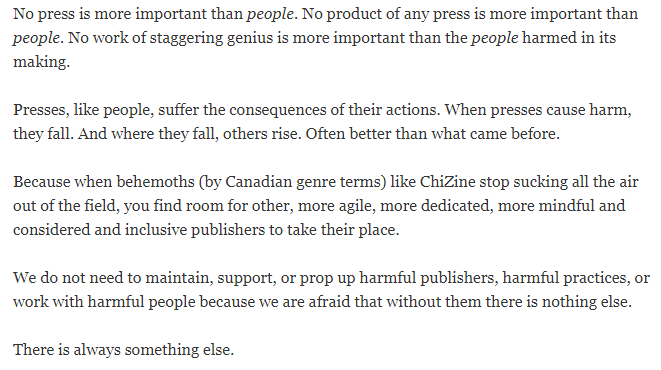
In a blog post, former CZP staffer Michael Matheson responds to those who would like to see publishers like CZP dealt with more kindly:

And, commenting on the Chizine situation, writer and reviewer Gabino Iglesias points out:


I agree 100%. But I'm not holding my breath.

******

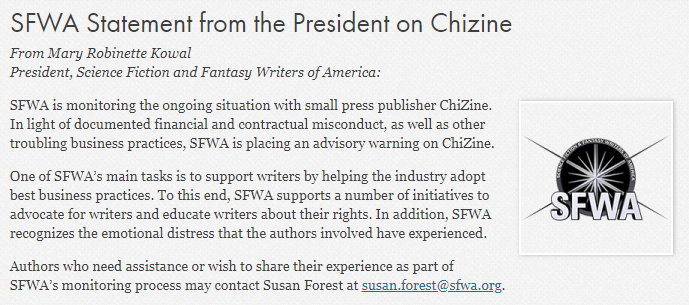
The scandal has unfolded very quickly but there've already been consequences. High Fever Books reports "a mass exodus" from CZP, with authors requesting rights reversions for their books, and withdrawing stories from CZP's forthcoming Christmas anthology. The Ontario Arts Council, one of CZP's funders, has recently removed CZP from its list of grant recommenders. And SFWA has issued a statement:


******

Finally, some semi-wonky publishing stuff.

There's been some discussion of irregularities with CZP's royalty statements. I've seen a number of these, kindly shared with me by CZP authors, and while they're somewhat of a chore to figure out and are missing some information that ideally should be present, the numbers do add up. However, a few things are sub-optimal.

- CZP's contract boilerplate empowers the publisher to set a "reasonable" reserve against returns. There are no specifics, so it's basically up to the publisher to decide what "reasonable" is.

For CZP, "reasonable" seems to mean 50%. This seemed high to me, so I did a mini-canvass of literary agents on Twitter. Most agreed that smaller is better--maybe 25-30%, though some felt that 50% was justifiable depending on the circumstances. They also pointed out that the reserve percentage should fall in subsequent reporting periods (CZP's remains at 50%, unless boilerplate has been negotiated otherwise), and that publishers should not hold reserves beyond two or three years, or four or five accounting periods (CZP has held reserves for some authors for much longer).

(If you're unclear on what a reserve against returns is, here's an explanation.)

- Per CZP's contract, royalties are paid "by the first royalty period falling one year after publication." What this means in practice (based on the royalty statements I saw) is that if your pub date is (hypothetically) April of 2016, you are not eligible for payment until the first royalty period that follows your one-year anniversary--which, since CZP pays royalties just once a year on a January-December schedule, would be the royalty period ending December 2017. Since publishers often take months to issue royalty statements and payments following the end of a royalty period, you'd get no royalty check until sometime in 2018--close to, or possibly more than, two full years after publication.

In effect, CZP is setting a 100% reserve against returns for at least a year following publication, and often much more. This gives it the use of the author's money for far too long, not to mention a financial cushion that lets it write smaller checks, since it doesn't have to pay anything out until after returns have come in (most sales and most returns occur during the first year of release).

I shouldn't need to say that this is non-standard. It's also, in my opinion, seriously exploitative.

- And...about that annual payment. It too is non-standard--even the big houses pay twice a year, and most small publishers pay quarterly or even more often. It's also extra-contractual--at least for the contracts I saw. According to CZP's boilerplate, payments are supposed to be bi-annual after that initial year-or-more embargo. The switch to annual payment appears to have been a unilateral decision by CZP owners for logistical and cost reasons, actual contract language be damned (I've seen documentation of this).

- A final wonky contract point: CZP's contract boilerplate mentions royalty payments (as in, they're bi-annual)--but does not, anywhere, mention royalty statements.

A publishing contract absolutely needs to bind a publisher not just to pay, but to account royalties on a regular basis (whether or not payments are due). If there's no contractual obligation for the publisher to provide royalty accounting, it may decline to do so--and that's not theoretical, I've gotten more than a few complaints about exactly this. Just one more reason to get knowledgeable advice on any publishing contract you're thinking of signing.


ca

What You Need to Know About How California's New Law AB-5 Affects Writers


Posted by Victoria Strauss for Writer Beware®

Scroll down for updates

Last year, California passed a new law, AB-5, intended to make things better for gig economy workers, such as Uber and Lyft drivers, by forcing these companies to provide employee protections and benefits for their freelance workers.

However, the narrowly-written law, which went into effect on January 2, has created unintended consequences for freelance writers, most of whom are independent by preference. If they sell 35 or more pieces to the same company in a year (which can easily happen with short blog posts or  product reviews), the company must treat them as employees rather than freelancers and pay payroll taxes as well as unemployment and other insurances. Even before the law went into effect, companies were laying off California freelancers and seeking replacements in other states.

Book writers may be affected too, under certain specific circumstances.

The article below was originally published by the Authors Guild; I'm re-printing it with permission. This is an issue all writers need to be aware of, as similar laws are under consideration in other states, including New York and New Jersey.

******

We have been receiving inquiries about California’s new law AB-5 and similar pending legislation in other states that require companies hiring individuals on a freelance basis for labor or services to treat them as employees, unless the individual’s work falls within one of several exceptions. Laws like AB-5 (which goes into effect on January 2) are meant to aid gig economy workers, such as Uber and Lyft drivers, who work for a single company and have no employee protections. They are well-intentioned pieces of legislation, but unless they are narrowly written, they can go beyond protecting gig workers and disadvantage many traditional freelancers who wish to remain independent by overriding existing state agency law.

To be clear, the Authors Guild fully supports employment protections for freelance journalists and authors, and will be lobbying for collective bargaining rights in 2020. Like Uber drivers, writers have no benefits and are often paid less than minimum wage. But forcing writers to work as employees, especially on a state-by-state basis, is not the way to go about it. The situation in California speaks to the importance of deliberation, careful drafting, and getting buy-ins from the various industry groups. Similar “gig worker” bills are in the works in New York and New Jersey. The new draft NJ bill includes a strict, sweeping version of the ABC test. Those working closely on the bill are concerned that freelance journalists will in many cases be treated as employees. We will watch the bill and do our best to ensure that the necessary protections for freelance journalists are added.

* The NY bill attempts to exclude freelance journalists, and we have provided comments to the drafters to make it clearer.* (correction 12.30.19)

AB-5’s 35-Submission Cap

As many of you are aware by now, much of the debate surrounding AB-5 comes down to its 35-submission cap applying to the contributions of freelance journalists, editors, and photographers. When the bill was being negotiated, a coalition of writer and photographer groups, including the Authors Guild, was able to get an exception for freelance writers. Unfortunately, Assemblywoman Lorena Gonzalez, who sponsored the bill, added a cap of 35 pieces per company—meaning that once a freelance journalist or editor submits 36 articles or jobs for the same company in one year, the freelancer must be treated as an employee and the employer must pay California State unemployment and employee insurances.

Many full-time writers today patch together a living from different sources—and they want to keep it that way. Because of AB-5, California freelance journalists writing 35 or more pieces for a single company fear losing clients to writers in states with laxer laws. Indeed, some publications have already stated that they will not hire California freelance writers because of the new law. 35 articles might seem like a lot, but there are plenty of writers who write more than that. Writing a short weekly blog piece for a client could easily put a writer over this limit.

Another problem with treating writers as employees and not freelancers is that employee-writers do not own the copyright in their work; instead, the employer is considered the “author” under copyright law and automatically owns the copyright in its creation. Of course, as most major publications today insist on an assignment of copyright anyway, the practical effect, unfortunately, is the same: the writer gives up copyright. Still, freelance writers who assign copyright can reclaim it after 35–40 years, which is a benefit that employee-writers lack.

Does AB-5 Apply to Book Contracts?

Authors have raised alarm that AB-5 will apply to book writers as well. The Authors Guild has been reviewing the bill from that perspective since it was first introduced. We were assured by those working on the bill that trade book authors are not covered, and we do not see a basis for disagreeing since the bill clearly states that AB-5 applies only to “persons providing labor or services” and authors provide neither “labor” nor “services” under standard book contracts—they instead grant copyright licenses or assignments. Additionally, royalties—even in the form of advance payments—are not considered wages. It is difficult to imagine how a court would conclude that a typical book contract is for labor or services.

Writers with Service-Like Obligations Should Get a Legal Opinion

There are, however, some book-writing agreements that could be considered service agreements and arguably would fall under AB-5, such as work-made-for-hire agreements and contracts where the author has ongoing obligations and the publisher has greater editing ability or control over the content. Authors and writers working under multi-book contracts are most likely to encounter such a situation. These authors’ contracts should be reviewed by an attorney to determine whether they are subject to AB-5. Publishers and authors who want to be certain to retain a freelancer relationship should be careful to make sure the contracts are written as simple license grants and not as services agreements. For instance, the agreement should be written as a copyright grant of a defined work without interim or ongoing obligations, and remuneration should be in the form of royalties and advances against royalties. The writer should also have full control over their work and use their own workspace and tools. As a general rule, it is also recommended that freelance editors and journalists have written contracts that allow them to work when and where they want with no oversight other than approval of the finished work product.

If you have such a contract and are an Authors Guild member, remember that we do review members’ contracts for free. You can send us the agreement using our online form, and our legal team will get you comments and let you know if you need to revise the agreement.

UPDATE 1/16/20: Washington (State, not DC) is contemplating a bill like this as well. From the comments, below:
WA should be on your watchlist, too. An AB5-like bill was just re-introduced in the Senate there, even though it had been defeated last year. It, too, requires writers and other freelancers and independent contractors be hired as employees when their works contribute to the normal business of their clients. The bill ignores a study of independent contractors that was prepared by the Dept of Commerce after the bill's defeat. The study documents that 3/4 of the independent contractors in WA don't need or want the employee benefits touted by the bill's advocates. Between their own efforts and those of their families and friends, they're doing fine. Read the study yourself then write to Sen. Karen Keiser about your opposition to being made employees against your will.

The study: https://app.leg.wa.gov/committeeschedules/Home/Documents/26113?//20902
Senator Keiser: karen.keiser@leg.wa.gov
A similar law may be in the works in Illinois.

UPDATE 1/20/20: This article from Digiday explores the negative impact that AB-5 is already having on freelancers and publishers in California.


ca

Mass Contract Cancellations at Mystery Publisher Henery Press


Posted by Victoria Strauss for Writer Beware®

Beginning on Friday, February 8, dozens of authors with mystery publisher Henery Press received some version of this email.
Dear ________,

Before entering 2020, we felt it prudent to review future projections for _______ series, taking into consideration recent releases and overall performance. To provide an unbiased professional opinion and guidance in our 3-year strategic plan, we hired a consulting firm with experience in the industry. This allowed us to analyze not only your specific series, but also the competitive landscape and industry as a whole.

Unfortunately the sales of _______ series do not justify the publication of future titles beyond 2020. We know this is disappointing. The market has become beyond saturated (especially in mystery fiction), with all leading indicators pointing to even more intense competition for consumer dollars in the next cycle and beyond....

Although we don’t have a pathway forward with your new titles, we will continue to sell and support your backlist titles as usual under the terms of our original publishing agreement. To be clear, we will not be reverting the rights on any of your already published title(s), only future titles specifically outlined in the addendum to follow in the next week.
A number of the cancellations affected books that had been completed, turned in, and scheduled for publication, with some authors having already made promotional plans. Others interrupted series whose first installment hadn't yet been published--with Henery holding on to the yet-to-be-published book and reverting rights to the rest. Cancellation of a series before it's completed can be tough--another publisher may not want to buy into a series mid-stream, and while followup titles can be self-published, it's difficult to promote a series when it's split up like this.

The cancellations came out of the blue (nothing had been said about any strategic plan or consulting firm). But while some writers were blindsided, others weren't hugely surprised. Although they have praise for the company's early days, Henery authors say that problems have been increasing for some time, with staff departures (interns are reportedly used to do a lot of the editing, with sometimes substandard results), late royalty checks and reports (several authors told me that they feel there are discrepancies in their sales figures), diminishing marketing (according to multiple writers, virtually no promotional support is provided), ordering problems (writers cite non-returnability and nonstandard discounts), and difficulty with communications.

"Over time," one author told me, "Henery Press’s business model started to look more like a company that assists with self-publishing and less like a real publisher." (In fact, Henery uses CreateSpace for printing, and Barnes & Noble lists Henery ebooks as "indie".)

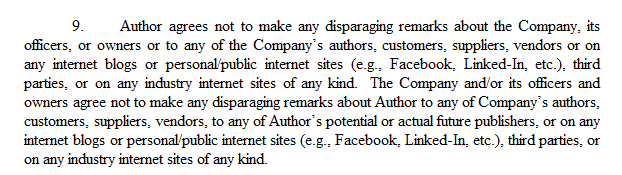
I've gotten a variety of additional complaints, which I'm not able to share here because they could compromise confidentiality. There seems to be considerable fear among Henery authors that they will be penalized for speaking out--which may be why almost no word of the cancellations has escaped. There's also the gag clause in the rights reversion addendum that authors are receiving:


One writer told me, "HP payback tactics (they're so vindictive) are hell. [Authors are] afraid if HP even suspects they've contributed, the books they have will go down." I truly wish this weren't such a common component of publisher implosions.

So is Henery imploding? Mass cancellations are never a good sign, and often indicate financial distress. Some Henery authors don't feel that's the issue, though, or not the only issue: they speculate that the owners intend to retire, and are keeping the company alive in order to retain the income stream from existing titles.

I emailed Henery's owner, Art Molinares, for comment. As of this writing, he hasn't responded.

Mystery Writers of America (where Henery is listed as an Approved Publisher) is aware of the situation, and is monitoring it. If you've been affected, you can contact MWA here. Be sure to put "Henery Press" in the subject line. All communications are confidential.

I will post updates as I receive them.


ca

Contest Scam Alert: Legaia Books Online Book Competition


Posted by Victoria Strauss for Writer Beware®

When is a literary contest not a literary contest?

When its purpose is to make money for the contest sponsor. Alternatively: when its purpose is to assemble a list of likely customers.

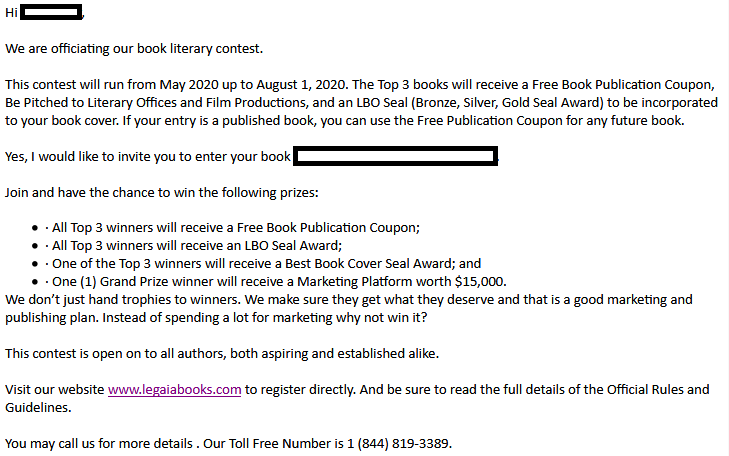
Take the online book competition (or book literary contest, or books competition--it doesn't seem to have an actual name) recently announced by Legaia Books, a publishing and marketing scam I've featured on this blog. Here's one of the solicitation emails that are going out:


Sound tempting? Here are all the reasons to kick this "contest" to the curb.

1. Legaia is a scam. This company--which claims a North Carolina address but really operates out of the Philippines--exists to rip off authors. That's really all the reason you need to give this contest a miss...but let's move on.

2. It's a scam within a scam. Legaia's contest has all the elements of a profiteering awards program--a different kind of scam, whose template Legaia is borrowing as a way to make some quick bucks and boost its customer list. Here are the markers:
  • Solicitation. See the email above.
  • A fat entry fee. You have to dig into the contest guidelines to find this: $40 for entries now, $70 for entries after May 11.
  • Policies designed to maximize entries. Most profiteering awards programs offer dozens or scores of entry categories, in order to attract the largest number of entrants and thus the biggest pot of entry fees. Legaia's contest doesn't have categories--but it's "open to all aspiring and established authors", which, combined with what is doubtless a sizeable email solicitation campaign (Legaia is a prolific spammer), is basically the same thing.
  • Mystery judging. The prestige of a literary competition is tied, in part, to the reputability of its judges. If the judges' identities aren't revealed, you have no way to know whether they have any credits or experience that would qualify them to be judges. They could be just the contest sponsor's own staff--or no one at all. Legaia's guidelines include multiple mentions of "judges" but, in true scam contest style, no names.
  • Opportunities to spend more money. This is where entrants' email addresses--which are required for entry--come in handy; non-winners will almost certainly be solicited to buy Legaia's publishing packages and other services. (Contest guidelines also invite entrants without a book cover to "call us for a professional book cover.")
  • Worthless prizes. Profiteering contest sponsors avoid cutting into entry fee income by offering "prizes" that cost them little or nothing to provide. Legaia is no exception. Given that its services are overpriced and substandard, a "Free Book Publication Coupon" is more like a lump of coal than a Christmas present. The "Seal Awards" aren't actual seals--just digital images. Winners are promised a "pitch program" that will expose them to "literary offices and film productions"--despite the fact that Legaia can't cite a single "literary office" or film studio that has ever picked up a book thanks to its (likely nonexistent) efforts. As for the "Marketing Platform worth $15,000"...Legaia offers only junk marketing ("marketing" that's cheap to provide, can be sold for giant markups, and is not effective for book promotion), so the actual worth is closer to zero. 
3. You have to work. In addition to submitting "your (a) manuscript, (b) synopsis, (c) book cover (front and full)" the contest guidelines indicate that there will be a public voting phase (see #7 and #8), which means you will have to bug your friends and family and annoy your social media followers with multiple vote-grubbing posts and announcements. Additionally, you must create a "pitch to the judges" which is "one of the criteria in the second phase of the contest as indicated in Rule 8". You have the option of making a video or using Legaia's "Free Pitch Template," whatever that is; the guidelines offer no guidance on length, content, or anything else.

4. Nobody has heard of it. The supposed benefits of a contest win or placement are often touted by sketchy contests or awards as one of the benefits of entering (not to mention a justification of a big entry fee). You'll be able to tag your book as an "award-winning book" and yourself as an "award-winning author". It'll impress agents and editors! It'll bring visibility to your work! It'll increase sales!

Most contests, however, don't have the prestige or name recognition to accomplish any of that. Agents and editors are well aware of how many dodgy contests are out there competing for writers' money; "I won Grand Prize in this contest you never heard of!" is unlikely to impress them. As for readers and book buyers, how much they care about award and contest wins is an open question--especially, again, where they've never heard of the award or contest. Is it worth $40 (or $70) to you to test that question?

5. A serious lack of literacy. Both the email solicitation reproduced above and the contest pages on the Legaia website are littered with grammatical and other errors (like its many brethren--see the sidebar--Legaia is based overseas). This really shouldn't need saying, but the sponsors of an English-language contest for English-language books should be able to demonstrate a good command of English.

Any one of these factors should be enough to at least cause you to give this contest the side-eye. Taken all together, they add up to a giant, screaming red flag.

My own feeling about literary contests is that they are mostly a waste of time (even if not of money). Scams and exploitation abound in this space (if you're a regular reader of this blog, you know how many posts I write about problem contests). Even where the contest is legit and doesn't have "gotchas" in its guidelines, those that can genuinely benefit your writing resume are a tiny minority. Again in my opinion, writers' time is better spent on publishing or submitting for publication.

That said...if you still are attracted by contests, there are resources on the Contests and Awards page of Writer Beware to help you research ones that won't rip you off. Also be sure to use the search box in the sidebar to search this blog for any contests I may have written about, and feel free to email me with questions.


ca

Update on cards, books, calendars, and more!

Here’s a new holiday card design for this year! I have only a limited supply of them, but the choices on offer for Wondermark holiday cards are myriad. This year, I am not making a printed 2020 calendar. What I have done, though, is re-issued four of my previous calendars (from 2013, 2014, 2015, and […]


  • Blog
  • blog: product announcements

ca

Make your own 2020 calendar from past calendars! PLUS: Progressive calendar free download

Although there is no 2020 Wondermark calendar per se, observant Marksman Gary T. let me know that dedicated calendar fans can make a 2020 calendar at home with the aid of: • January–February: The 2014 Wondermark calendar • March–December: Either the 2009 or 2015 Wondermark calendar It’s Leap Day this year that throws things off. SO, […]


  • Blog
  • blog: stuff I made

ca

#1514; In which the Question is Rhetorical


ca

I Asked the Department of Education to Fight for Black Girls. They Ignored Me.

Walking down the hallway at school, an administrator stopped me in my tracks. I felt her eyes glare from the top of my head, past my torso and down my legs. She told me that my shorts were too short and that she didn’t want to see me wearing them ever again. I felt embarrassed […]


ca

What Backlash Against “Political Correctness” is Really About

The last few weeks have seen Virginia racked by government scandals, including Democratic Gov. Ralph Northam and Attorney General Mark Herring’s histories with blackface, and allegations of sexual assault against Lt. Gov. Justin Fairfax. Democratic Party leadership has since swiftly called for the resignations of Northam and Fairfax — demands that some on both sides of the aisle […]


ca

When public health becomes a casualty of the right-wing culture war, innocent people will die.

As we watch right-wing agitators, Fascists, media personalities, and the impeached president howl about ending Stay at Home before the public health experts say we should, remember that, as a […]

ca

Cartoons from the March 9, 2020, Issue


Cartoons from the March 9, 2020, Issue


ca

Cartoons from the March 16, 2020, Issue


Cartoons from the March 16, 2020, Issue


ca

Cartoons from the March 23, 2020, Issue


Cartoons from the March 23, 2020, Issue


ca

Cartoons from the March 30, 2020, Issue


Cartoons from the March 30, 2020, Issue