ed

Issues at Audible's ACX: Attempted Rights Fraud, Withdrawn Promotional Codes


Posted by Victoria Strauss for Writer Beware®

Two issues involving Audible's ACX have come across my desk recently.

Rights Fraud

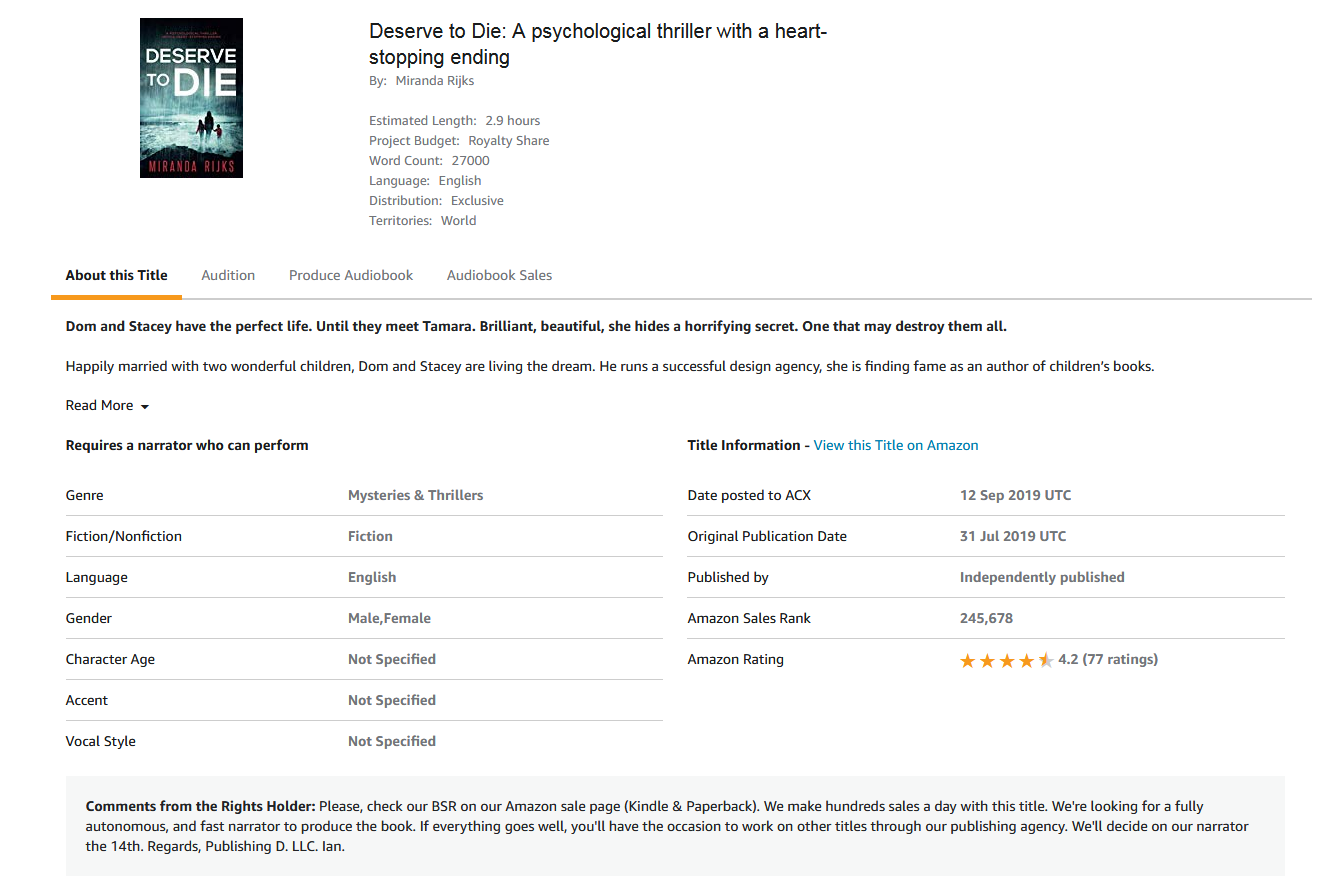
I've heard from several self- and small press-pubbed authors who report that they've found their books listed on ACX as open to narrator auditions...except that they, or their publishers, didn't put them there. This appears to be an attempt to steal authors' audio rights.

Below is one listing. Here's another and another and another. (All of these listings have been invalidated by ACX.)


See "Comments from the Rights Holder" at the bottom. The purported company, Publishing D LLC, does not show up on any searches.

The fraud seems pretty elaborate. Here's what one of the authors who contacted me told me:


These comments from a freelance audiobook narrator illustrate that "Publishing D" is not an isolated incidence.

Promotional Code Shenanigans

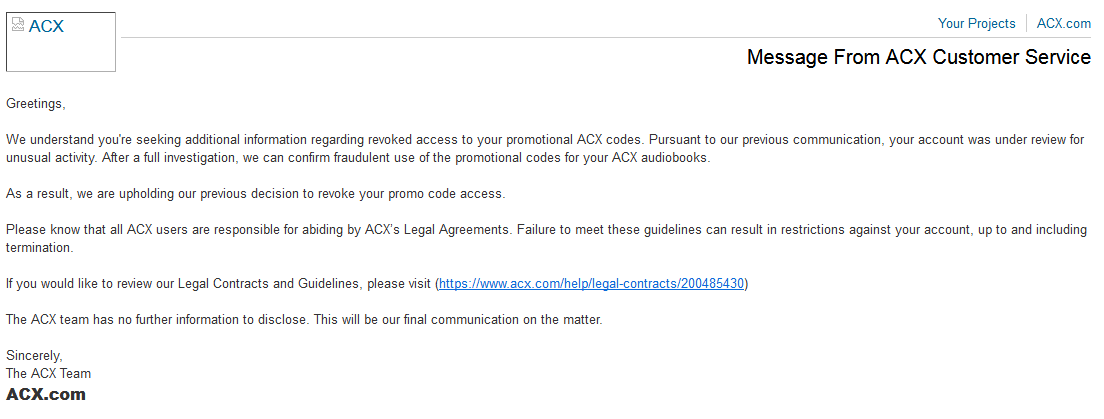
Multiple authors have contacted me to report that they've received an email from ACX withdrawing their promotional codes. The cited reason: "unusual activity," with no explanation of what that means.

The authors say that they have not used the codes improperly or violated ACX guidelines; in some cases, they've used the codes only a handful of times or not at all. See, for instance, blog posts by authors G. Michael Vasey and Adam Piggott. Per discussions on the KBoards and Reddit, a lot of authors seem to be affected.

Is this one of Amazon's (Audible's parent company) periodic crackdowns on misuse or fraud that has inadvertently ensnared innocent authors? According to author and self-publishing expert David Gaughran, ACX promo code scamming is a major problem, and Amazon's anti-abuse sweeps often involve a lot of collateral damage. Or could it be an error--a glitch or rogue algorithm?

So far, authors' efforts to get a fuller explanation have run up against the black box that is Amazon:


If I hear anything further, I'll update this post.

UPDATE 11/27/19: One of the authors who alerted me to the promo code withdrawal has received a notice saying that their codes are reinstated--however, they say that the promo code tab has yet to appear in their dashboard.


UPDATE 2/25/29: More about ACX scams, from a comment left by a narrator:
About the ACX thing...I was contacted by ACX to narrate three books, however, the person who offered the contracts kept emailing and frantically telling me to send them my book codes. I got leary and called ACX. They said unfortunately there are many scams taking place where if a book is "unclaimed" in their system, someone may grab it and offer it as an audiobook contract. Then they keep the codes and blackmarket sell them. They do not pay the narrators. Many other authors are experiencing it, they said, but they have no way to regulate it.

I declined the offers and got a nasty note from the contract holder. I was also told that since I corresponded with them, they had my email that is associated with Amazon..the same one. So, ACX said I had to go change my email on Amazon or they would have access there too. Geez.


ed

How Predatory Companies Are Trying to Hijack Your Publisher Search, Part 3


Posted by Victoria Strauss for Writer Beware®

In my first post about the ways that predatory companies attempt to ensnare unwary writers who are searching for publishers, I discussed fake publisher-matching websites. In my second, I exposed the scammy Google ad tactics of vanity publisher Austin Macauley.

In this third post, I'll talk about an equally insidious practice: providing misinformation or even outright lies about traditional publishing, in order to make self- or vanity publishing appear superior.

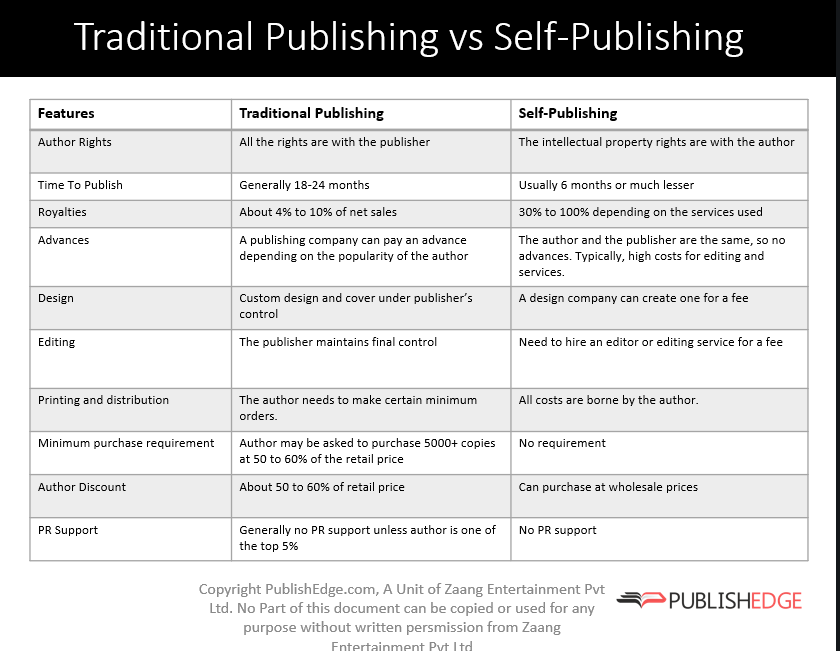
Yesterday on Twitter, someone tweeted this chart, which purportedly compares traditional publishing and self-publishing.


If you're even slightly savvy about publishing, the inaccuracies are easy to spot. Trad pubs often pay royalties on retail price (not "net sales"), or pay a higher percentage (higher royalties are especially common in the small press world). Trad pubs that pay advances don't withhold them from less popular authors, and they don't require authors to make "certain minimum orders" or to buy thousands of copies of their own books. And while it's often true that smaller traditional publishers don't provide much in the way of PR or marketing support, and larger houses invest more marketing in more popular books and authors, they don't simply ignore 95% of their output (this makes no sense; what business markets only 5% of its products?)

As for author rights...trad pubs do license exclusive rights from authors, sometimes for a period of years, sometimes for the life of copyright (with reversion usually happening well before then). But they don't gain ownership of them (as "all rights are with the publisher" implies), because the author retains copyright--plus, authors can often negotiate to keep some of their subsidiary rights. And although self-publishing is typically non-exclusive, allowing authors to publish on multiple platforms if they wish, they do still have to license publishing and distribution rights to whichever platform or service provider they choose--otherwise, the platform couldn't legally produce and sell their books.

The chart comes from this how-to-self-publish article, which is really just a long ad for PublishEdge, which is (surprise!) a paid publishing services provider.


PublishEdge is a "division" of Zaang Entertainment Pvt Ltd, which, unlike the Philippines-based scams I've been covering so much lately, is based in India. The range of services it sells aren't priced as high as some of the scammers', but there are still plenty of warning signs: no information about who is providing the services on offer (so you have no idea who they are or if they're qualified); no cover or website design samples (so you have no idea what you'd be getting for your money); and this pitch for ghostwriting services, which invites you to "Discover the simple secret to how celebrities and busy professionals get their books published without actually writing", courtesy of "our book writing experts", who (judging from the description of the service) basically type up a Skype interview into a chapter book. Most likely these unnamed "experts" are hired on Upwork or Fiverr or a similar jobs site (holy plagiarism scandal, Batman!).

PublishEdge isn't alone in misrepresenting traditional publishing in order to make itself look more attractive. Among other alternative facts, this chart from Morgan James, a vanity publisher with an author purchase requirement, claims that "many major houses" require authors to buy 5,000 copies or more of their own books (doesn't that make MJ's 2,500 purchase requirement seem appealing?), and that trad pubs provide no PR or marketing support for 94% of their books and authors. (Hmmm. Could PublishEdge have borrowed a little something there?)

Here's another misleading comparison, from Union Square Publishing, a self-styled hybrid (read: vanity) publisher. It too borrows heavily from Morgan James's chart, with several of the same dubious claims. Here's another one--this time from Success Publishing, which sells Chicken Soup-style anthology slots.

This one, from "custom" publisher Momosa Publishing (packages start at $5,900), doesn't tell quite so many fibs, but encourages you to believe that trad pubs cap their royalties at 6%, and don't market their books to libraries. And then there's this from Atmosphere Press, another so-called hybrid, which wants to convince writers that a $5,000 publishing fee will save them from the "raw end of the deal" they'd get from a trad pub, "losing not just their royalties but also the rights to their material and to their control over their art." Not addressed: the likelihood of ever making that $5,000 back.

These are just a few examples; there are many more. If you use the internet as part of your publisher search, you're very likely to encounter them (in some cases, disseminated by self-styled experts who ought to know better). It's a great argument for a step that many writers skip: learning about publishing before diving into the quest for publication. As with all aspects of publishing, knowledge is your greatest ally and your best defense: the more you know about the way things really work, the better protected you will be against the disinformation described above.

Final note: I know that many writers have had bad experiences with traditional publishers--I've had some myself. Especially in the small press world, many traditional (at least in the sense that they don't charge fees) publishers engage in nonstandard and author-unfriendly business practices. There's plenty of discussion of that on this blog. I'm not trying to paint trad pub as perfect, or argue that it's necessarily a better choice for any given writer.

But deliberate distortions like those described above don't help anyone, even if you don't take into account their obvious self-serving agenda. Tarring an entire segment of the publishing market with a broad negative brush--especially where some of the supposed negatives are demonstrably false--is as irresponsible as arguing (as some people still do) that only traditional publishing is a worthwhile path. 


ed

Beware: Wid Bastian a.k.a. Widtsoe T. Bastian / Genius Media Inc. / Kairos Phoenix Company


Posted by Victoria Strauss for Writer Beware®

Scroll down for updates

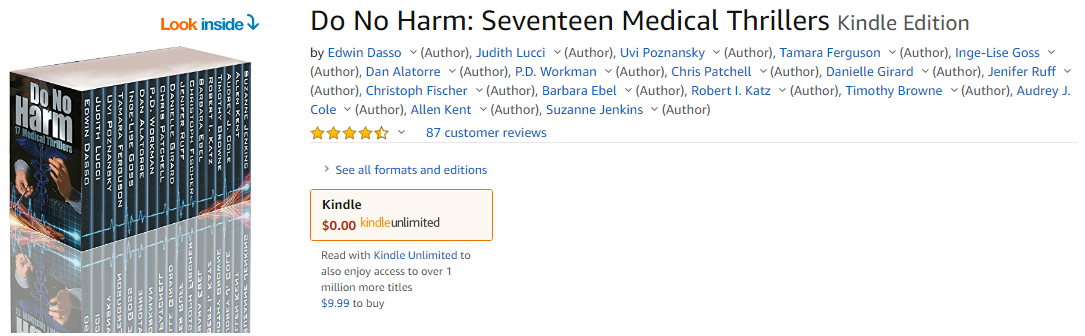
Early in 2019, seventeen writers were recruited to participate in a box set of medical thrillers, called (with unforeseen irony) Do No Harm.

The buy-in: $750, with net income from sales going to two designated charities, and participating writers receiving a pro-rated share of any net income above those contributions. The goal: through cooperative marketing efforts, to get the set on the USA Today bestseller list.

Here's how the opportunity was presented to potential participants (this is from an email that was shared with me):


In other words, right off the bat, authors were being primed not to expect to make money.

Helming the endeavor was a five-year-old PR company called Genius Media Inc., owned by a man called Wid Bastian (full name: Widtsoe T. Bastian). Per this long 2017 discussion on KBoards, one of Genius Media's not-so-genius MOs was to cold-contact writers by form email and offer glowingly-described Kindle Unlimited promotions. "For you, my estimate on an eBook promo is 10,000 plus downloads and 700 plus sales, positive ROI right out of the gate and huge page read income."

The cost: $2,000.

KBoards members urged caution, especially after expert analysis of Genius's claims indicated that its promotions weren't as successful as it advertised, and information offered by a writer who'd paid for a promo suggested that Genius was violating the TOS of the advertising platforms it used. Also noteworthy: this post from a writer who bought two promos from Genius, and lost money on each one. "That is what Genius Media told me to expect, that the first promo would not show a profit, but that by the second or third promo, they would show a profit." (The writer bought a third promo.)

As it turns out, these concerns were a sign of things to come.

Do No Harm was published, as promised, and made the USA Today bestseller list, also as promised. On October 3 (or possibly October 4), it was unpublished--three (or possibly four) days after the contractually-stipulated end date of September 30.

Per the contract (which you can see here), final reporting and payment was due to authors "no later than December 1". December 1 came...and went. Bastian promised anxious authors they'd get everything by December 15.

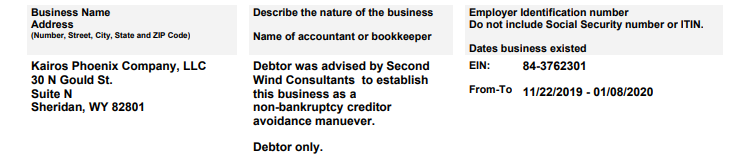
One day past that deadline, they did receive a report...but not from Genius Media. Between early December and December 16, with no notice or warning, a company called Kairos Phoenix had purportedly acquired Genius. Other than its business registration--in Wyoming, just like Genius's--and hometown--Logan, Utah, again just like Genius's--Kairos was a black box, with zero web presence. It had incorporated less than a month earlier, on November 22. (You can see the report here.)

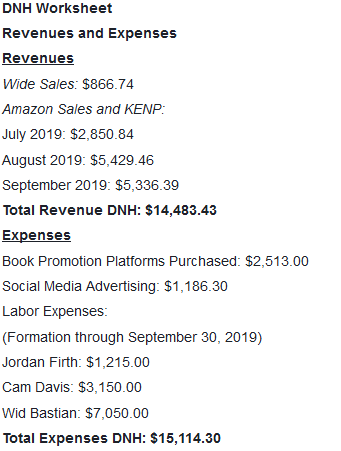
That wasn't all that was suspicious. Here's Kairos's financial breakdown:


In other words, USA Today bestselling box set Do No Harm hadn't just failed to make a profit, it had lost money. But...where was the revenue from the $750 buy-in fees--which, with 17 authors, totaled $12,750? (Kairos's explanation: it wasn't included because it was "ordinary income" for Genius Media. "As stated in the contract, the fee was paid to 'participate' in DNH Collab by the author and for no other purpose".) Where were revenues for the days the set had been on sale past the unpublish deadline? (Kairos: "The contractual period for DNH Collab was strictly defined in the contract" as September 30, so any revenue past that date was "irrelevant".)

Equally troubling, why were there more than $15,000 in expenses--three-quarters of which were for "labor"--when the contract stipulated that expenses were not to exceed the total of the buy-in fees? According to Kairos, this wasn't really an expense cap: "This provision was specifically and intentionally included in the contract language to avoid the possibility of a 'cash call' – Genius Media asking authors to contribute more to DNH Collab to achieve the goal of making USA Today Bestseller status. No 'cash call' was ever made in the DNH Collab."

Here's the actual contract wording, though (my bolding):
For the purposes of the USA Today Bestseller Medical Thriller Author Publishing Collaborative Boxed Set program, Genius Media shall not incur any publication and promotion expenses of any nature in excess of the fees paid under the terms of its author agreements and shall have no power to obligate [redacted] or any other author for any publication and promotion expense above author fees paid whatsoever.
There's a "cash call" prohibition and an expense cap. But Kairos wanted writers to believe otherwise, so it could inflate expenses and ensure a loss.

It was obvious to Do No Harm participants that Kairos was taking the money and running--avoiding the substantial payouts it would otherwise have to make by retroactively interpreting contract language, and also enabling Bastian himself to claim he was blameless because of Genius's supposed takeover by an unrelated company. (No one was under any illusion that Kairos Phoenix was anything other than Bastian in a different guise.)

Authors were furious. On December 22, two of them, Christoph Fischer and Dan Alatorre, went public with their experience. Others posted warnings on Kairos's corporate business listing.

Do No Harm isn't the first time Bastian has run this scheme, either.


The box set in question appears to be Tales From Big Country, which was published around the same time as Do No Harm. A third set, Galaxia, was pubbed in September, with profits supposedly going to the Well Aware clean water charity. I've been told that Bastian is recruiting for other sets, including a collection of thrillers.

So who is Wid Bastian, a.k.a. Widtsoe T. Bastian?

His LinkedIn profile ("EXPOSE your new book to develop your author brand and sell more books!") identifies him as the owner of Genius Media, and also of an ebook promotion program called Book Dynamite. In an earlier profile on a freelancers' job site, he describes himself as a "published novelist and screenwriter" (more on that below) who "makes most of my daily bread as a ghostwriter." He also has an IMDB profile, presumably because of his efforts to make a film of the life of Greek Orthodox priest Fr. Themi Adamopoulos.

Genius Media's website has been taken offline, but traces remain in the form of cached pages, and here's how it looked in January 2016, courtesy of the Internet Archive (more recent versions haven't been archived). The company has a D+ rating from the BBB. Bastian also owned or was an officer with at least three other companies during the early to mid-1990s: Off & Flying, Prospex Interntaional [sic] (yes, it really was registered with a typo in the name), and Nevada Pension Investment Fund. Both Off & Flying and Prospex had their statuses "permanently revoked" a few years after incorporating. All three are long dead.

There is also a Widtsoe T. Bastian who pleaded guilty to 13 felony counts including embezzlement, money laundering, and bankruptcy fraud in US District Court in North Carolina, and in 2005 was sentenced to one hundred and forty-four months in prison and restitution of more than $3,000,000. Nothing I can find online directly connects Widtsoe T. Bastian of Genius Media to Widtsoe T. Bastian of North Carolina, so it may be a different person. But Widtsoe T. Bastian is quite an unusual name, as a websearch will make clear.

Finally...I can't say "what goes around comes around", since this pre-dates the ripoff that's the subject of this post, but it certainly seems like a case of advance karma: Bastian's own 2010 novel, Solomon's Porch, was published by none other than Tate Publishing & Enterprises, a notorious vanity publisher that scammed thousands of authors and a multitude of staff, and whose owners pleaded guilty in 2017 to an array of felony charges very similar to the ones described in the previous paragraph.

Tate authors suffered terribly at the hands of their unscrupulous publisher, but Wid Bastian is one Tate author I can't feel all that sorry for.

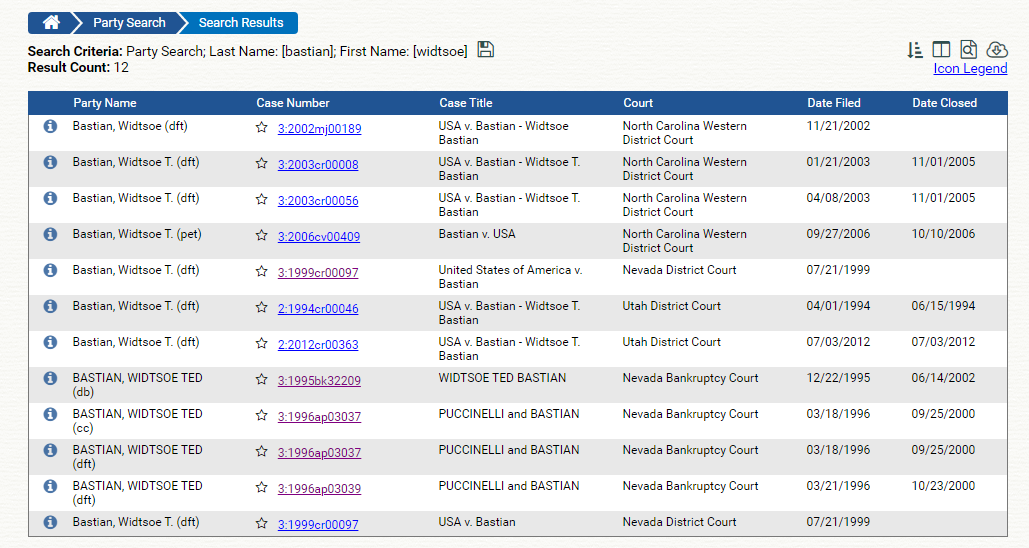
UPDATE 12/31/19: PACER was down yesterday, so I wasn't able to do a case search. I did so this morning, and here's what's there for Widtsoe T. Bastian:


Some of the listings are redundant, and several cite court documents without any links to those documents. But there's enough available to paint a tangled picture of a 1995 Chapter 11 bankruptcy in Nevada involving several companies in addition to the three mentioned above (the case was finally closed in 2002); a 1999 indictment in Nevada "on charges related to the operation of [Bastian's] venture capital firm"; failure to appear in a Nevada court in 2001; and a 2002 arrest in North Carolina, leading to the plea of guilty on 13 felony counts referenced above.

In 2012, Bastian was placed on probation or supervised release, and jurisdiction over his case was transferred to US District Court for Utah. His probation ended on May 4, 2015.

UPDATE 2/21/19: I'm featuring this comment from yesterday, as it's more indication of a pattern (the commenter has shared documentation with me that confirms what they say below):
In 2013-15, I hired Mr. Bastian as a ghost writer and later co-author of a novel we wrote together called Henry and Tom, sold through Amazon/Kindle Direct Publishing (KDP).

In mid 2015, Mr. Bastian embezzled money from a joint bank account we opened to pay for marketing campaigns for Henry and Tom. Rather than pursue embezzlement charges, I hired an expensive lawyer in Washington DC to transfer all rights for Henry and Tom to me in exchange for a $4K payment to Wid and a non-disparagement clause for both of us. This seemed at the time like the most expedient and cost effective way to deal with all the problems Mr. Bastian had caused.

I thought this matter was concluded until recently when Amazon/KDP informed me that a debt collection firm had placed a lien on Henry and Tom due to a bankruptcy filed by Wid Bastian/Genius Media Inc. KDP is currently sending my royalties to the collector per the lien. I have filed formal complaints with Attorneys General in Connecticut, New Jersey, and New York in an attempt to have the lien removed in states where the debt collectors are registered. I have also filed formal complaints against Wid and Genius Media Inc. with the Attorney General of Utah and the County Attorneys Office in Providence, Utah.

I think blogs like this are creating awareness of the depth and extent of Wid’s continuing criminal activities so we can all work together to stop him from doing this to others and get him to face justice.
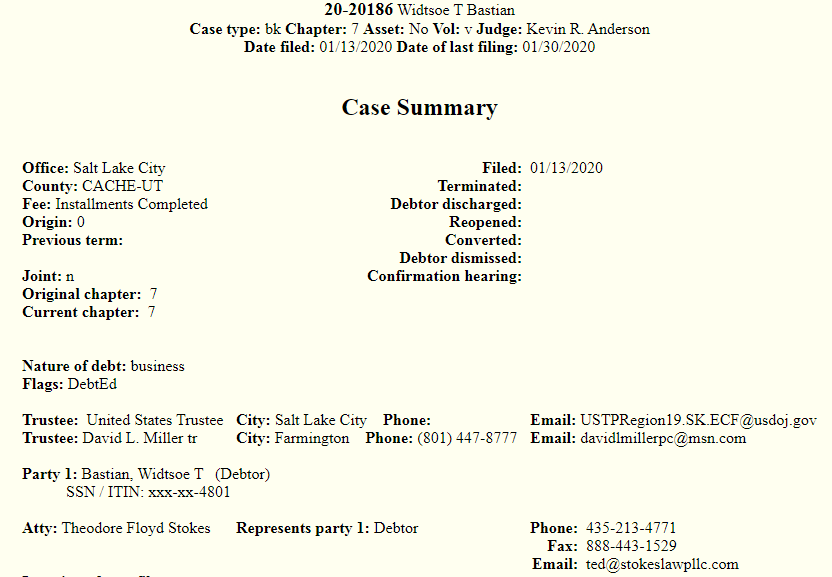
You'll note a reference to a bankruptcy. Wid Bastian filed a Chapter 7 bankruptcy petition on January 13, 2020.


A number of victims of his box set schemes are listed as unsecured creditors; if you're one of them, you should have received a snail mail notice, but if you haven't, and are wondering if you're included, here's the Certificate of Notice, with all Bastian's claimed creditors.

The bankruptcy filings also confirm what everybody already knew: Kairos Phoenix was Wid Bastian. The reason he set up this company probably won't surprise you, either.


ed

What You Need to Know About How California's New Law AB-5 Affects Writers


Posted by Victoria Strauss for Writer Beware®

Scroll down for updates

Last year, California passed a new law, AB-5, intended to make things better for gig economy workers, such as Uber and Lyft drivers, by forcing these companies to provide employee protections and benefits for their freelance workers.

However, the narrowly-written law, which went into effect on January 2, has created unintended consequences for freelance writers, most of whom are independent by preference. If they sell 35 or more pieces to the same company in a year (which can easily happen with short blog posts or  product reviews), the company must treat them as employees rather than freelancers and pay payroll taxes as well as unemployment and other insurances. Even before the law went into effect, companies were laying off California freelancers and seeking replacements in other states.

Book writers may be affected too, under certain specific circumstances.

The article below was originally published by the Authors Guild; I'm re-printing it with permission. This is an issue all writers need to be aware of, as similar laws are under consideration in other states, including New York and New Jersey.

******

We have been receiving inquiries about California’s new law AB-5 and similar pending legislation in other states that require companies hiring individuals on a freelance basis for labor or services to treat them as employees, unless the individual’s work falls within one of several exceptions. Laws like AB-5 (which goes into effect on January 2) are meant to aid gig economy workers, such as Uber and Lyft drivers, who work for a single company and have no employee protections. They are well-intentioned pieces of legislation, but unless they are narrowly written, they can go beyond protecting gig workers and disadvantage many traditional freelancers who wish to remain independent by overriding existing state agency law.

To be clear, the Authors Guild fully supports employment protections for freelance journalists and authors, and will be lobbying for collective bargaining rights in 2020. Like Uber drivers, writers have no benefits and are often paid less than minimum wage. But forcing writers to work as employees, especially on a state-by-state basis, is not the way to go about it. The situation in California speaks to the importance of deliberation, careful drafting, and getting buy-ins from the various industry groups. Similar “gig worker” bills are in the works in New York and New Jersey. The new draft NJ bill includes a strict, sweeping version of the ABC test. Those working closely on the bill are concerned that freelance journalists will in many cases be treated as employees. We will watch the bill and do our best to ensure that the necessary protections for freelance journalists are added.

* The NY bill attempts to exclude freelance journalists, and we have provided comments to the drafters to make it clearer.* (correction 12.30.19)

AB-5’s 35-Submission Cap

As many of you are aware by now, much of the debate surrounding AB-5 comes down to its 35-submission cap applying to the contributions of freelance journalists, editors, and photographers. When the bill was being negotiated, a coalition of writer and photographer groups, including the Authors Guild, was able to get an exception for freelance writers. Unfortunately, Assemblywoman Lorena Gonzalez, who sponsored the bill, added a cap of 35 pieces per company—meaning that once a freelance journalist or editor submits 36 articles or jobs for the same company in one year, the freelancer must be treated as an employee and the employer must pay California State unemployment and employee insurances.

Many full-time writers today patch together a living from different sources—and they want to keep it that way. Because of AB-5, California freelance journalists writing 35 or more pieces for a single company fear losing clients to writers in states with laxer laws. Indeed, some publications have already stated that they will not hire California freelance writers because of the new law. 35 articles might seem like a lot, but there are plenty of writers who write more than that. Writing a short weekly blog piece for a client could easily put a writer over this limit.

Another problem with treating writers as employees and not freelancers is that employee-writers do not own the copyright in their work; instead, the employer is considered the “author” under copyright law and automatically owns the copyright in its creation. Of course, as most major publications today insist on an assignment of copyright anyway, the practical effect, unfortunately, is the same: the writer gives up copyright. Still, freelance writers who assign copyright can reclaim it after 35–40 years, which is a benefit that employee-writers lack.

Does AB-5 Apply to Book Contracts?

Authors have raised alarm that AB-5 will apply to book writers as well. The Authors Guild has been reviewing the bill from that perspective since it was first introduced. We were assured by those working on the bill that trade book authors are not covered, and we do not see a basis for disagreeing since the bill clearly states that AB-5 applies only to “persons providing labor or services” and authors provide neither “labor” nor “services” under standard book contracts—they instead grant copyright licenses or assignments. Additionally, royalties—even in the form of advance payments—are not considered wages. It is difficult to imagine how a court would conclude that a typical book contract is for labor or services.

Writers with Service-Like Obligations Should Get a Legal Opinion

There are, however, some book-writing agreements that could be considered service agreements and arguably would fall under AB-5, such as work-made-for-hire agreements and contracts where the author has ongoing obligations and the publisher has greater editing ability or control over the content. Authors and writers working under multi-book contracts are most likely to encounter such a situation. These authors’ contracts should be reviewed by an attorney to determine whether they are subject to AB-5. Publishers and authors who want to be certain to retain a freelancer relationship should be careful to make sure the contracts are written as simple license grants and not as services agreements. For instance, the agreement should be written as a copyright grant of a defined work without interim or ongoing obligations, and remuneration should be in the form of royalties and advances against royalties. The writer should also have full control over their work and use their own workspace and tools. As a general rule, it is also recommended that freelance editors and journalists have written contracts that allow them to work when and where they want with no oversight other than approval of the finished work product.

If you have such a contract and are an Authors Guild member, remember that we do review members’ contracts for free. You can send us the agreement using our online form, and our legal team will get you comments and let you know if you need to revise the agreement.

UPDATE 1/16/20: Washington (State, not DC) is contemplating a bill like this as well. From the comments, below:
WA should be on your watchlist, too. An AB5-like bill was just re-introduced in the Senate there, even though it had been defeated last year. It, too, requires writers and other freelancers and independent contractors be hired as employees when their works contribute to the normal business of their clients. The bill ignores a study of independent contractors that was prepared by the Dept of Commerce after the bill's defeat. The study documents that 3/4 of the independent contractors in WA don't need or want the employee benefits touted by the bill's advocates. Between their own efforts and those of their families and friends, they're doing fine. Read the study yourself then write to Sen. Karen Keiser about your opposition to being made employees against your will.

The study: https://app.leg.wa.gov/committeeschedules/Home/Documents/26113?//20902
Senator Keiser: karen.keiser@leg.wa.gov
A similar law may be in the works in Illinois.

UPDATE 1/20/20: This article from Digiday explores the negative impact that AB-5 is already having on freelancers and publishers in California.


ed

Space Kadet: The Twisted Tale of a Sad, Sad Internet Troll


Posted by Victoria Strauss for Writer Beware®

Scroll down for updates

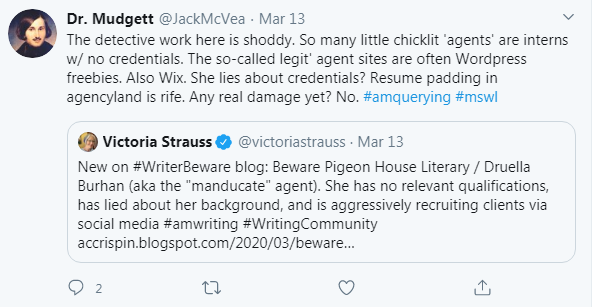
A couple of weeks ago, my Twitter warning about an amateur literary agent received a fairly curmudgeonly response.


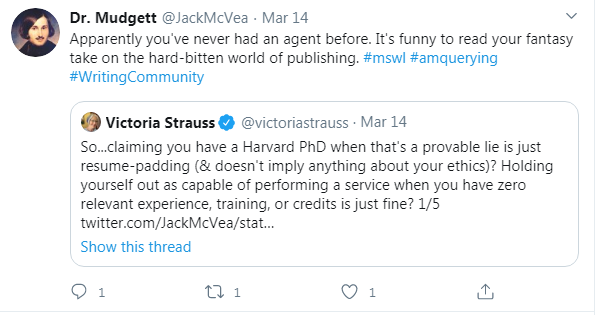
Mistaking it for a serious (if misguided) comment, I responded with a thread about why it's, well, bad for an agent to lie about their credentials. Which prompted this:

Ooookayyyy then.

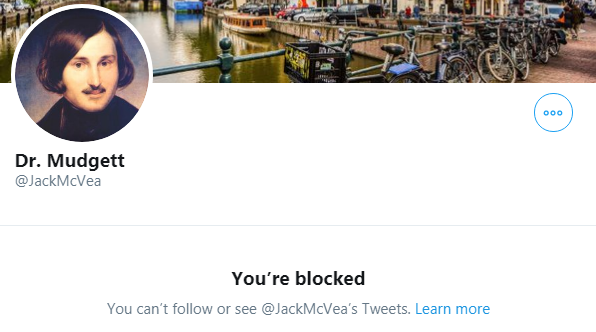
After a couple more exchanges in a similar vein, plus a not-so-subtle threat (I do give this person credit for knowing the difference between slander and libel), "Dr. Mudgett" flounced.


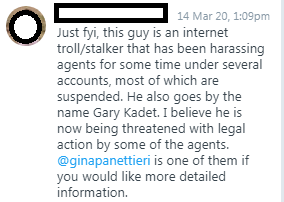
Soon after, several alert individuals messaged me to let me know that "Dr. Mudgett" isn't just a rando with an inflated sense of self-worth and a profile named after an infamous American serial killer, but one of the sockpuppets of an astonishingly prolific Twitter troll possessed of awesome vitriol and seemingly unlimited free time to indulge it.


The troll's full name is Gary S. Kadet--and though I'd never heard of him before he decided to call me out, he is well known in the Twitter writing community as someone who, via large numbers of fake accounts (most of which have been suspended by Twitter), hijacks popular hashtags like #amquerying, #mswl, and #WritingCommunity to launch vicious unprovoked attacks against writing and publishing people of all kinds, especially new writers and literary agents. So copious is his output--we're talking daily, even hourly tweets--that sometimes he runs out of new insults and has to recycle them. (Sample, if you can stomach it, the stream-of-invective narrative of his Dr. Mudgett Twitter feed.)

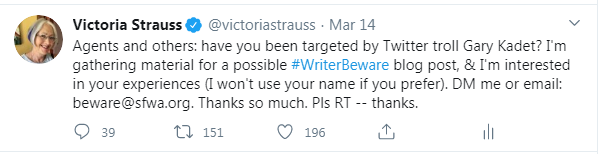
I'm always interested in the bizarro side of writing and publishing, and Mr. Kadet certainly seemed to fit the bill. So I put out a call for contact.


I got a perfect flood of responses. I heard from agents and agency interns whom Mr. Kadet had targeted for insults, mockery, and general harassment--especially if they were women, and in some cases after they rejected one of his manuscripts (Mr. Kadet is a [currently] frustrated novelist). I heard from writers he'd savaged for nothing more than posting positive comments about something, or announcing a book sale, or just for talking about writing. Much of his trolling seems to be of the drive-by variety, but I also heard from writers for whom he has conceived a deeper grudge--some of whom he has been stalking and attacking for years, and not just with nasty tweets, either. Some of these individuals told me that he has doxxed them, and made public things about their personal lives they would have preferred not to share. One of his targets was forced to seek help from the police.

Several people have written about their encounters with him (prompting him, in at least one case, to send a laughably bogus cease-and-desist). More personal accounts of Kadet encounters are here. Also here. In fact, he's so famous--at least, as a troll--that he has inspired a parody Twitter account. I guess that's some form of validation, right?

Sockpuppet accounts Mr. Kadet has used in the past (all deleted or suspended): @JohnnyRacetrack, @JimboRockfordPI, @JacktheTrippe11, @JacktheTrippe12, @GaryKDarkLord, @GaryKadet, @RealGarySKadet, @CastleMurder,  @MudgettMania, @MudgettRedux, @FrugSigmund, @Joe_Nesmith. @JoeChristmas6, @ImmortalGSK.

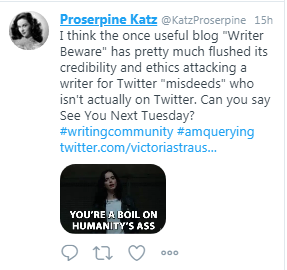
Socks he's using currently (that I know of): @JackMcVea, @KatzProserpine.

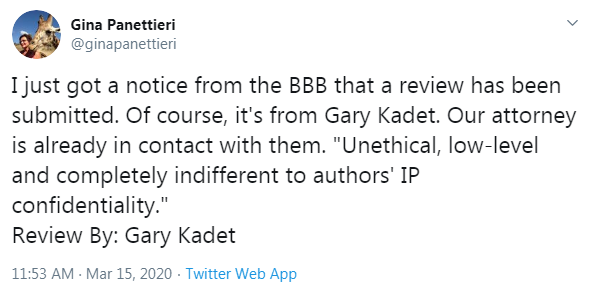
Mr. Kadet loathes a lot of people, but for one agent in particular, his hatred burns with a white-hot flame: Gina Paniettieri of Talcott Notch Literary Services. In 2018, Talcott Notch rejected one of Mr. Kadet's manuscripts, to which Mr. Kadet took extreme offense, and he has been targeting the agency and its agents ever since. In addition to a veritable tsunami of noxious tweets, promises to sue, accusations of violating his "IP confidentiality" (apparently because Gina revealed the rejected ms.), and bogus bad reviews wherever he can place them (not always successfully, since they are so demented that they get flagged), Gina tells me that he has called her home to harass her, and that he's currently demanding that she "settle" with him--i.e., pay him off--so that he'll stop.


Here's an interview with Talcott Notch agent Tia Mele about toxic writers in general and Mr. Kadet in particular.

So who is Gary S. Kadet IRL? There's not a great deal to be found on a websearch, but he did publish a novel in 2000 with Forge, and was apparently an editor with the Boston Book Review. He has lived in Cambridge, MA and Providence, R.I. Twitter isn't the only place where he has been accused of stalking.

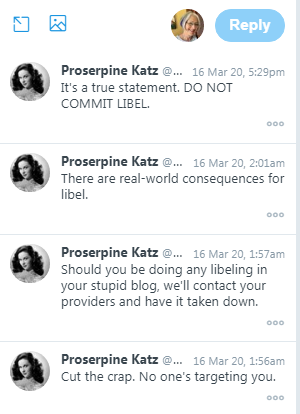
Soon after my call for contact, Mr. Kadet's @KatzProserpine sock account DM'd me this:


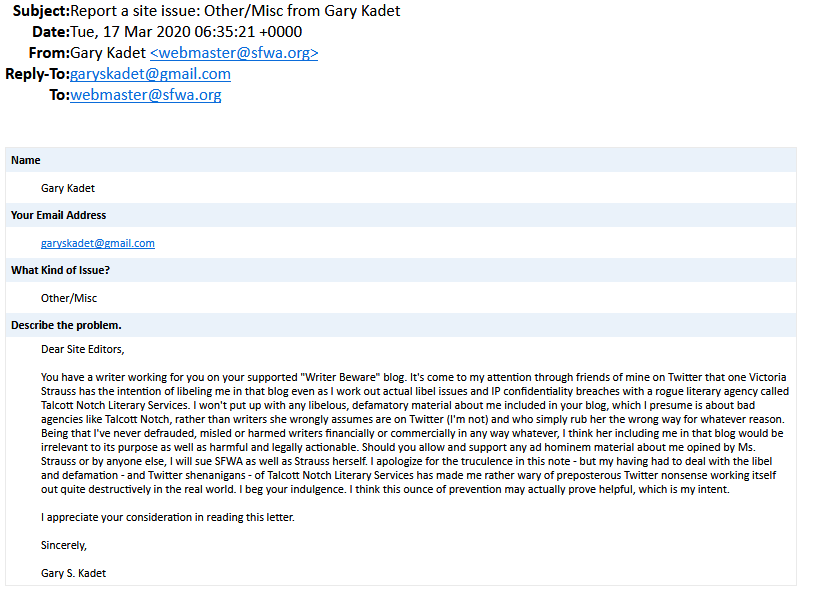
Ooooh, scary! Not to be outdone by his alter ego, Mr. Kadet reached out to SFWA under his own name. Of course, he couldn't resist mentioning Talcott Notch. Also note the date: more than a week before I put this post online.


Mystery Writers of America, one of Writer Beware's supporters, received an identical "complaint" on the same date. Fortunately, both SFWA and MWA know how to handle trolls.

So what's the bottom line here--other than the bigger issue of the toxicity that flourishes on social media and the inevitability of encountering it if you're active online? I guess it's really just the familiar advice: "Don't feed trolls". Starve the energy monster. The thing with trolls is that, for the most part, it's really not personal. They don't care about you; it's your reaction they need. They thrive on your distress, and draw strength from your response. Depriving them of these things may not shut them up--they can't really control themselves--but it is probably the single most frustrating thing you can do to them.

So if you find yourself targeted by Mr. Kadet--or, indeed, if any random tweet of yours receives a nasty or belittling response from an account you've never heard of--the best possible comeback is simply to block the account and move on.

UPDATE: I learned this evening that Mr. Kadet today sent his "bad writer Strauss" message to Horror Writers Association, another of Writer Beware's supporters--and for good measure, sent it to MWA a second time. He has also weighed in in the comments here.

UPDATE 4/10/20: Sockpuppet account @KatzProserpine has reached out again on Twitter, alleging, as it often does, that Mr. Kadet has no Twitter presence...


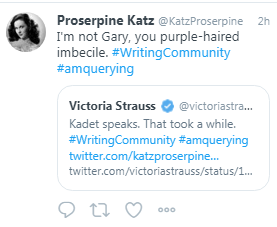
...and claiming that it is not Mr. Kadet's sockpuppet account...

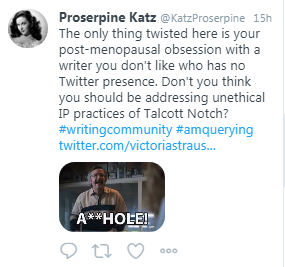
...while exhibiting Mr. Kadet's twin obsessions (Talcott Notch, nefarious "IP practices"--see Mr. Kadet's complaint about me, above).


ed

Copyright Violation Redux: The Internet Archive's National Emergency Library


Posted by Victoria Strauss for Writer Beware®

The enormous digital archive that is the Internet Archive encompasses many different initiatives and projects. One of these is the Open Library Project, a huge repository of scanned print books available for borrowing in various digital formats.

Unlike a regular library, the IA does not purchase these books, but relies on donations to build the collection. Nor are permissions sought from copyright holders before creating the new digital editions. And although the IA claims that the project includes primarily 20th century books that are no longer widely available either physically or digitally, the collection in fact includes large numbers of 21st century books that are in-copyright and commercially available--and whose sales the Open Library's unpermissioned versions have the potential to harm.

Most professional writers' groups consider the Open Library to be not library lending, but massive copyright violation. Many have issued alerts and warnings (you can see SFWA's alert here), and many authors have contacted the IA with takedown requests (to which the IA was not always terrific at responding; you can see my account of my own frustrating experience here).

In the fall of 2018, a novel (and disputed) legal theory was created to justify the Open Library and similar initiatives, called Controlled Digital Lending (CDL). CDL's adherents present it as "a good faith interpretation of US copyright law for American libraries" seeking to conduct mass digitization projects, and invoke as support the "exhaustion" principle of the first sale doctrine (the idea that an authorized transfer of a copyrighted work "exhausts" a copyright holder's ability to subsequently control the use and distribution of  that copy; this is what allows used book sales, for example) and the fair use doctrine (a complex principle that permits the copying of a copyrighted work as long as the copying is limited and transformative). As long as the library restricts its lending in ways similar to restrictions on the lending of physical books (for instance, allowing only one user at a time to access each digital format), CDL holds that creating new digital editions of in-copyright books and lending them out is fair use, and copyright holders' permission isn't necessary.

Libraries in particular have embraced CDL. Publishers' and writers' groups...not so much, especially in light of a recent legal decision that rejected both the first sale doctrine and fair use as basis for re-selling digital content. Here's the Authors Guild:
CDL relies on an incorrect interpretation of copyright’s “fair use” doctrine to give legal cover to Open Library and potentially other CDL users’ outright piracy—scanning books without permission and lending those copies via the internet. By restricting access to one user at a time for each copy that the library owns, the proponents analogize scanning and creating digital copies to physically lending a legally purchased book. Although it sounds like an appealing argument, the CDL concept is based on a faulty legal argument that has already been rejected by the U.S. courts.

In Capitol Records v. ReDigi, the Second Circuit held that reselling a digital file without the copyright holder’s permission is not fair use because the resales competed with the legitimate copyright holder’s sales. It found that market harm was likely because the lower-priced resales were sold to the same customers who would have otherwise purchased new licenses. In this regard, the court emphasized a crucial distinction between resales of physical media and resales of digital content, noting that unlike physical copies, digital content does not deteriorate from use and thus directly substitutes new licensed digital copies.

The same rationale applies to the unauthorized resale or lending of ebooks. Allowing libraries to digitize and circulate copies made from physical books in their collection without authorization, when the same books are available or potentially available on the market, directly competes with the market for legitimate ebook licenses, ultimately usurping a valuable piece of the market from authors and copyright holders.
For a more detailed deconstruction of CDL's arguments, see this statement from the Association of American Publishers.

Flash forward to 2020, and the coronavirus pandemic crisis. Last week, the IA announced the debut of the National Emergency Library--really just the Open Library, but with some new provisions.
To address our unprecedented global and immediate need for access to reading and research materials, as of today, March 24, 2020, the Internet Archive will suspend waitlists for the 1.4 million (and growing) books in our lending library by creating a National Emergency Library to serve the nation’s displaced learners. This suspension will run through June 30, 2020, or the end of the US national emergency, whichever is later.

During the waitlist suspension, users will be able to borrow books from the National Emergency Library without joining a waitlist, ensuring that students will have access to assigned readings and library materials that the Internet Archive has digitized for the remainder of the US academic calendar, and that people who cannot physically access their local libraries because of closure or self-quarantine can continue to read and thrive during this time of crisis, keeping themselves and others safe.
What this boils down to, under all the high-flying verbiage: the IA is ditching the one-user-at-a-time restriction that is one of the key justifications for the theory of controlled digital lending, and allowing unlimited numbers of users to access any digitized book in its collection.

The Authors Guild again, on how this harms authors:
IA is using a global crisis to advance a copyright ideology that violates current federal law and hurts most authors. It has misrepresented the nature and legality of the project through a deceptive publicity campaign. Despite giving off the impression that it is expanding access to older and public domain books, a large proportion of the books on Open Library are in fact recent in-copyright books that publishers and authors rely on for critical revenue. Acting as a piracy site—of which there already are too many—the Internet Archive tramples on authors’ rights by giving away their books to the world.
Here's just one concrete example. Katherine Harbour's Nettle King is available for borrowing in the National Emergency Library as a scan, an EPUB, and a PDF (the IA's EPUB versions are OCR conversions full of errors). Published in 2016, it's also "in print" and available on Amazon and other online retailers as an ebook, in addition to other formats. The IA, which never bought a digital license to Ms. Harbour's book and scanned and uploaded it without permission, now is proposing to allow unlimited numbers of users to access it, potentially impacting her sales. How is this any different from a pirate site?

Announcement of the National Emergency Library has been greeted rapturously by the press and by libraries. Less regarded has been the flood of protest and criticism from authors and professional groups. In situations like these, authors and publishers tend to be dismissed as greedy money-grubbers who are putting profits ahead of the march of progress and the noble dream of universal access to content...despite the fact that authors' right to make money from their work--and, just as important, to control the use of it--springs directly from the US Constitution, and has been enshrined in law since 1790.

In response to the outcry over the National Emergency Library, the IA has issued a justification of it, citing the "tremendous and historic outage" of COVID-19-related library closures, with "books that tax-paying citizens have paid to access...sitting on shelves in closed libraries, inaccessible to them." This noble-sounding purpose conveniently ignores the fact that those libraries' (legally-acquired and paid-for) digital collections are still fully available.

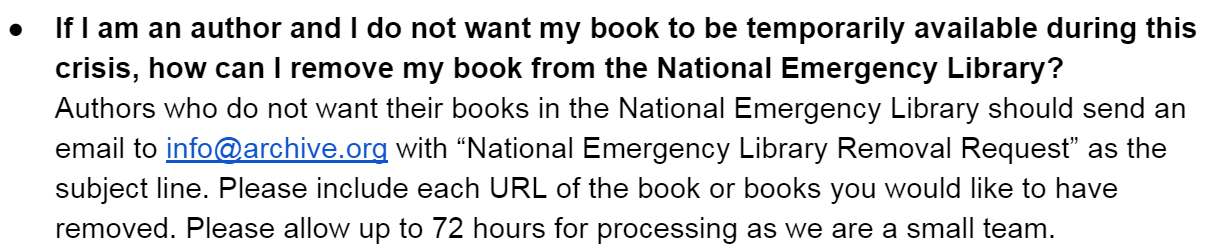
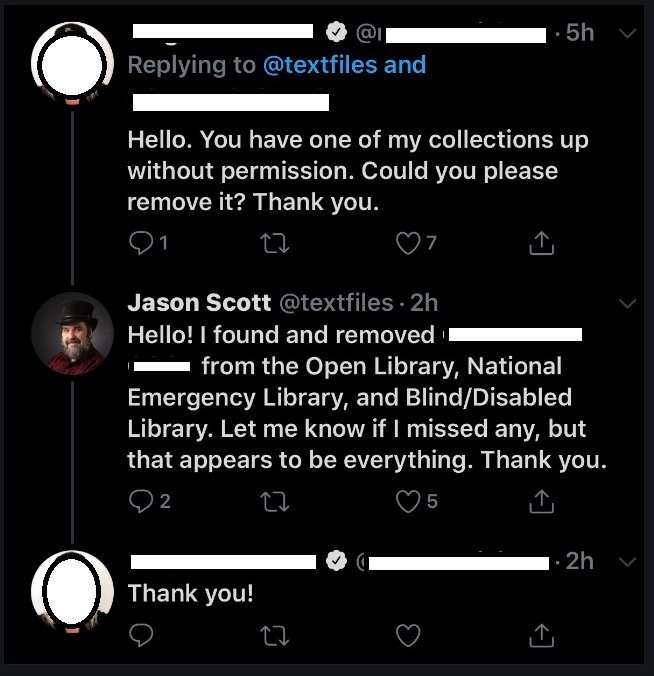
If your book is included in the National Emergency Library, and you don't want it there, the IA will graciously allow you to opt out (another inversion of copyright, which is an opt-in system).


Hopefully they'll be more responsive than they were in 2018, when I sent them DMCA notices that they ignored. Or later, when they began rejecting writers' takedown requests by claiming that the IA "operates consistently with the Controlled Digital Lending protocol.”

******************

I've covered this question above, but I want to highlight it again, because it's such a persistent objection when this kind of infringement occurs: Brick-and-mortar libraries lend out books for free, so how are the IA's "library" projects any different?

A few reasons.

- Brick-and-mortar libraries buy the books they lend, a separate purchase for each format (hardcover, paperback, ebook, audiobook, etc.). The author gets a royalty on these purchases. The IA seeks donations, and lends those. Authors get nothing.

- Brick-and-mortar libraries lend only the books they purchase. They don't use those books to create new or additional, un-permissioned lending formats. That's exactly what the IA does. Moreover, one of its additional lending formats is riddled with OCR errors that make them a chore to read. Apart from permission issues, this is not how authors want their books to be represented to the public.

- People who advocate for looser copyright laws often paint copyright defenders as greedy or mercenary, as if defending copyright were only about money. It's worth remembering another important principle of copyright: control. Copyright gives authors not just the right to profit from their intellectual property, but to control its use. That, as much as or even more than money, is the principle the IA is violating with its library projects.

UPDATE: It appears that the IA--on its own initiative--is removing not just illegally-created digital editions in response to authors' takedown requests, but legally-created DAISY editions as well, even where authors don't ask for this (DAISY is a format for the visually impaired, and like Braille, is an exception in copyright law and is also permissioned in publishing contracts).


It did the same thing in 2018, even where the takedown requests specifically exempted DAISY editions. I don't know if the current removals reflect expediency or possibly are just a kind of FU to writers (and, indirectly, to disabled readers), but if you send a removal request to the IA, you might consider specifically asking them not to remove any editions for the blind and disabled (which, again, are legal for the IA to distribute).

UPDATE 4/2/20: The Authors Guild has issued a statement encouraging writers to demand that the Internet Archive remove their books from its National Emergency Library. The statement includes instructions on what to do, along with a sample DMCA notice in the proper legal form.

UPDATE 4/8/20: SFWA has issued a statement on the National Emergency Library, describing the legal theory of Controlled Digital Lending as "unproven and dubious". (A link to SFWA's DMCA notice generator is included.)
[U]sing the Coronavirus pandemic as an excuse, the Archive has created the “National Emergency Library” and removed virtually all controls from the digital copies so that they can be viewed and downloaded by an infinite number of readers. The uncontrolled distribution of copyrighted material is an additional blow to authors who are already facing long-term disruption of their income because of the pandemic. Uncontrolled Digital Lending lacks any legal argument or justification.
UPDATE 4/9/20: The Chairman of the US Senate Subcommittee on Intellectual Property, Thom Tillis, has sent a letter to the Internet Archive, pointing out the many voluntary initiatives by authors, publishers, and libraries to expand access to copyrighted materials, and expressing concern that this be done within the law. 
I am not aware of any measure under copyright law that permits a user of copyrighted works to unilaterally create an emergency copyright act. Indeed, I am deeply concerned that your "Library" is operating outside the boundaries of the copyright law that Congress has enacted and alone has the jurisdiction to amend.
The letter ends by punting "discussion" until "some point when the global pandemic is behind us." So, basically, carry on and maybe at some point we'll talk.

UPDATE 4/15/20: Internet Archive founder Brewster Kahle has responded to Sen. Tillis's letter, claiming that the National Library is needed because "the entire physical library system is offline and unavailable" (even though libaries' legally acquired digital collections are still fully available) and that "the fair use doctrine, codified in the Copyright Act, provides flexibility to libraries and others to adjust to changing circumstances" (there's no such language in the actual Fair Use statute).

Kahle also notes:
In an early analysis of the use we are seeing what we expected: 90% of the books borrowed were published more than ten years ago, two-thirds were published during the twentieth century. The number of books being checked out and read is comparable to that of a town of about 30,000 people. Further, about 90% of people borrowing the book only looked at it for 30 minutes. These usage patterns suggest that perhaps that patrons may be using the checked-out book for fact checking or research, but we suspect a large number of people are browsing the book in a way similar to browsing library shelves.
But this is hardly a compelling argument. Large numbers of these books are certainly still in copyright, and many are likely still "in print" and commercially available (in digital form as well as hardcopy). Just because a book was published more than ten years ago or prior to 2000 doesn't magically cause it to become so hard to find it must be digitized without permission in order to save it. "But they're older books" sidesteps, rather than addresses, the thorny copyright issues raised by the IA's unpermissioned scanning and digitizing.

This passage also tacitly confirms the IA's abandonment of the one-user-at-a-time restriction that is a key feature of the rationale for the Controlled Digital Lending theory. If the basis for your enterprise is a legal theory whose strictures can be jettisoned at will, how credible is that theory really?

Kahle also claims that "No books published in the last five years are in the National Emergency Library". As it happens, the example I provide above (Katherine Harbour's Nettle King) handily disproves this statement: it was published in 2016, and was digitized by the IA in 2018 (you can see the scan here). I seriously doubt it's the only instance. Either Kahle is being disingenuous, or he doesn't know his own collection.

As a sop to creators, Kahle reiterates that concerned authors "need only to send us an email" and their books will be removed. As I've pointed out above, this is yet another inversion of copyright law, which explicitly gives creators control over the use of their work. In other words, it's the IA, not authors, who should be the petitioners here.

UPDATE 4/16/20: This terrific, comprehensive article from the NWU's Edward Hasbrouck examines the multiple ways the Internet Archive is distributing the page images from its unpermissioned scanning of print books--"[o]nly one of [which] fits the Internet Archive’s and its supporters’ description of so-called Controlled Digital Lending (CDL)."


ed

All The Wilted Women

Hayley Williams “Roses/Lotus/Violet/Iris” The first time I heard this song I had no idea who it was by, and was legitimately shocked to discover it was the singer of Paramore, a band I’ve never had any affection for in either their emo phase or their pivot to boppy pop a few years ago. Whereas the […]


ed

Stupidly Good-Hearted

Twice “Sweet Talker” When I write about songs sung in languages I cannot understand I generally try to find an English translation. This is helpful in getting the idea of the song, but it can do a weird thing in my brain where my understanding of the song is at a remove from my experience […]


ed

Oppressed By These Energies

Car Seat Headrest “Hollywood” “Hollywood” is blunt and bratty in a way Car Seat Headrest haven’t been before, it’s like Sum 41/Blink-182 energy filtered through Will Toledo’s usual dry deadpan tone and indie rock aesthetics. The song is a duet with drummer Andrew Katz, who delivers his parts with a borderline obnoxious punk shout that […]


ed

Spitting Blood Over Red Lipstick Stains

Alexandra Savior “Bad Disease” Alexandra Savior belongs to a long tradition of torch singers, but the sound and lyrical concerns of “Bad Disease” place her in the overlap of a Venn diagram of Portishead and Lana Del Rey. I know it can read like a backhanded compliment to say an artist sounds like two others, […]


ed

I Tried Listening To The Blues

Kate Bollinger “A Couple Things” The music of “A Couple Things” is so loose, smooth, and assured that it’s a little surprising the lyrics are so anxious and obsessed with making mistakes. Kate Bollinger’s voice conveys some vulnerability, but even that seems measured, like she’s answering the concerns of her past self with a display […]