v
pharmaceutical discovery
Today on Married To The Sea: pharmaceutical discovery
The Worst Things For Sale is Drew's blog. It updates every day. Subscribe to the Worst Things For Sale RSS!

musicisart magazine SAN HOLO – THE FUTURE (FEAT. JAMES VINCENT MCMORROW)
Producer San Holo, AKA Sander van Dijck, creates ballad like electronic music that brings a listener on a journey full of emotion. San Holo is most known for his hit single ‘Light‘, which reached over 151 thousand likes on Soundcloud. SAN HOLO – THE LIGHT || San Holo’s latest single ‘The Future‘ features the smooth Irish vocals of […]
The post SAN HOLO – THE FUTURE (FEAT. JAMES VINCENT MCMORROW) appeared first on musicisart magazine.
Viral marketing is different from conventional marketing in that it contains elements that are exceedingly attractive to the audience and compel those exposed to it ...
The post 10 Sure-fire Viral Marketing Tips That Will Get You Noticed appeared first on Saleschase Stories.
If your referral marketing program is not bringing in the desired results, then you’re probably not doing it right. A well-oiled referral marketing program can ...
The post 13 Reliable Tips to Take Your Referral Marketing Program to the Next Level appeared first on Saleschase Stories.
Today, most B2B clients are aware of environmental issues, and some of them actively look for environmentally friendly products and services. This trend is going ...
The post Top 6 Environmental B2B Marketing Ideas for Small Businesses appeared first on Saleschase Stories.
Business newsletters need not be yawn-inducing; they can be interesting and informative at the same time. Here are a few ideas on producing newsletters that ...
The post How to Create Captivating Business Newsletters appeared first on Saleschase Stories.
Originally posted 2016. Revised. Longing this morning to trade back my boots for the soft soles I surrendered to get them. I can’t feel the ground when I walk in these. Doctors try to tell me it’s neuropathy from my diabetes. They’re half right, I suspect; certainly some shiny whiteness is to blame and whether […]
Touring the homes of all the dead who have ever lived Even the ones long gone burned buried torn down vanished Wandering halls Opening rooms Crossing borders to see all the places the dead have been Trying to learn what it means to remain present after the body has gone It is not something I have thought […]
No doubt — this is a crazy, scary, sad, worrying time for everyone. Most of us are sheltering in place and trying our best to adjust to a new reality. While we are not performing heroic deeds like all the frontline healthcare workers and first responders, grocery store employees and delivery drivers, we can all … Continue reading nine cool things on a tuesday (stay home, save lives edition)
Did you know that tomorrow, April l8, is National Animal Crackers Day? ???? Oh, to return to a simpler, more innocent time, when it was all about glee rather than guilt! * ANIMAL CRACKER (no s) by Gretchen Friel My students are inspired to read more poems aloud if I bring frosted … Continue reading animal crackers: a sweet memory in every bite
Feeling a little peckish? What’s your pleasure? If you’re craving something savory, perhaps we should zip on over to Illinois for some deep dish pizza and pierogies. Something a little more substantial? Well, we could feast on chicken fried steak in Oklahoma and bison burgers in Wyoming, before topping everything off with a platter … Continue reading [tasty review] United Tastes of America by Gabrielle Langholtz, Jenny Bowers, and DL Acken
“We begin in infancy by establishing correspondence of eyes with eyes.” ~ Robert Frost FRAGMENTARY BLUE by Robert Frost Why make so much of fragmentary blue In here and there a bird, or butterfly, Or flower, or wearing-stone, or open eye, When heaven presents in sheets the solid hue? Since earth is earth, … Continue reading baby’s got blue eyes (+ a giveaway)
Each bird, bee, blossom, butterfly — was a source of joy and wonder for young Emily Dickinson. In this beautiful new picture book biography, aptly illustrated with a butterfly motif, we witness her singular metamorphosis from a keenly observant child into one of the most original and innovative poets in American literature. On Wings … Continue reading [review + recipe] On Wings of Words by Jennifer Berne and Becca Stadtlander
So pleased to welcome NYC author Erin Yun to the blog today. Her debut middle grade novel, Pippa Park Raises Her Game (Fabled Films Press, 2020), is a contemporary reimagining of the Dickens’s classic Great Expectations. Life is full of great expectations for Korean American Pippa Park. It seems like everyone, from her … Continue reading [spicy guest post] Pippa Park’s Favorite Korean Stew by Erin Yun
In today's The Times, you can read in an article by David Pace O’Shea, that, in general, Maltese are a helpful people, generous, hardworking, humble, careful with their money, welcoming, peaceful and unaggressive and that they love their families and, especially, their children. In the Observer’s opinion, anyone who states that he or she has all those qualities also might add the words conceited and boastful. The word humble is not the first that comes to one’s mind when reading all the other characteristics Mr. O’Shea states that Maltese in general possess. Thank God (just an expression!) that most Maltese do not consider themselves to have all those qualities (and I do not know of any other country’s citizens that would claim all these good characteristics). Since the article is written by a convinced catholic believer it might be interesting to hear his humble view, from a moral and Christian standpoint, on prostitution in Malta. Every time one passes the area around the closed Empire Stadium one can see prostitutes hanging out from windows or standing on the street offering men their services. In Malta it is allowed to buy and sell sexual services; such services are forbidden in many other EU states. One can ask how this complies with the Maltese character as described in today’s Times. The Maltese government and the Church might not officially be in favor of prostitution but they certainly do not try hard to solve the problem. Prostitution is closely connected with criminality such as trafficking and drug related crimes. There is no reason whatsoever to let young women be treated like slaves in any country and especially not in a country like Malta, which is said to be one of the most Christian in the world. It is a shame for Malta!
When reading The Times one does not know if one should laugh or cry. Malta government seems more and more like a Donald Duck government, a joke, with government officials, sadly including members of the Judicial, being so dishonest that it is difficult to comprehend. The government officials seem so eager to be just bigwigs that they have forgotten who they are put to serve.The judicial system seems to be in a mess.
The Observer just wants to give a few examples from todays The Times.
Once more a new bribery probe is ongoing against Transport Malta officials.
This governmental body seems to be one of the most dishonest not only in Malta but in the whole EU. This time the bribery inquiry concerns three officials so far, but in 2010 another three officials and 230 other people were charged in connection with hundreds of driving licenses granted to people who had not even sat for a test. This proves that The Observer was absolutely right in the article “Traffic in Malta, a risky business” of Feb 14, although some of the licenses have been seized by the police. However, one thing was not correct; the driving licenses are not issued by Disney World or come with the cereal packages from Scotts, but are issued by Transport Malta against a monetary compensation. This way of giving out driving licenses must surely be promoting road safety in Malta.
Malta has a very old fashioned system for ensuring that people can show that they are entitled to vote in the coming council election. Policemen deliver the documents to every single voter in person. This means that the policemen knock doors for several weeks; no wonder that there are more policemen in Malta in relation to the size of the population than in most EU countries. In Sliema the police have failed to deliver documents to 58 % of the voters.
Since Sliema is said to be a PN stronghold one can wonder if this is one more situation in which bribes are occurring. A policeman who delivers documents in Sliema and is a convinced PL supporter can easily neglect to deliver in areas with strong support for PN. The Observer does not state that this is the case but has a time saving suggestion that also will exclude the possibility of bribes; Malta should modernize its system and this is very easily done. Malta has computerized lists of the population which easily can be sorted (if not this has been done already) by place of residence in voting lists. People then just have to show their ID cards when coming to the polls and be ticked off. The present system is just ridiculous.
The Observer just want to stress what is said in the article of Feb 15, “Reflections on the judicial system in Malta” by referring to the following articles in The Times of today. Here.
And do not forget to look into this one!
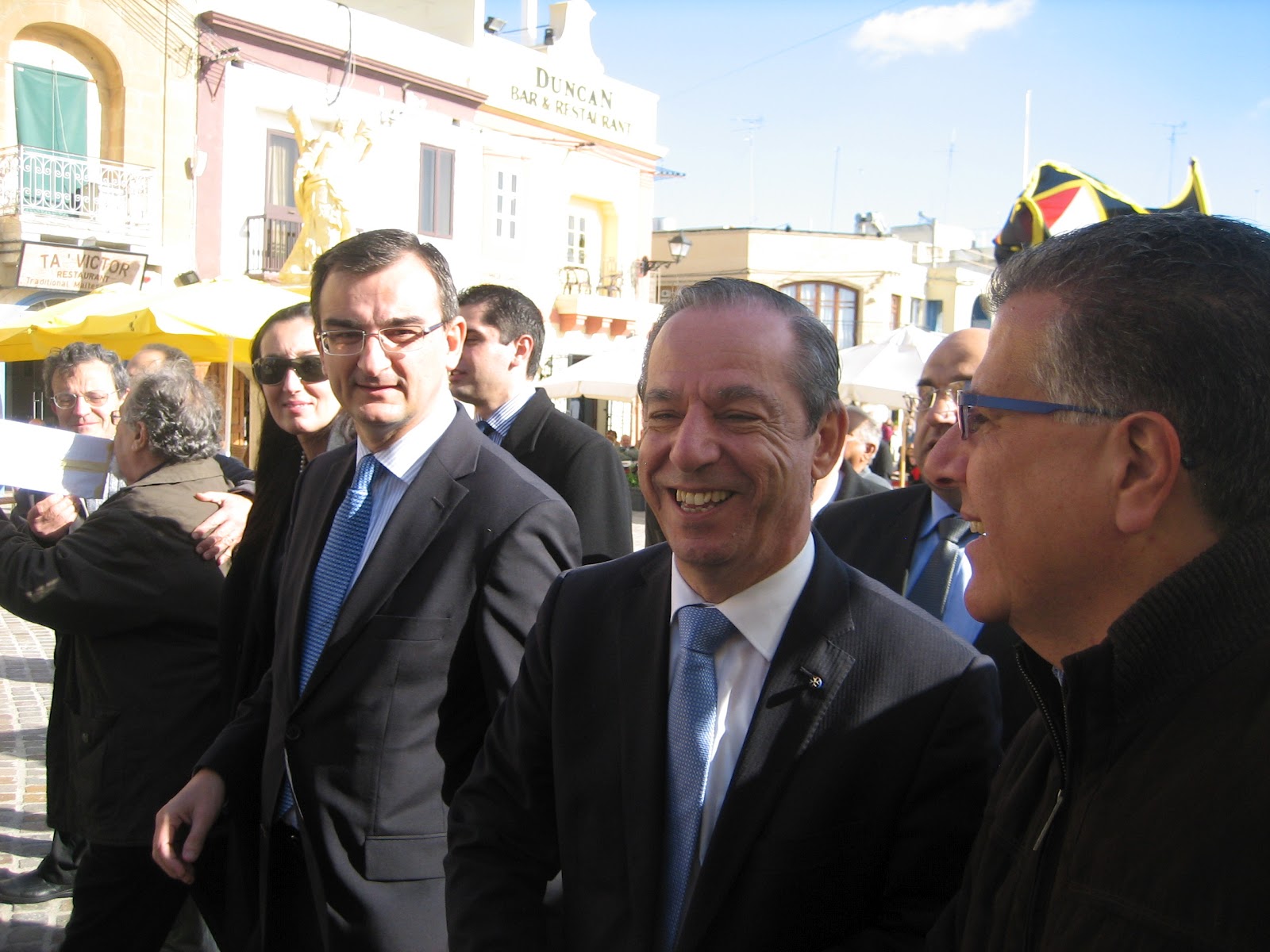
| PM in Marsascala during his tour for support |
| Memorial plaque |
| Memorial plaque |
| Archbishops BMW license plate |
| Gozo bishops Toyota license plate |
| President Abela's car and flag |
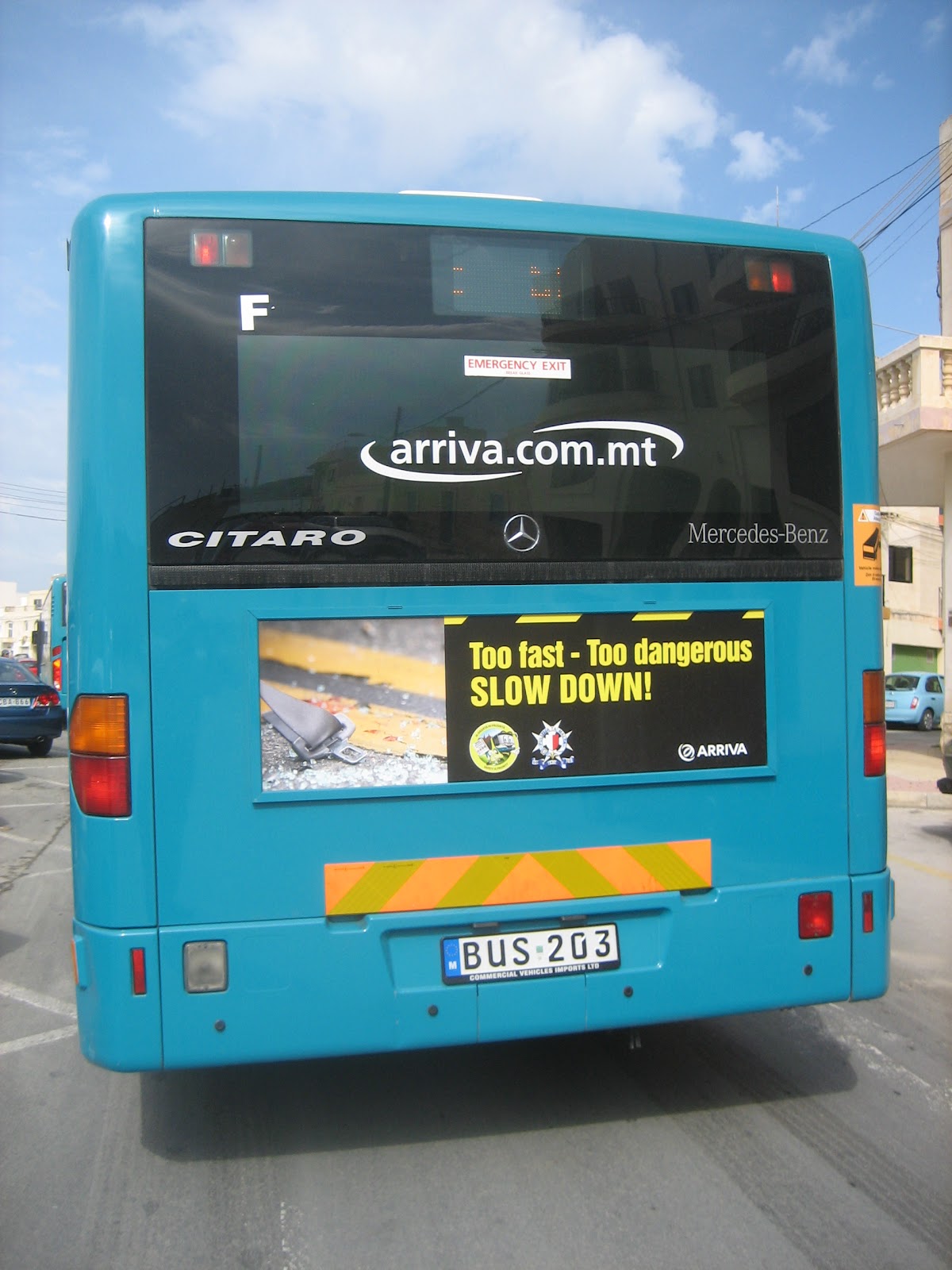
| Notice the text on the bus to Marsaxlokk |
| Prospective Formel-1 champion |
From Andrey Mokhov's twitter feed:
Is there any intermediate abstraction between applicative functors and monads? And if yes, what is it? In a new paper with @geo2A, @simonmar and @dimenix we explore "selective functors", which are essentially applicative functors with branching: https://www.staff.ncl.ac.uk/andrey.mokhov/selective-functors.pdf
We've implemented selective functors in Haskell: https://github.com/snowleopard/selective, OCaml: https://github.com/snowleopard/selective-ocaml, and even Coq: https://github.com/tuura/selective-theory-coq (the Coq repository contains some proofs of correctness that our selective instances are lawful). And there is also a PureScript fork!
Seven Sketches in Compositionality: An Invitation to Applied Category Theory
2018 by Brendan Fong and David I. Spivak
Category theory is becoming a central hub for all of pure mathematics. It is unmatched in its ability to organize and layer abstractions, to find commonalities between structures of all sorts, and to facilitate communication between different mathematical communities. But it has also been branching out into science, informatics, and industry. We believe that it has the potential to be a major cohesive force in the world, building rigorous bridges between disparate worlds, both theoretical and practical. The motto at MIT is mens et manus, Latin for mind and hand. We believe that category theory—and pure math in general—has stayed in the realm of mind for too long; it is ripe to be brought to hand.A very approachable but useful introduction to category theory. It avoids the Scylla and Charybdis of becoming incomprehensible after page 2 (as many academic texts do), and barely scratching the surface (as many popular texts do).
Histogram: You have to know the past to understand the present by Tomas Petricek, University of Kent
Programs are created through a variety of interactions. A programmer might write some code, run it interactively to check whether it works, use copy and paste, apply a refactoring or choose an item from an auto-complete list. Programming research often forgets about these and represents programs as the resulting text. Consequently, thinking about such interactions is often out of scope. This essay shifts focus from programs to a more interesting question of programming.
We represent programs as lists of interactions such as triggering an auto-complete and choosing an option, declaring a value, introducing a variable or evaluating a piece of code. We explore a number of consequences of this way of thinking about programs. First, if we create functions by writing concrete code using a sample input and applying a refactoring, we do not lose the sample input and can use it later for debugging. Second, if we treat executing code interactively as an interaction and store the results, we can later use this information to give more precise suggestions in auto-complete. Third, by moving away from a textual representation, we can display the same program as text, but also in a view inspired by spreadsheets. Fourth, we can let programmers create programs by directly interacting with live previews as those interactions can be recorded and as a part of program history.
We discuss the key ideas through examples in a simple programming environment for data exploration. Our focus in this essay is more on principles than on providing fine tuned user experience. We keep our environment more explicit, especially when this reveals what is happening behind the scenes. We aim to show that seeing programs as lists of interactions is a powerful change of perspective that can help us build better programming systems with novel features that make programming easier and more accessible. The data exploration environment in this interactive essay may not yet be that, but it gives a glimpse of the future.
There is no reason to think that Nobel prize-winning author Gabriel García Márquez "Love in the Time of Cholera" and my desperate attempt at writing a book "Last Five Minutes of Fame" should be uttered in the same breath for literary purposes. But then again, Donald Trump shouldn't be President of the United States, so fuck it...here goes.
To what lengths does one have to go in order to achieve fame? It wasn’t until years later that by simply sucking on someone’s cock (Monica Lewinsky and Kim Kardashian) that the distance one had to go to achieve fame was not that far at all. The only distance they had to go...was down.
STUDIO 54 – THE FIRST FIVE MINUTES
It was “the only” time, and for sure, the best years of my life. Though it’s still not clear when or how, but at some point, I began running with the Beautiful People (BPs).