es

News: Guest Strip - Jamie Cosley

Scott R. Kurtz: Today's hilarious guest comic was created by Jamie Cosley! I love his take on PvP. Look how expressive they are. I always learn something when other artists do their take on my characters. Jamie is currently creating comic strips for Star Wars Insider and Walt Disney World Magazine. You can also find him on Instagram at @jamiecosley


es

News: Guest Strip - Terry Blas

Scott R. Kurtz: Today's guest comic was written and illustrated by my good friend Terry Blas. Not only is Terry the inspiration for Max's boyfriend, he's also an accomplished writer and cartoonist. His books Hotel Dare and Dead Weight are available on Amazon and are sure you lift your spirits during the quarantine. And his Instagram account is full of his amazing art. I think we're going to work together on more Max and Terry strips, so stay tuned.


es

News: Guest Strip - Steve Conley

Scott R. Kurtz: Today's guest strip was created by none other than smilin' Steve Conley, and I adore his take on my characters. I've known Steve for years, and have wonderful memories of both SPX and the Baltimore Comicon hanging out after the show and talking shop. Steve was a pioneer in syndicating web-content and has always been a little bit ahead of the curve. I've always been impressed with his art, his writing, and his ability to discover new ways to distribute his comics. His current book, The Middle Age, continues this trend. It's hilarious, sweet and gorgeous. Steve is creating the entire book


es

A Walk Among The Tombstones.

Yesterday I went looking for a homeless person who probably wasn’t going to accept any help.  “Have you seen this person?” I asked two DPW workers doing landscaping in a nearby park.  “Try the supermarket,” one of them told me. “Might be there. Walks around town all day.”  “Thanks.”  I’d parked my car next to […]

The post A Walk Among The Tombstones. appeared first on Waiter Rant.


es

From the Philippines, Not With Love: A Plague of Publishing and Marketing Scams


Posted by Victoria Strauss for Writer Beware®

I've been expending a lot of words and time lately warning about the latest scam phenomenon to hit the writing world: fake publishing and marketing companies that, through outrageous prices and worthless services, extract enormous amounts of money from unwary writers.

Based in the Philippines (despite their apparent US addresses, phone numbers, and telemarketer names) and focusing primarily on small press and self-published authors (particularly authors who've published with one of the Author Solutions imprints), these companies recruit writers with relentless--and highly deceptive--phone and email solicitations. Some do provide the services authors pay for, albeit at seriously inflated prices and often of poor quality. Others just take the money and run. I'm hearing from a growing number of writers who've paid five figures in fees to one--or, in some cases, more than one--of these scams, with next to nothing to show for it.

Given how fast the scams are proliferating (I learn about a new one every few weeks), I thought it would be helpful to gather all the information I've put together about them in one place.

My posts about the scams--where they come from, how they work, and how to recognize them:

- Army of Clones: Author Solutions Spawns a Legion of Copycats
- Army of Clones Part 2: Twenty-One (More) Publishing and Marketing "Services" to Beware Of
- Solicitation Alert: LitFire Publishing
- Amelia Publishing and Amelia Book Company: Sons of LitFire Publishing
- Solicitation Alert: Book-Art Press Solutions and Window Press Club
- Solicitation (and Plagiarism) Alert: Legaia Books / Paperclips Magazine

Here's a list of the scams themselves--at least, the nearly 100 I've identified so far (the list is also posted in the sidebar of this blog). You'll note that a number of them operate under more than one name--I suspect the interconnection is much greater than this, but I've only indicated the additional names where I've been able to reliably document them.

Some have perished since I began the list--I've noted this, but left their names, for the sake of authors who may have been scammed while they were operational.

- Access Media Group (aka Quill Space Media)
- Ace Media Creative Publication / Ace Media International / APM Media Production (aka Pearson Media Groups)
- ADBooks Media (aka Coffee Press / Okir Publishing, which is defunct)
- Alpha Books Solutions
- Alpha Books United
- Amelia Publishing / Amelia Book Company (aka LitFire Publishing / GoToPublish)
- AnalytIQ
- Ascribed LLC (defunct)
- Author Aide
- Author Codex (aka BookSpine Press)
- Author Media Express
- Author Pro Creatives and Marketing (defunct) (still doing business as Matchstick Literary)
- Author Reputation Press
- Author University
- AuthorCentrix (formerly BookBlastPro)
- AuthorLair
- Author's Note 360
- Authors Press (aka Westwood Books Publishing [formerly Greenberry] / Creative Books)
- Beacon Books Agency
- Black Lacquer Press & Marketing
- BooConn Marketing
- Book Agency Plus (aka BookTrail Agency)
- Book Art Press Solutions (aka Window Press Club / Booktimes)
- Book Avenue Publishing (aka Nivra Press, which is defunct)
- Book Magnets
- Book Reads Publishing (defunct)
- BookSpine Press (aka Author Codex)
- Booktimes (aka Book Art Press Solutions / Window Press Club)
- BookTrail Agency (aka Book Agency Plus)
- Book Vine Press
- Books Scribe
- BookVenture Publishing
- BookWhip (aka Carter Press / PRM Solutions)
- Box Office Media Creatives (aka Buzz Media Creatives)
- Bright Lights Distribution
- Buzz Media Creatives (aka Box Office Media Creatives)
- Capstone Media Services (defunct) (now doing business as Stampa / Stampa Global)
- Carter Press (aka BookWhip / PRM Solutions)
- Chapters Media & Advertising (aka Techbooks Media)
- Coffee Press (aka ADBooks Media) (formerly Okir Publishing)
- Creative Books (aka Westwood Books Publishing / Authors Press)
- Creative Titles Media  (aka TrueMedia Creatives)
- Crest Media Distribution
- Diamond Media Press
- Dream Books Distribution
- EC Publishing
- Editor's Creative Media (aka Editor's Press and Media)
- Editor's Press and Media (aka Editor's Creative Media)
- Global Summit House
- Gold Touch Press
- Golden Ink Media Services
- Goldman Agency
- GoToPublish (aka LitFire Publishing / Amelia Publishing / Amelia Book Company)
- Happy Media Consulting
- Haynes Media Group
- IdeoPage Press Solutions (aka The Writer Central)
- Legaia Books
- Lettra Press
- LitFire Publishing (aka Amelia Publishing / Amelia Book Company / GoToPublish)
- Maple Leaf Publishing
- MatchStick Literary (aka Author Pro Creatives and Marketing --defunct)
- McNaughton Books / McNaughton Publishing (website is currently dead)
- Netsfilm & Media Press
- New Leaf Media
- New Reader Media
- Nivra Press (defunct) (still doing business as Book Avenue Publishing)
- Okir Publishing (defunct) (still doing business as ADbook Press / Coffee Press)
- Outstrip (defunct)
- PRM Solutions LLC (aka Carter Press / Bookwhip)
- Pacific Books
- PageClapp Media
- PageTurner, Press and Media
- Parchment Global Publishing
- Paradigm Print
- Paramount Books Media
- Pearson Media Groups (aka Ace Media Creative Publication / Ace Media International)
- Press To Impress Publishing
- Pubkits.com
- Quill Space Media (aka Access Media Group)
- Readers Magnet
- Royale House (defunct)
- Rushmore Press
- Sherlock Press (defunct)
- Silver Fox Media
- Stampa / Stampa Global (formerly Capstone Media Services)
- Stonewall Press (aka Uirtus Solutions) (both defunct)
- Stratton Press
- Techbooks Media (aka Chapters Media & Advertising)
- Toplink Publishing
- TrueMedia Creatives (aka Creative Titles Media)
- Uirtus Solutions (aka Stonewall Press) (both defunct)
- Universal Book Solutions
- URLink Print and Media
- Vivlio (a.k.a. Vivlio Hill, Vivlio Hill Publishing, Vivlio Solutions, Vivlio Marketing Solutions)
- WestPoint Print and Media
- Westwood Books Publishing (formerly Greenberry) (aka Authors Press / Creative Books)
- Window Press Club (aka Book Art Press Solutions / Booktimes)
- WorkBook Press
- The Writer Central (aka IdeoPage Press Solutions)
- YourOnlinePublicist
- Zeta Publishing

(I'm continuously updating this list--adding new companies as I discover them, noting the ones that disappear.)

I know my warnings are having an effect, not just because I'm hearing from writers who've found my posts or my list and have been able to avoid being ripped off, but because some of the scams are getting...a little defensive. Book-Art Press now includes this in its solicitation emails:
The links are to anti-Writer Beware screeds from people WB has exposed.

The grievance is definitely on display in this one, from MatchStick Literary (it also showcases the scams' trademark fractured English):

See ya at Writer Beware, scammers!

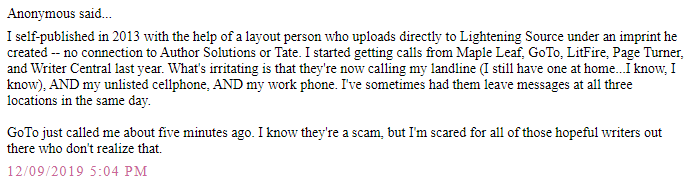
UPDATE 12/10/19: I want to highlight this recent comment, which illustrates how ubiquitous and persistent these scams are. Bottom line: if you self-publish, you can count on being solicited. Be on your guard. (By "GoTo", I'm assuming the commenter means GoToPublish.)


es

Authors' Concern Grows Over Late Royalty Payments at Dreamspinner Press

&

Posted by Victoria Strauss for Writer Beware®

Scroll down for updates

On Wednesday, September 11, Publishers Lunch published an article by Erin Somers about payment issues at Dreamspinner Press, which I'm reprinting here with permission.
Dreamspinner Keeps Promising Authors to "Catch Up What Everyone Is Due" In Payments

Romance publisher Dreamspinner Press has not been paying royalties in timely fashion, authors have been reporting online, at least partially confirmed by emailed updates from the company that have been shared. Earlier this summer, authors posted on Twitter that the publisher had been inconsistent with payments for over a year, including delays in issuing both first quarter and second quarter 2019 royalties. In June, author TJ Klune posted, "Out of the last 8 quarters, this is the fourth time payments have been late, and the second in which I am owed penalties for said lateness." (Klune had said in March he would part ways with Dreamspinner after delivering three more books.) Author Suki Fleet posted, "I'm not waiting on a lot--but what I am waiting on is from foreign royalties paid to Dreamspinner this time *last* year, that I had to specifically ask for."

That month authors began announcing requests to revert their rights, a trend that continued over the course of the summer. There was some controversy within the romance community over whether authors withdrawing their work could cause the publisher to fail (or fail faster), in which case no one would get paid. Criticism extended to authors who supported the publisher as well, even though they were owed money.

Multiple agents PL spoke to said they were no longer doing business with Dreamspinner, except to negotiate their clients' rights back. They told us that acquisitions at the publisher had dwindled over the past year, confirmed by the sharp drop in PM deal reports, with Dreamspinner acquiring mostly from their existing authors, many of whom are unrepresented.

Dreamspinner provided authors a number of explanations in weekly emails, including writing that they had "not received payments from Amazon for UK or EU currencies," that they were awaiting deposits from "vendors," and that the late payments had been caused by a software glitch. In their latest update on September 4, the publisher said that they are anticipating a small business loan that will enable them to issue payments, and that they "can't offer a firm payment date to catch up what everyone is due." The email goes on, "With every set of deposits we receive, we've been sending payments, and we are continuing to respond as best we can to author requests." They added that they can't provide proof of the impending loan that authors have asked for because, "legal and banking documents are confidential and can't be posted online."

Meanwhile, authors including Indra Vaughn, Avon Gale, Jeff Adams, Will Knauss, CJane Elliott, Meredith Shayne, Tia Fielding, and many more have requested rights back. Fielding wrote on Facebook, "In the last year or so, they've repeatedly been more or less late in royalty payments." TJ Klune wrote in an email to the company that he posted on Twitter, that he is owed $27,448 in royalties and plans to involve a lawyer. A Facebook group of 75 former DSP authors has formed for people who have pulled their books or are considering it.

RWA has offered support for authors who have experienced trouble with Dreamspinner. They said in an August 21 statement: "We're aware of the situation, and members who need professional relations assistance, should contact memberadvocacy@rwa.org to reach our staff professional relations manager." Dreamspinner did not respond to PL's request for comment.
Writer Beware has been receiving similar complaints about late royalty and advance payments and confusing/conflicting explanations for the delays, with some authors saying they are owed four- and even five-figure amounts. According to a number of authors who contacted me, these problems have become more acute in the past few months, but they aren't new: periodic payment delays, with attendant excuses, began as much as two years ago.

Although Dreamspinner regularly sends out update emails (you can see an archive of these here), several authors told me they were having trouble getting responses from Dreamspinner CEO Elizabeth North.

Also of concern: in the midst of repeated payment delays, and despite its admissions of financial distress, Dreamspinner appears to be proceeding with sweeping expansion plans, including a shift to mass market paperback format, increasing the number of translations for the foreign market, and rolling out a new accounting and payment system (which several of the authors who contacted me told me they'd had trouble with). Multiple authors told me that they fear that author royalties, which Dreamspinner says go into an escrow account, are instead being used to finance company operations.

Authors' anger at the situation is growing. Meanwhile, Dreamspinner is still open for submissions. Writers who are considering approaching this publisher might want to hold off for the moment.

More information:

Tweets from authors Avon Gale, TJ Klune, Roan Parrish, KJ Charles (search "Dreamspinner" on Twitter to see many more).

Blog posts by authors Mary Winter, RJ Scott, Rhys Ford, TJ Klune.

Non-Dreamspinner author X. Marduk is compiling a Dreamspinner timeline, with lots of links to tweets and blog posts.

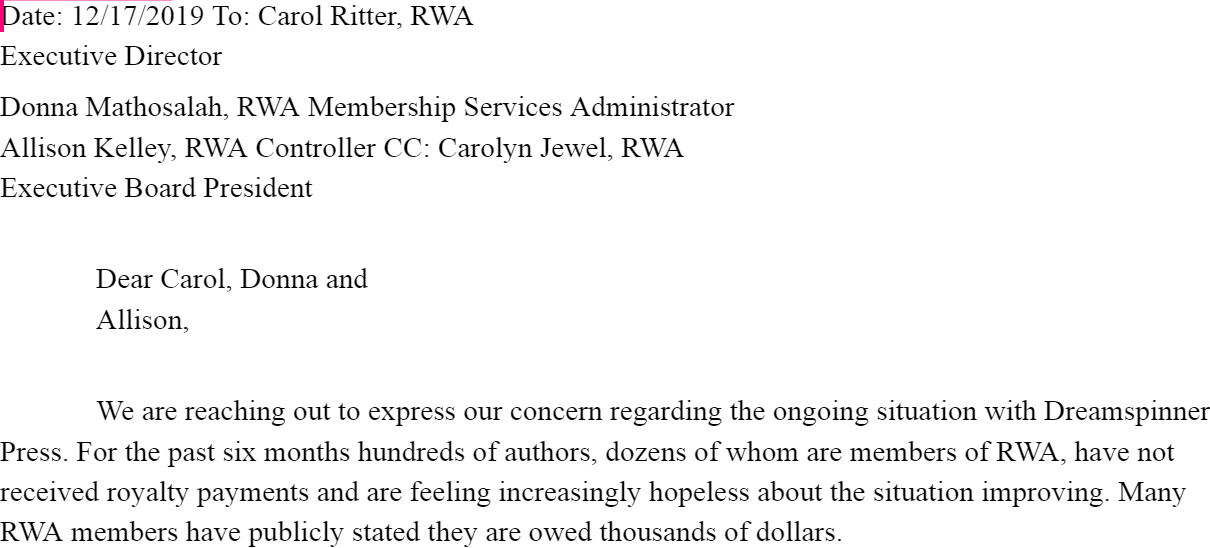
UPDATE 12/25/19: The payment problems at Dreamspinner appear to be ongoing. A group of Dreamspinner authors contacted RWA to request help:


You can read the entire letter here.

According to one of the letterwriters, RWA responded that there is nothing they can do. Dreamspinner's issues are now part of the implosion of Romance Writers of America, with writers increasingly furious over RWA's alleged foot-dragging in addressing complaints--not just about Dreamspinner, but generally.

UPDATE 12/28/19: Another of Dreamspinner's eminently reasonable-sounding but holy-crap-if-you-read-between-the-lines updates. (Summary, if you don't want to click on the tweet: they've hired a firm that specializes in financial restructuring to "develop a plan for 2020 and a structured repayment of all past due amounts." They promise to "be in touch with authors directly about their repayment schedule".)
When you have to explain yourself by saying "We want to make clear that this isn't bankruptcy", it's not generally a good sign.

UPDATE 1/16/20: I continue to hear from Dreamspinner authors who have not been paid. Some are owed thousands of dollars for the first three quarters of 2019, and have received no payment at all; some have gotten partial payment, or are owed for fewer quarters. Bottom line: Dreamspinner owes a crapload of money to its authors.

According to the latest update from Elizabeth North, "Payments for November have started posting. They will all be submitted through Tipalti [Dreamspinner's accounting software] by Friday, January 10." What this appears to mean--at least, as of this writing and based on the authors who have contacted me--isn't actual payment (as in, money in bank account), but a status change on Tipalti from "In Process" to "Submitted For Payment." Also, the payments are for November royalties only. Anything prior to that will be folded into the restructuring plan Dreamspinner says it is pursuing.

Other stuff:
  • Writers seem to be requesting rights reversion in droves. Many of them have multiple titles with Dreamspinner.
  • In some cases,Dreamspinner seems to be unilaterally charging certain fees or expenses or other amounts against what they owe individual writers--i.e., reducing royalties owed by whatever the amount of the expense is. I don't want to provide details here, because I don't want to risk identifying the writers.
  • The National Writers Union wants to hear from Dreamspinner authors who haven't been paid.
  • Dreamspinner is fully enmeshed in the implosion of RWA. Claire Ryan has an exhaustive timeline of the crisis that's tearing RWA apart, with references to RWA's anemic response to Dreamspinner authors' complaints, and allegations that recently-resigned RWA President and Dreamspinner author Damon Suede may not have been eligible for the office based on his actual publications.
One thing that's really striking to me in this whole mess is how, if you look at just one of Dreamspinner's announcements and updates, they sound so very businesslike and reasonable. It's only if you go back and read them all in sequence--as I just did--that the facade starts to crumble, with unmet deadlines, moving goalposts, and unfulfilled commitments.

Back in June, Dreamspinner was promising that "the remainder of outstanding royalties" were about to be released...but here we are in January 2020, and they still owe tens of thousands of dollars. In July, they promised that they were "in the final steps" with the Small Business Administration loan, and "estimated funding has been moved back to mid-August"...but as of January, the loan is still pending. Over the months from June through December, they promised repeatedly to get everyone paid (especially, again and again, royalties for Quarter 2)...and then, in December, they suddenly announced the hiring of a firm to re-structure the entire debt from October backward, with no details about the process, or even an end date for it. Presumably, this firm will want a fee...from a publisher that can't afford to pay its authors.

I get that it's tough out there for small presses. Things go wrong. Vendors are tardy. Loans fall through. Personal emergencies happen. But read from beginning to end, Dreamspinner's updates--so reasonable-seeming individually--start to feel like mere excuses. Together with authors' frustrations and complaints, they paint a really troubling picture.

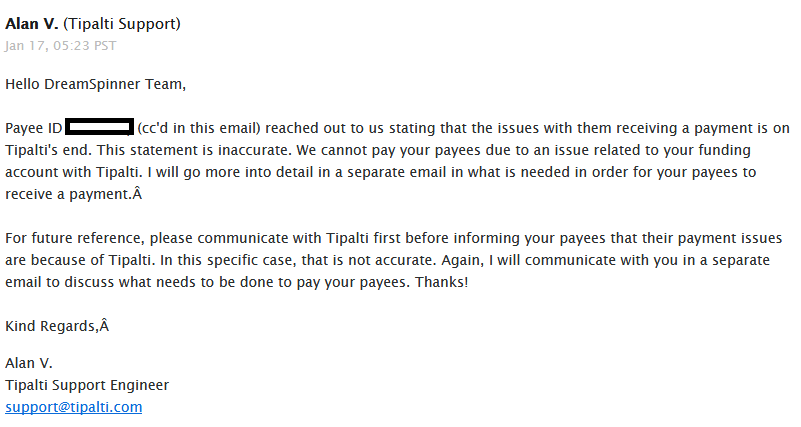
UPDATE 1/17/20: Re: all those November royalties that were to be released by January 10, and are currently listed in authors' Tipalti dashboards as "submitted" but not actually paid...this rather irate email from Tipalti to Dreamspinner in response to an author's inquiry about the delay suggests why nothing is landing in authors' bank accounts: Dreamspinner's payment account is not funded.


This is not good news. It's really starting to feel like there's some serious gaslighting going on here.

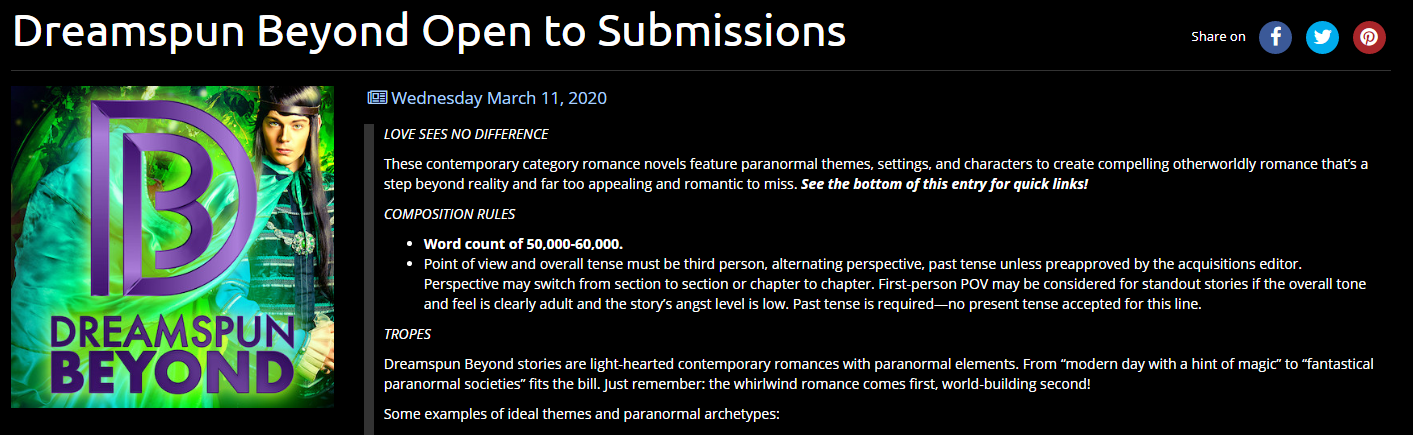
UPDATE 3/19/20: Dreamspinner has not provided an author update since January 7, and writers are still reporting that royalties are in arrears. Yet, amazingly, Dreamspinner is open to submissions:


Also seeking submissions: Dreamspun Desires.

Writer beware.


es

A Pack Of Scammer Lies


Posted by Victoria Strauss for Writer Beware®

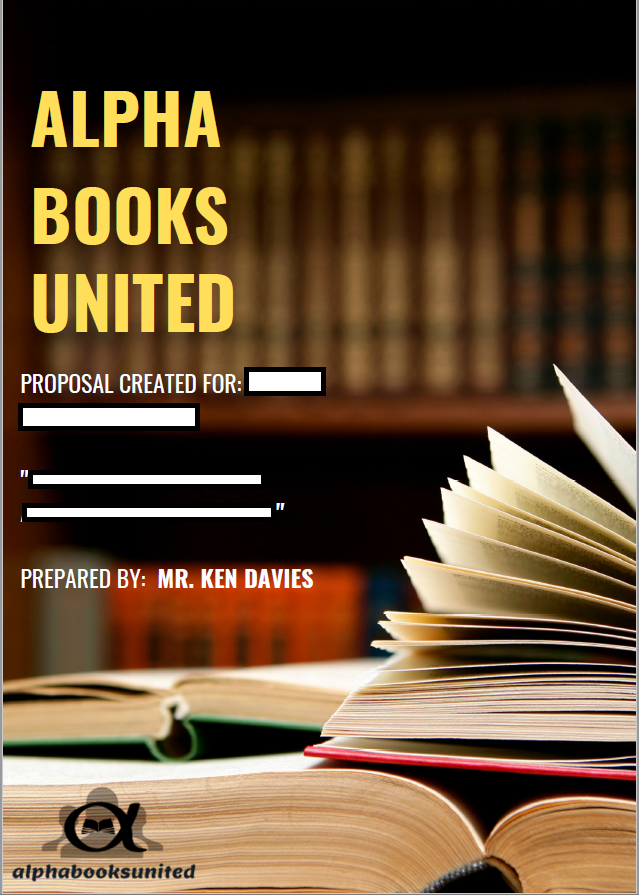
How do scammers entrap unwary writers? The other day, an especially egregious example came across my desk, in the form of this "proposal" shared with me by an author who really, really wanted to believe it was real (I've redacted the author's name and book title to protect their privacy).


Not to beat a horse, dead or otherwise, but if you'll glance at the sidebar, you'll see that Alpha Books United is on Writer Beware's big list of Philippines-based Author Solutions copycat publishing and marketing scams. (When I got hold of this proposal, on September 26, Alpha Books' website was working fine, but when I checked it today it refused to load. "Mr. Ken Davis", however, has not stopped emailing and calling the author who contacted me.)

(UPDATE: Just a few hours later, Alpha Books' website is back online. Check out its specifics-free About Us page, on which it tells the following lie: "Once you’re earmarked, we open the possibility for you to be eligible for a non-contributory agreement with us.")

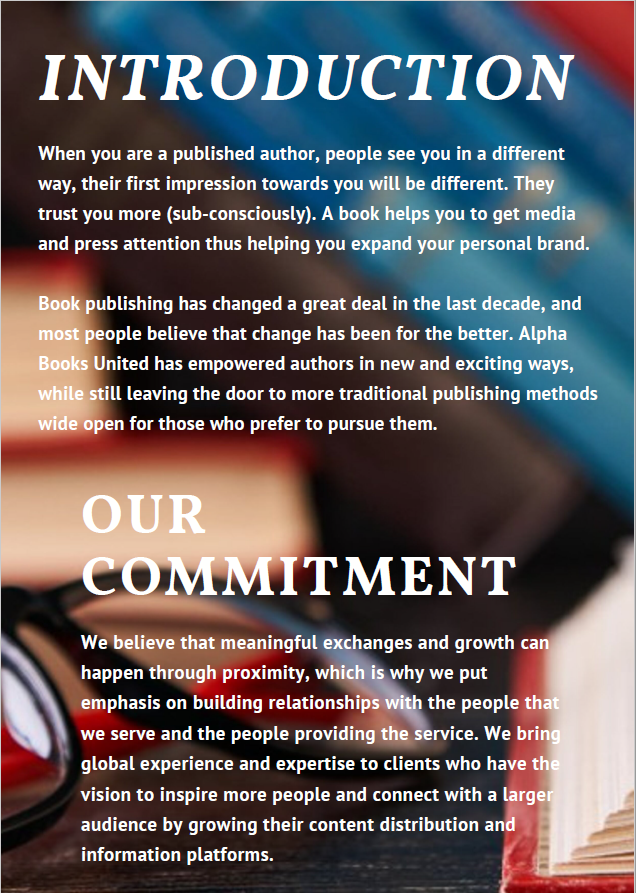
Here's the bait. Author empowerment! Amazing expertise! Commitment! Relationships! Sounds good, right? (Other than the complete lack of any verifiable specifics, of course.) Like most scammers, Alpha Books is counting on establishing a direct line to the author's deepest hopes, dreams, and ego.

Note that there's no mention of money. The initial phone calls and emails sent by "Ken Davis" didn't mention money, either.


Here are the "PUBLISHING Inclusions" supposedly on offer (only "if needed", of course!). Kind of bare bones basic, right? But for an author who isn't all that savvy about what goes into design and production, it hits the high spots: cover design, print and ebook format, and the all-important "content evaluation," which Alpha Books is hoping the author will wrongly interpret as "editing".

Again: no mention of money. That will come later, after the author has responded with interest to what they may believe is an amazing offer, especially if it's accompanied by flattery about how their book has been "discovered" or "recommended" by "book scouts" or "literary agents". These scams are successful in part because they solicit so relentlessly, but also because they have an acute grasp of author psychology. They know that it's easier to hook victims if you first get the victims to hook themselves.


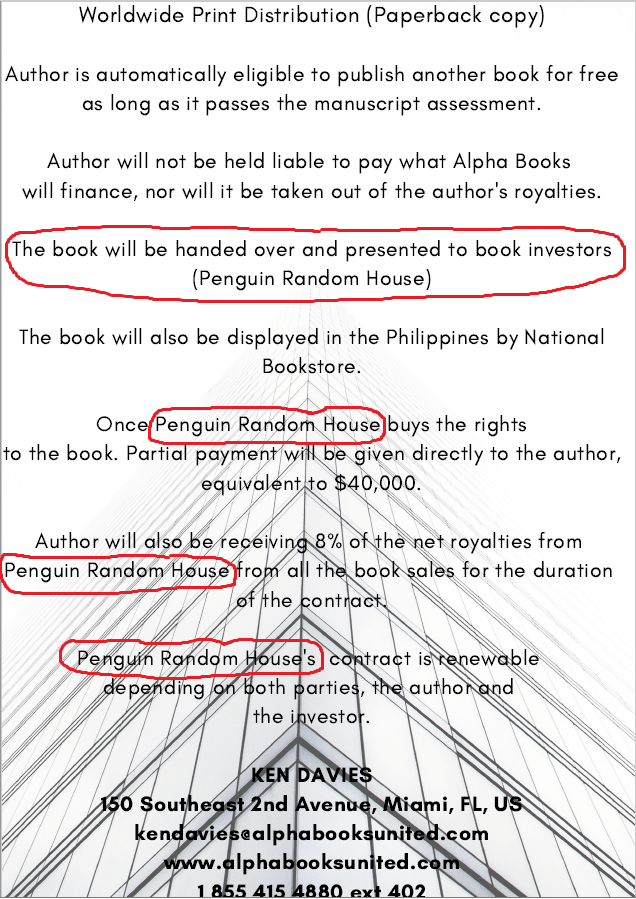
And here is the pack of lies. Well, pretty much everything the scammers offer is a lie, but these are mostly slant lies: they could be true (it's just that they aren't). Alpha Books, on the other hand, distinguishes itself by going well beyond the usual obfuscations and half-truths with a great big alternative fact: guess what, we have access to Penguin Random House! Which will pay you $40,000!

If Alpha Books' previous phone calls and emails haven't convinced the potential victim, this magic name surely will. It's an especially sneaky tactic because there really is an Alpha Books associated with PRH: it's under the umbrella of the DK imprint, and publishes, among other things, the popular Idiots Guides series.

Of course, to anyone who knows a little bit about publishing, Alpha Books' claims about PRH are laughable:


The author who received this pitch nearly fell for it. Only when "Ken Davis" told them they'd have to pay $7,000 for this wonderful opportunity (the "true" cost being $19,000, of which Alpha Books would supposedly defray the bulk) did they start to balk. At that point, this happened:


As brazen as most of these scams are, this is just about the worst I've seen.

Fortunately the author contacted me, and I was able to convince them they were being scammed. (It wasn't the first time: they'd originally published with one of the Author Solutions imprints, and had previously been solicited by scammers Bookwhip, Stonewall Press, and True Media Creatives.)

I'm guessing that at least a few of my readers will be thinking "Well, if someone is that naive/ignorant/unwary, they deserve what they get." Believe me, I get frustrated too with writers' gullibility, and in particular with how many writers fail to educate themselves about publishing and self-publishing before trying to publish. But no one, no matter what, deserves to be deceived and ripped off by a pack of con artists.

That's why I keep doing what I do. Suck it, scammers.


es

Fireside Press Cancels Multiple Contracts

Posted by Victoria Strauss for Writer Beware®

Last week, the SFWA Contracts Committee issued this advisory.
SFWA Contracts Committee Advisory on No-advance Contracts

Recently, SFWA's Contracts Committee was made aware of a situation in which a well-liked publisher canceled the publication of a number of books it had contracted to publish. The publisher said the decision was made because of "unexpected changes" at the company. The Committee has reviewed the contract in use, which lacked a provision for such a cancellation. The Committee believes that canceling a contracted book that satisfies the author’s obligations is at odds with the spirit of the contract. Making this situation worse is the fact that these were no-advance contracts. Because no advance was paid, the publisher could make this decision without financial penalties. The authors' books, were, in effect, put in limbo for many months and the authors received nothing but an apology. Besides depriving the authors of the ability to sell the books elsewhere during this delay and putting off any income from the books into the indefinite future, the authors careers suffer as a result.

Publishers of all sizes may find themselves unable to live up to their contractual commitments for a wide variety of reasons, some of which could not have been reasonably anticipated. Hence, the Contracts Committee urges writers to think carefully about signing a contract that provides no advance, or only a nominal advance, while tying up their work for a lengthy period of time. Critically, payment of an advance gives an indication the publisher actually has the financial resources to meet its obligations. Publishers who do not pay advances or pay only nominal advances should include language in their contracts specifying how they can cancel a book and what happens if they should cancel a book, including a specified amount of compensation to the author.

SFWA Contracts Committee
October 25, 2019

Legal Disclaimer: The contract alert should not be understood to be legal advice. The issues presented by contract law are complex. Authors should consult a competent attorney familiar with the business of publishing as well as contract law before signing any contract.
The publisher in question is Fireside Press.

The cancellations were first reported on October 8 by Jason Sanford in his Genre Grapevine column, and discussed on October 9 in Mike Glyer's File 770. Fireside publisher Pablo Defendini issued a statement on October 8, in which he revealed that the five canceled contracts were for manuscripts that were "unpublished and unannounced", and attributed the cancellations to disruptions caused by editorial departures.

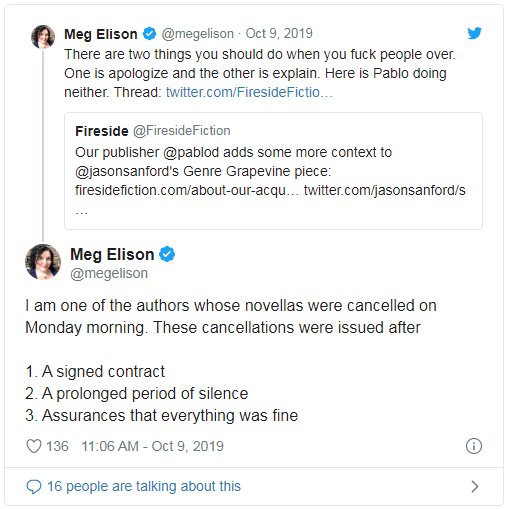
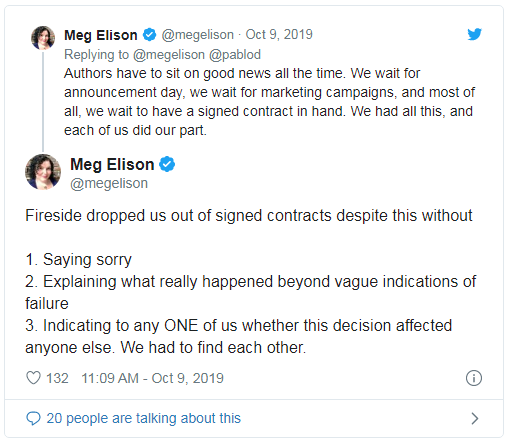
Author Meg Elison, one of the canceled authors, did not find this to be a sufficient explanation...and she was livid.


A few days later, Defendini issued an apology. "I can see now how [the cancellation emails] read as callous, uncaring, and dismissive of the authors’ feelings," he wrote. "I’m very sorry for that....My behavior was not consistent with Fireside’s values, and I deeply regret it."

Beyond the Contracts Committee's general warning about no-advance contracts (and if you're part of the small press world, you know how common these are): multiple simultaneous contract cancellations are not frequent or normal, and can signal trouble beyond whatever the publisher offers as an explanation (if it explains at all). Ditto for a publisher that suddenly starts offering to revert rights on request.

Fireside's situation also highlights the risks of signing with a publisher that's essentially a one-person operation (as Defendini admits in his apology). With the best will in the world, the publisher can be sidelined by a single bad event (personal or professional), leading to glitches, errors, and delays in scheduling, payment, and more. Writer Beware's files are stuffed with such stories.

Troubled publishers do recover, or at least hang on. Month9, which canceled dozens of contracts in 2016, is still publishing, as is Permuted Press, which axed an undisclosed number of titles in 2015 (both publishers cited overstocked lists, though in both cases there were other issues as well). In the short term, though, if a publisher is or has been actively shedding writers, it's best to hold off on submitting until it's clearer what's going on.


es

Contest Caution: The Sunday Times Audible Short Story Award


Posted by Victoria Strauss for Writer Beware®

Founded in 2010, The Sunday Times Audible Short Story Award bills itself as "the richest prize for a single short story in the English language." And indeed, the prize is major: the winner receives a cool £30,000 (no, I did not add extra zeroes.)

With judges yet to be finalized, the selection process will include a 20-story longlist announced in May 2020, a six-story shortlist unveiled in June 2020, and the winner revealed on July 2. The shortlisted stories will be published in an Audible audiobook, with included writers receiving "an extra £1,000 fee, on top of a prize payment of £1,000". To be eligible, writers must previously have had at least one work published in the UK or Ireland by an "established print publisher or an established printed magazine" (the Terms and Conditions include an extensive list of the kinds of publishers and magazines that don't qualify). The contest is open for entries until 6:00 pm on December 13.

You can read more about the award, including the prestigious judges who've participated and the well-known writers who've submitted stories, here.

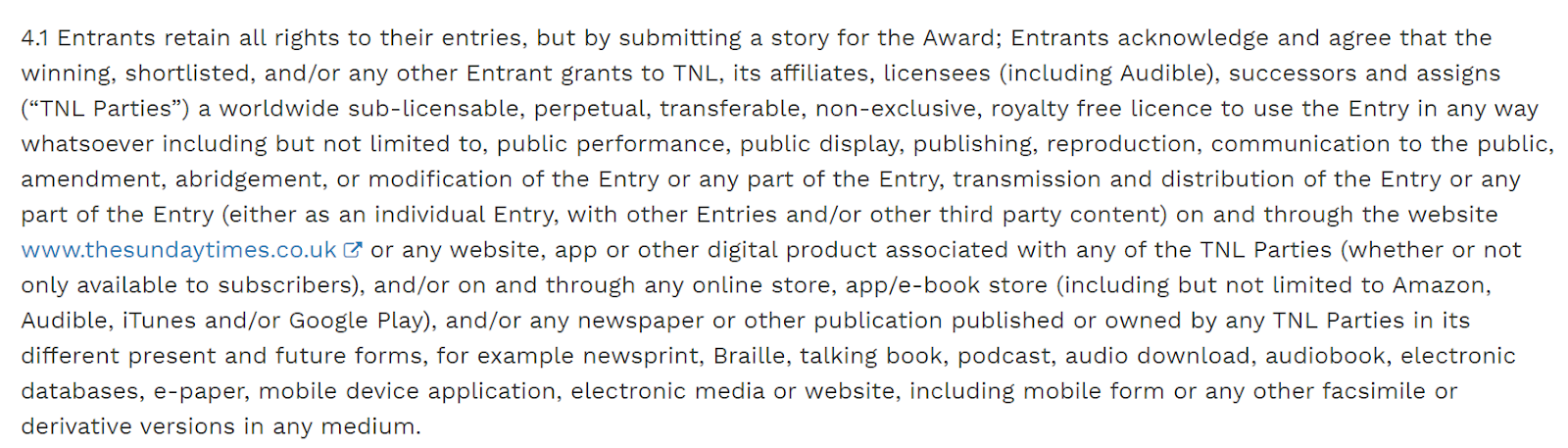
So what's the catch? -- because you know I wouldn't be writing this post if there weren't one. Well, as so often happens, it's in the Terms and Conditions. Specifically:


To summarize this dense paragraph: simply by entering the competition, you are granting a sweeping, non-expiring license not just to Times Newspapers Limited (The Sunday Times' parent company), but also to Audible and any other licensees of TNL, to use your story or any part of it in any way they want, anywhere in the world, without payment to or permission from you.

This is far from the first time I've written about "merely by entering you grant us rights forever" clauses in the guidelines of literary contests, some of them from major publishers or companies that should know better. Sure, in this case the license is non-exclusive, so you could sell your story elsewhere--but only as a reprint, because by granting non-exclusive rights to one company, you remove your ability to grant first rights to another, at least for as long as the initial rights grant is in force.

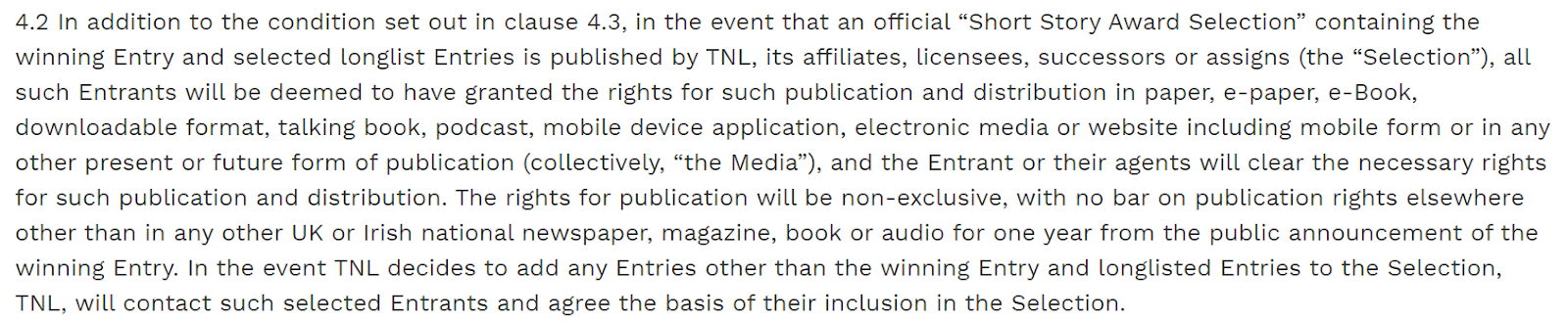
It's not uncommon for literary contests that involve publication to bind all entrants to a uniform license or grant of rights--so that, when winners are chosen, the license is already in place. But ideally, the license should immediately expire for entries that are removed from consideration--or, if the contest sponsor wants to retain the right to consider any entered story for publication (as TNL clearly does--see Clause 4.2, below), rights should be released within a reasonable period of time after the contest finishes--say, three or six months. There's simply no good reason to make a perpetual claim on rights just in case, at some unspecified point in the future, you might just possibly want to use them.

Not to mention--why should Audible get to make this same claim?

There's a couple of other things to be aware of. Shortlisted authors enter into a 12-month exclusive contract with Audible, for which they are given a "one-off" lump-sum payment (the £1,000 noted above). But thereafter, Audible retains the right "to record, distribute and market such audio version for at least ten (10) years." Again, this right is non-exclusive--but there's no indication that Audible has to pay these authors for potentially exploiting their work for a decade. (If you don't consent to these terms, you can't be shortlisted.)


Finally, although publication is guaranteed only for the shortlist, TNL reserves the right to publish longlist and non-listed entries as well. Great! Except...there's nothing to suggest these writers would be paid either.


There's no question that this is a prestigious--and, for the winner, rich--award. But sober evaluation is definitely in order here. Enter at your own risk.


es

Issues at Audible's ACX: Attempted Rights Fraud, Withdrawn Promotional Codes


Posted by Victoria Strauss for Writer Beware®

Two issues involving Audible's ACX have come across my desk recently.

Rights Fraud

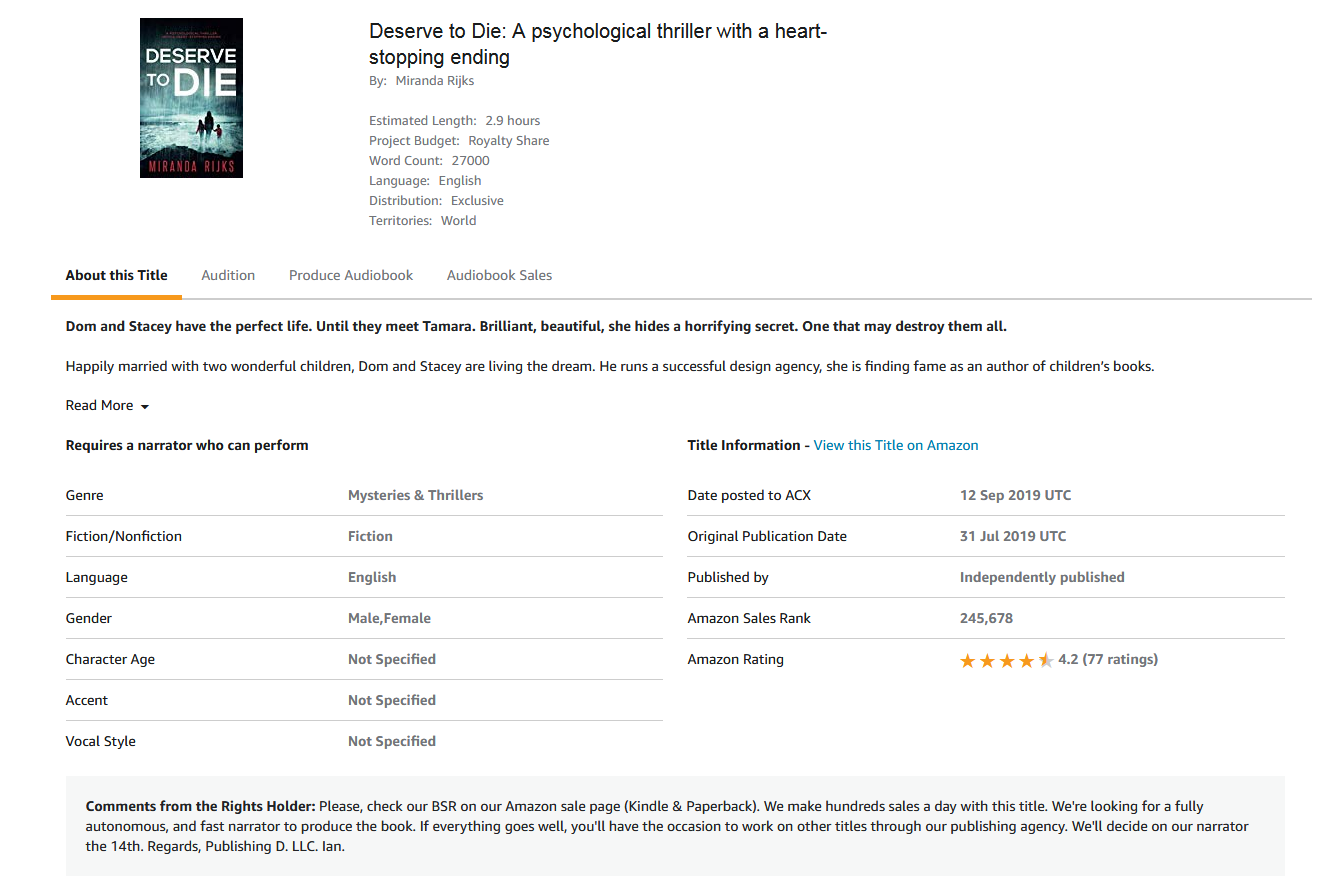
I've heard from several self- and small press-pubbed authors who report that they've found their books listed on ACX as open to narrator auditions...except that they, or their publishers, didn't put them there. This appears to be an attempt to steal authors' audio rights.

Below is one listing. Here's another and another and another. (All of these listings have been invalidated by ACX.)


See "Comments from the Rights Holder" at the bottom. The purported company, Publishing D LLC, does not show up on any searches.

The fraud seems pretty elaborate. Here's what one of the authors who contacted me told me:


These comments from a freelance audiobook narrator illustrate that "Publishing D" is not an isolated incidence.

Promotional Code Shenanigans

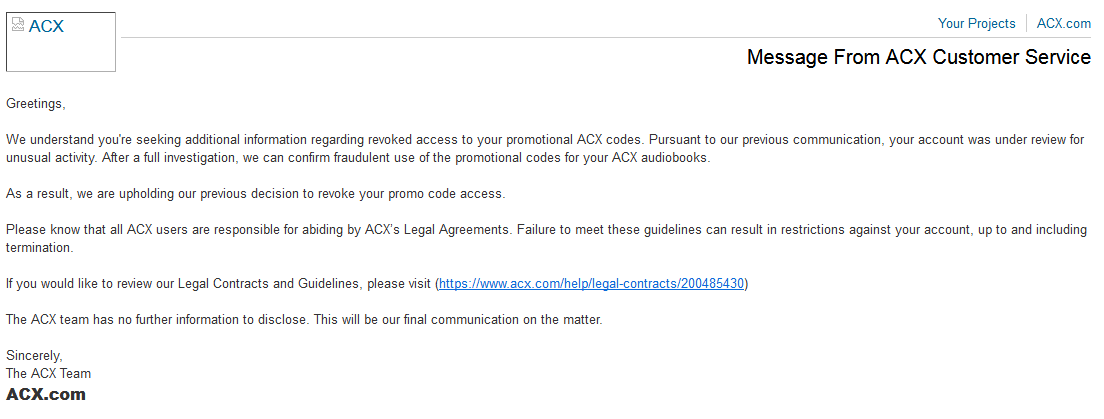
Multiple authors have contacted me to report that they've received an email from ACX withdrawing their promotional codes. The cited reason: "unusual activity," with no explanation of what that means.

The authors say that they have not used the codes improperly or violated ACX guidelines; in some cases, they've used the codes only a handful of times or not at all. See, for instance, blog posts by authors G. Michael Vasey and Adam Piggott. Per discussions on the KBoards and Reddit, a lot of authors seem to be affected.

Is this one of Amazon's (Audible's parent company) periodic crackdowns on misuse or fraud that has inadvertently ensnared innocent authors? According to author and self-publishing expert David Gaughran, ACX promo code scamming is a major problem, and Amazon's anti-abuse sweeps often involve a lot of collateral damage. Or could it be an error--a glitch or rogue algorithm?

So far, authors' efforts to get a fuller explanation have run up against the black box that is Amazon:


If I hear anything further, I'll update this post.

UPDATE 11/27/19: One of the authors who alerted me to the promo code withdrawal has received a notice saying that their codes are reinstated--however, they say that the promo code tab has yet to appear in their dashboard.


UPDATE 2/25/29: More about ACX scams, from a comment left by a narrator:
About the ACX thing...I was contacted by ACX to narrate three books, however, the person who offered the contracts kept emailing and frantically telling me to send them my book codes. I got leary and called ACX. They said unfortunately there are many scams taking place where if a book is "unclaimed" in their system, someone may grab it and offer it as an audiobook contract. Then they keep the codes and blackmarket sell them. They do not pay the narrators. Many other authors are experiencing it, they said, but they have no way to regulate it.

I declined the offers and got a nasty note from the contract holder. I was also told that since I corresponded with them, they had my email that is associated with Amazon..the same one. So, ACX said I had to go change my email on Amazon or they would have access there too. Geez.


es

Publisher Alerts: Complaints at Month9 Books, Nonstandard Business Practices at Black Rose Writing


In mid-2016, I wrote about YA publisher Month9 Books' abrupt decision to scale back its list, reverting rights to as many as 50 authors across all its imprints. Explaining the culling, Month9 founder and CEO Georgia McBride cited her own health problems, along with staffing issues and the company's "substantial growing pains" over the past six to nine months.

McBride's announcement triggered a surge of complaints from Month9 authors, who described a host of serious problems at the company, including late or missing payments (for staff as well as authors), problems with royalty accounting, delayed pub dates, broken marketing promises, overcrowded publication schedules, communications breakdowns, and harsh treatment and bullying by McBride.

According to authors and staff, these problems were not new or even recent, but had been ongoing for a long time. Why had authors kept silent? Almost every writer who contacted me mentioned their fear of retaliation--along with the draconian NDA included in Month9's contracts. I've rarely encountered a situation where authors seemed so fearful of their publisher.

Things quieted down after the initial flood of revelations, as they often do. Month9 survived and kept on publishing, though its list continued to shrink: between a high point in 2016 and now, the number of titles appears to have fallen about 50%. Apart from a handful of additional complaints in late 2016 and early 2017 (similar to this one), I didn't hear much about Month9 in the years following.

Until now. Over the past few weeks, I've been contacted by multiple writers who say they are still suffering from the same problems that surfaced in 2016: primarily, late (sometimes very late) royalty and subrights advance payments and statements (in many cases received only after persistent prodding by authors and their agents), and allegations of irregularities in royalty reporting.

The intimidation level, too, seems not to have changed. Most of the authors told me that they feared reprisal for coming forward, and asked me specifically not to mention their names or book titles. (Writer Beware never reveals names or other unique identifying information, unless we receive specific permission from the individual. That disclaimer is included on our website and in our correspondence.)

If you've been following the recent ChiZine scandal, you may be feeling some deja vu--notably, in the alleged existence of a toxic culture within the publisher that makes authors fearful and and helps to keep them silent. It's disappointing to learn that even if the issues that thrust Month9 into the spotlight three years ago have gone quiet, they don't seem to have eased. Writers be warned.

******

I wrote about Black Rose Writing in 2009, in connection with its requirement that authors buy their own books. Writers who submitted were asked how many of their own books they planned to buy; their response was then written into their contracts. (Book purchase requirements are back-end vanity publishing: even if writers aren't being asked to pay for production and distribution, they still must hand over money in order to see their work in print.)

Black Rose got rid of the book purchase requirement a few years later, and claimed to be a completely fee-free publisher. I had my suspicions that money might still somehow be involved, though...and as it turns out, I wasn't wrong.

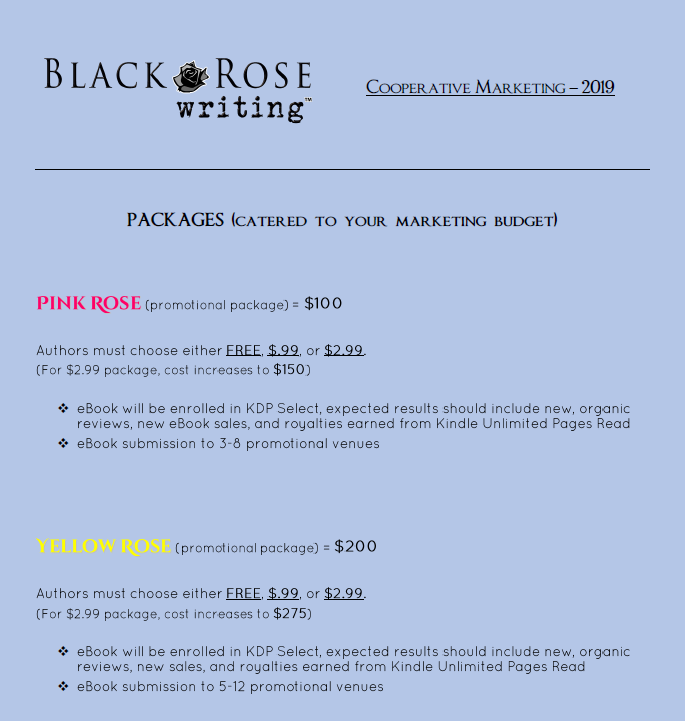
I've recently learned that new Black Rose authors receive a Cooperative Marketing Catalog that sells a range of pay-to-play marketing and promotional services, with costs ranging from a few hundred dollars to four figures. For instance:


It's true that purchase is optional (though I would guess that authors are heavily solicited to buy). But reputable publishers don't sell marketing services to their authors--and in any case, much of what's on offer are things that other publishers, even very small ones, do for their authors free of charge, as part of the publication process.

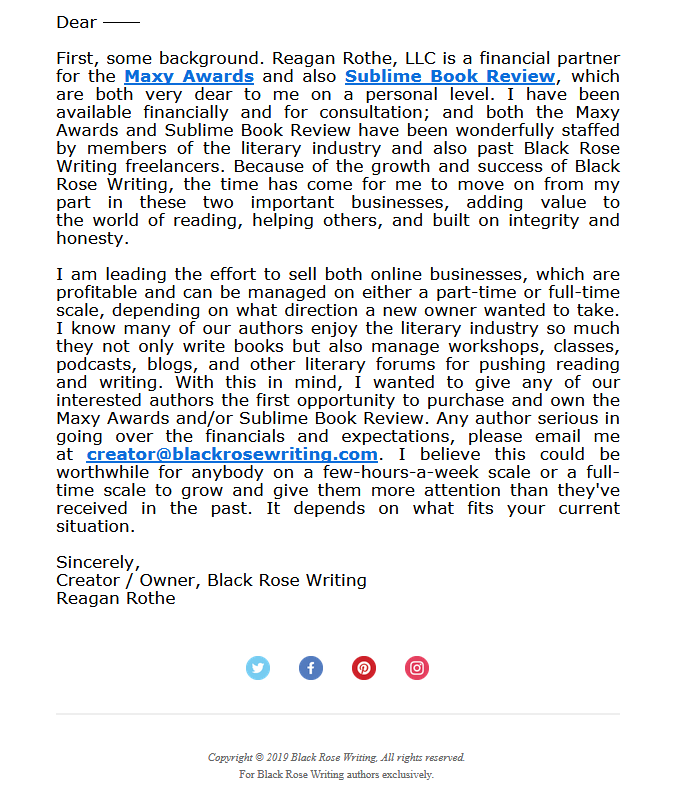
That's not the only way in which Black Rose authors are encouraged to pay their publisher. Owner Reagan Rothe is a self-described "financial partner" in two additional businesses: the Maxy Awards, a high entry fee book competition that donates "a large part of every entry" to a charity (how large? No idea; that information is not provided); and Sublime Book Review, a paid review service.

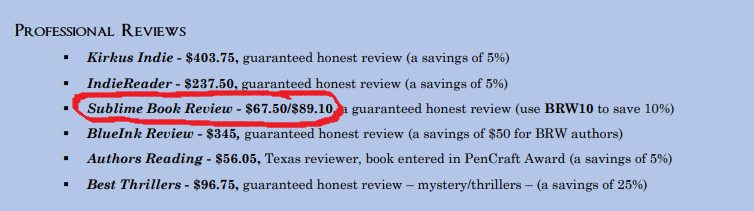
Though Mr. Rothe's financial interest in these businesses is not disclosed on the business's websites, both businesses are clearly energetically promoted to Black Rose authors. On Sublime's website, nineteen of the first 20 book reviews are for Black Rose books. There's also this, from the marketing catalog (note the lack of disclaimer):


As for the Maxys, thirteen of the 17 winners and runners-up for 2019 are Black Rose books.

Mr. Rothe does admit his relationship with the businesses in this recent email to Black Rose authors--though only to afford them yet another opportunity to give him money:


es

How Predatory Companies Are Trying to Hijack Your Publisher Search, Part 3


Posted by Victoria Strauss for Writer Beware®

In my first post about the ways that predatory companies attempt to ensnare unwary writers who are searching for publishers, I discussed fake publisher-matching websites. In my second, I exposed the scammy Google ad tactics of vanity publisher Austin Macauley.

In this third post, I'll talk about an equally insidious practice: providing misinformation or even outright lies about traditional publishing, in order to make self- or vanity publishing appear superior.

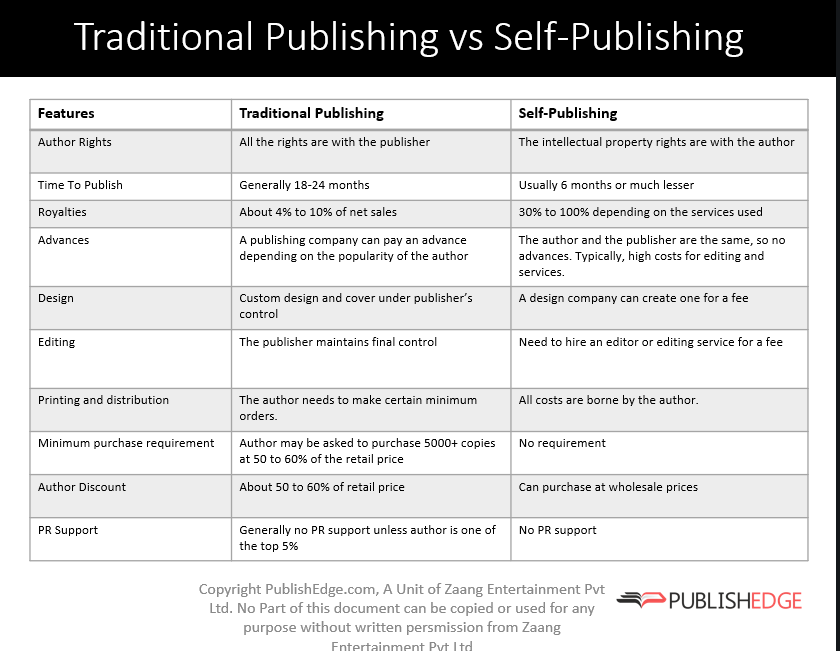
Yesterday on Twitter, someone tweeted this chart, which purportedly compares traditional publishing and self-publishing.


If you're even slightly savvy about publishing, the inaccuracies are easy to spot. Trad pubs often pay royalties on retail price (not "net sales"), or pay a higher percentage (higher royalties are especially common in the small press world). Trad pubs that pay advances don't withhold them from less popular authors, and they don't require authors to make "certain minimum orders" or to buy thousands of copies of their own books. And while it's often true that smaller traditional publishers don't provide much in the way of PR or marketing support, and larger houses invest more marketing in more popular books and authors, they don't simply ignore 95% of their output (this makes no sense; what business markets only 5% of its products?)

As for author rights...trad pubs do license exclusive rights from authors, sometimes for a period of years, sometimes for the life of copyright (with reversion usually happening well before then). But they don't gain ownership of them (as "all rights are with the publisher" implies), because the author retains copyright--plus, authors can often negotiate to keep some of their subsidiary rights. And although self-publishing is typically non-exclusive, allowing authors to publish on multiple platforms if they wish, they do still have to license publishing and distribution rights to whichever platform or service provider they choose--otherwise, the platform couldn't legally produce and sell their books.

The chart comes from this how-to-self-publish article, which is really just a long ad for PublishEdge, which is (surprise!) a paid publishing services provider.


PublishEdge is a "division" of Zaang Entertainment Pvt Ltd, which, unlike the Philippines-based scams I've been covering so much lately, is based in India. The range of services it sells aren't priced as high as some of the scammers', but there are still plenty of warning signs: no information about who is providing the services on offer (so you have no idea who they are or if they're qualified); no cover or website design samples (so you have no idea what you'd be getting for your money); and this pitch for ghostwriting services, which invites you to "Discover the simple secret to how celebrities and busy professionals get their books published without actually writing", courtesy of "our book writing experts", who (judging from the description of the service) basically type up a Skype interview into a chapter book. Most likely these unnamed "experts" are hired on Upwork or Fiverr or a similar jobs site (holy plagiarism scandal, Batman!).

PublishEdge isn't alone in misrepresenting traditional publishing in order to make itself look more attractive. Among other alternative facts, this chart from Morgan James, a vanity publisher with an author purchase requirement, claims that "many major houses" require authors to buy 5,000 copies or more of their own books (doesn't that make MJ's 2,500 purchase requirement seem appealing?), and that trad pubs provide no PR or marketing support for 94% of their books and authors. (Hmmm. Could PublishEdge have borrowed a little something there?)

Here's another misleading comparison, from Union Square Publishing, a self-styled hybrid (read: vanity) publisher. It too borrows heavily from Morgan James's chart, with several of the same dubious claims. Here's another one--this time from Success Publishing, which sells Chicken Soup-style anthology slots.

This one, from "custom" publisher Momosa Publishing (packages start at $5,900), doesn't tell quite so many fibs, but encourages you to believe that trad pubs cap their royalties at 6%, and don't market their books to libraries. And then there's this from Atmosphere Press, another so-called hybrid, which wants to convince writers that a $5,000 publishing fee will save them from the "raw end of the deal" they'd get from a trad pub, "losing not just their royalties but also the rights to their material and to their control over their art." Not addressed: the likelihood of ever making that $5,000 back.

These are just a few examples; there are many more. If you use the internet as part of your publisher search, you're very likely to encounter them (in some cases, disseminated by self-styled experts who ought to know better). It's a great argument for a step that many writers skip: learning about publishing before diving into the quest for publication. As with all aspects of publishing, knowledge is your greatest ally and your best defense: the more you know about the way things really work, the better protected you will be against the disinformation described above.

Final note: I know that many writers have had bad experiences with traditional publishers--I've had some myself. Especially in the small press world, many traditional (at least in the sense that they don't charge fees) publishers engage in nonstandard and author-unfriendly business practices. There's plenty of discussion of that on this blog. I'm not trying to paint trad pub as perfect, or argue that it's necessarily a better choice for any given writer.

But deliberate distortions like those described above don't help anyone, even if you don't take into account their obvious self-serving agenda. Tarring an entire segment of the publishing market with a broad negative brush--especially where some of the supposed negatives are demonstrably false--is as irresponsible as arguing (as some people still do) that only traditional publishing is a worthwhile path. 


es

Writing Contest Beware: Pressfuls


Posted by Victoria Strauss for Writer Beware®

On Sunday morning, I woke up (late, I admit) to a flurry of emails about an website I'd never heard of before: Pressfuls.

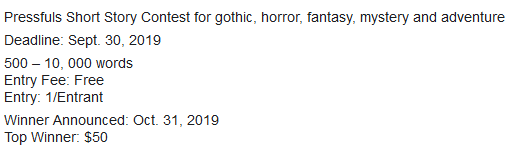
The writers who contacted me reported that they'd entered a free short story contest this past September.


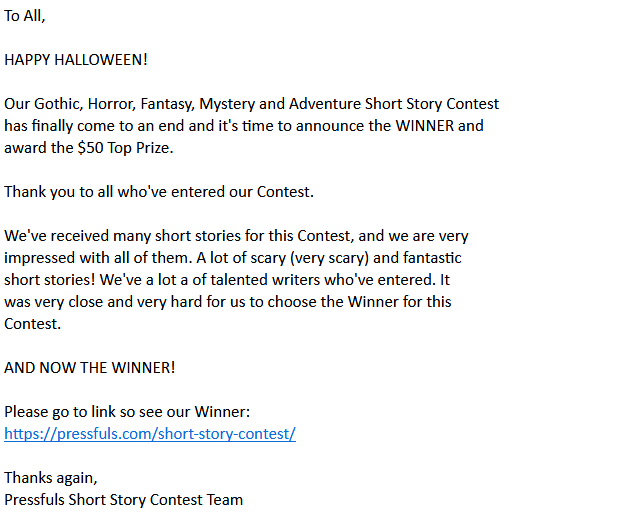
As you can see, pretty minimal information. At the end of October, they received a mass email (which, curiously, cc'd all the recipients instead of bcc'ing them, so that all email addresses were visible to everyone), announcing the winner:


Although the contest entry info hadn't mentioned that the winner would be published, the writers thought they were done and moved on. Some submitted their contest stories elsewhere. Some of those stories got accepted.

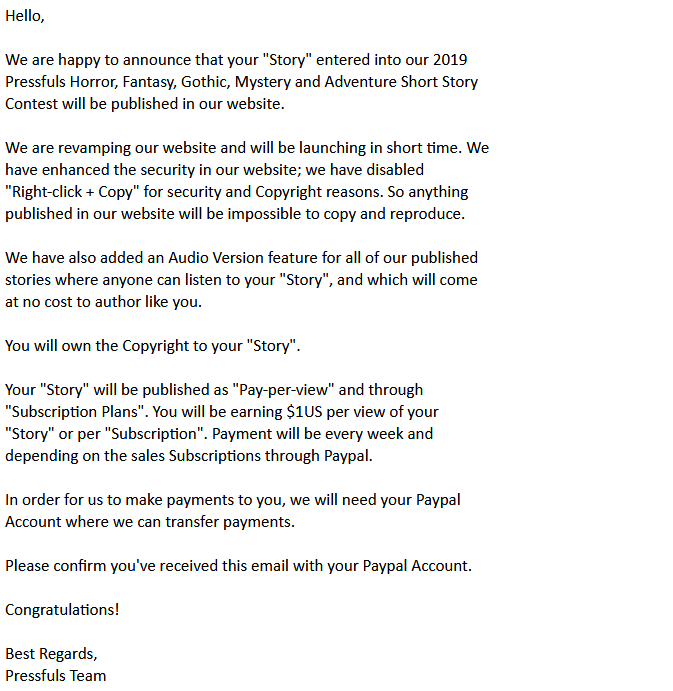
Then, just a few days ago, on December 19--surprise!


Writers were shocked. As far as they knew, they had never granted permission for their stories to be published or turned into audio versions--much less made part of some sort of pay-per-view subscription service. As for the request for PayPal information, that sounded really scammy. Writers who emailed Pressfuls to ask questions or emphasize that they hadn't granted publication rights received a non-responsive response reiterating that their story was going to be published, and that "We will give you more details about it in short time [sic]."

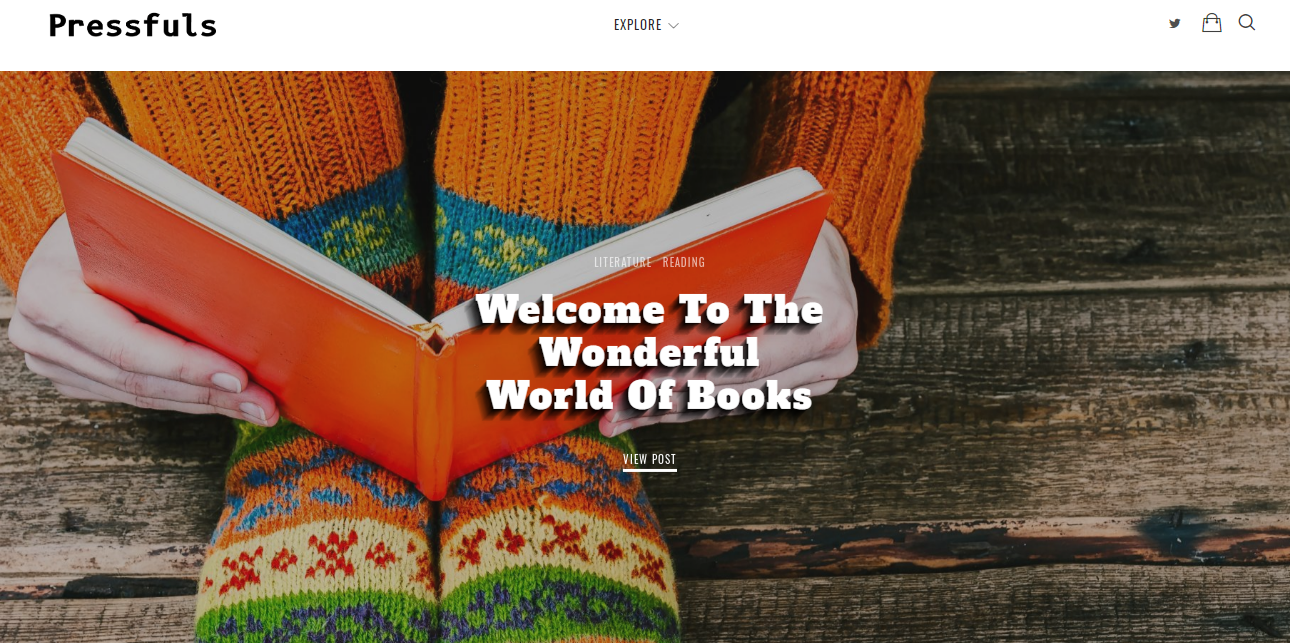
So what is Pressfuls? With a web domain registered just six months ago, its current website (which writers tell me has been overhauled since the contest) presents as a short fiction subscription service, with a bizarrely large variety of paid subscription plans. There is no information whatever about staff, owners, the company, or, on the submission page, payment structure and publishing rights.

There's also a couple of new short story contests with 2020 entry deadlines. And that brings me to my main reason for writing this post. Beyond the questionable happenings in this particular case, Pressfuls is like an archetypal object lesson on the kinds of contests you want to avoid.

Count the red flags:

- No rules or guidelines. The page for the September contest is gone, but writers who contacted me say that there were no posted rules or guidelines--and certainly there are none for the current contests. Bad contest rules are a red flag...but no rules at all is a giant, klaxon-blaring, run-away-now warning sign. Pressfuls' attempt to monetize entries it was never authorized to publish in the first place illustrates why.

Never, never, NEVER enter a contest if you can't find, read, and/or understand the rules.

- No information about rights or payment. Plenty of contests have unfriendly rights demands. For instance, you may have to grant publication rights simply by entering, and the contest sponsor may never release them. At least when that info is present on the sponsor's website, you can't say you weren't warned. But if there's no rights or payment information whatsoever, you are really setting yourself up for the possibility of a nasty surprise...like finding out your entry has been included in a subscription service with a sketchy payment plan.

- No information about the company. Do you seriously want to enter a contest whose organizers or sponsors you know absolutely nothing about--not even where they're located or how long they've been around? I'll give you a hint: No. If you can't confirm who's running the contest, don't enter.

- No information about judges. Part of the prestige of a contest (if it has any--and most contests don't) depends on who is doing the judging. Reputable contests disclose their judges.Otherwise, you have no guarantee the contest isn't just pulling names out of a hat.

- English-language errors. Sure, anyone can make mistakes or typos (although you have to wonder about the professionalism of a contest sponsor that isn't capable of proofing its own website). But if it's an English-language contest, and you see errors or odd syntax that suggest the website has been created by people whose first language is not English, be wary. A lot of scams these days are coming from overseas. The Pressfuls website isn't as bad as many I've seen, but there are enough lapses (dropped plurals, missing articles, mis-spellings--for instance, in several locations "Fantasy" is spelled "Fanstasy") to prompt caution. (Pressfuls' emails provide much clearer examples.)

So what is Pressfuls, really? A phishing scheme? A sleazy way to acquire and monetize content? A clueless would-be publisher with no idea how things should be done? I really can't tell. But none of these possibilities are good ones.

A couple of the writers who contacted me told me that Pressfuls complied (though without any acknowledgment) when they demanded that their stories be taken down. However, another writer said that they tried several times and their story is still online.

Since Pressfuls has no real "contact us" option on its website, my suggestion is to send a DMCA takedown notice to its email address (shortstorycontest@pressfuls.com) or, if that yields no response, to the email address of its web host (abuse@in2net.com). You can find out more about DMCA notices (which are legal notices demanding removal of infringed material from the internet) here. SFWA offers a handy DMCA notice generator.

For more information and cautions about contests, see Writer Beware's Contests and Awards page. I've also written a blog post that covers some of the same ground: Some Tips on Evaluating Writing Contests.

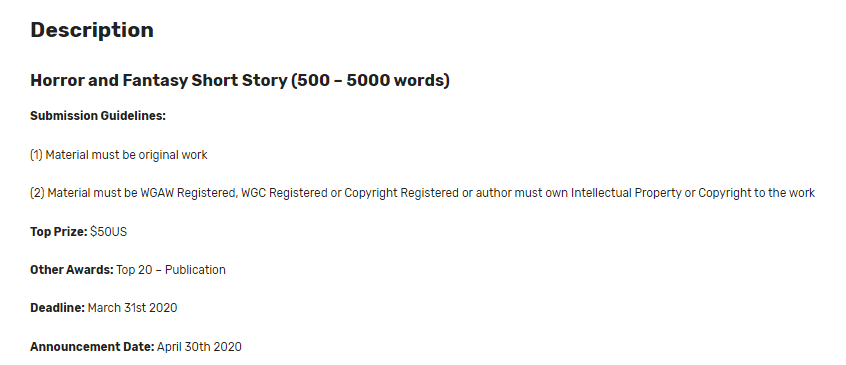
UPDATE 12/24/19: Since I put this post online yesterday, Pressfuls has amended the descriptions on its contests. Originally they looked like the description for the original contest (see above). Now they look like this:


This is not an improvement, since there's still nothing about publication or rights. Also, the copyright info is ignorant on multiple levels. WGA and WGC registrations (which are primarily for screenwriters) are not legally equivalent to US copyright registration--and they don't prove anything anyway, since the author already owns copyright, by law, as soon as the words are written down.

I shouldn't need to say that you really want your publisher to have an accurate understanding of copyright.

Writers tell me that Pressfuls sent out another mass email with instructions on how to have content removed, so it seems they're paying attention. We shall see.


es

Junk Book Marketing: Pay-to-Play Magazines


Posted by Victoria Strauss for Writer Beware®

Scroll down for updates

On this blog and elsewhere, I spend a lot of time warning about junk book marketing services: so-called marketing and promotional services that are cheap to provide, but can be sold at a big markup, and for the most part are of little worth for book promotion or can more effectively be done by the author him/herself. Some examples: press releases, email blasts, book trailers, book fair display, social media setup, and social media advertising.

All these and more are hawked to writers at exorbitant prices by assisted self-publishing companies like the various Author Solutions imprints--and also, increasingly, by their scam imitators. Either way, they're a ripoff...but the scammers demand even bigger fees, tell even bigger lies, and deliver even more shoddy results. And that's when they're not just taking your money and running.

A few weeks ago, I focused on pay-to-play radio interviews--another junk marketing service--and why they're not worth the huge fees charged by providers. This week, I'm going to talk about pay-to-play magazines. (You'll note that all the companies discussed below are on my Big List of Publishing and Marketing Scams.)

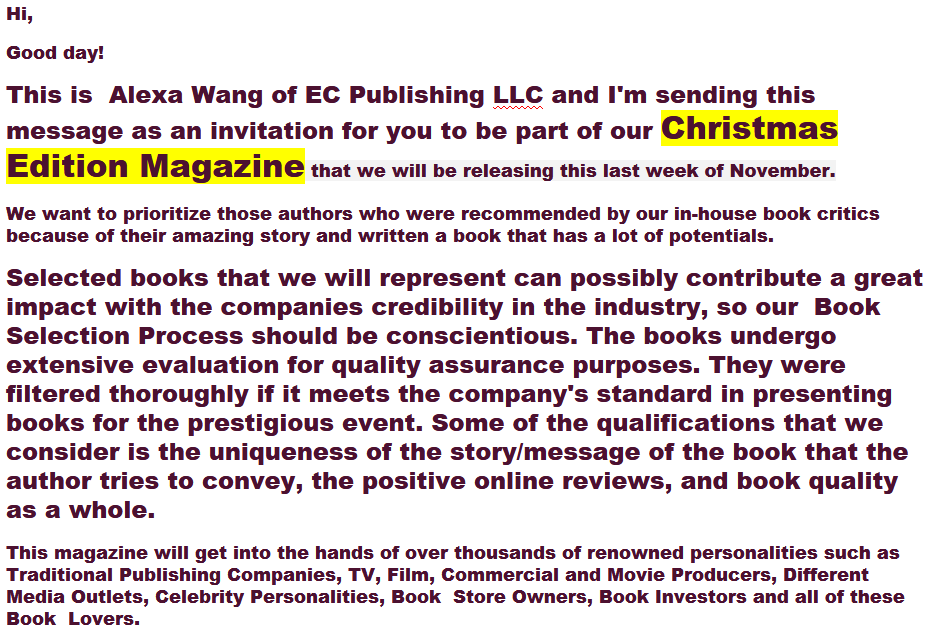
Have you ever received a solicitation like this one?
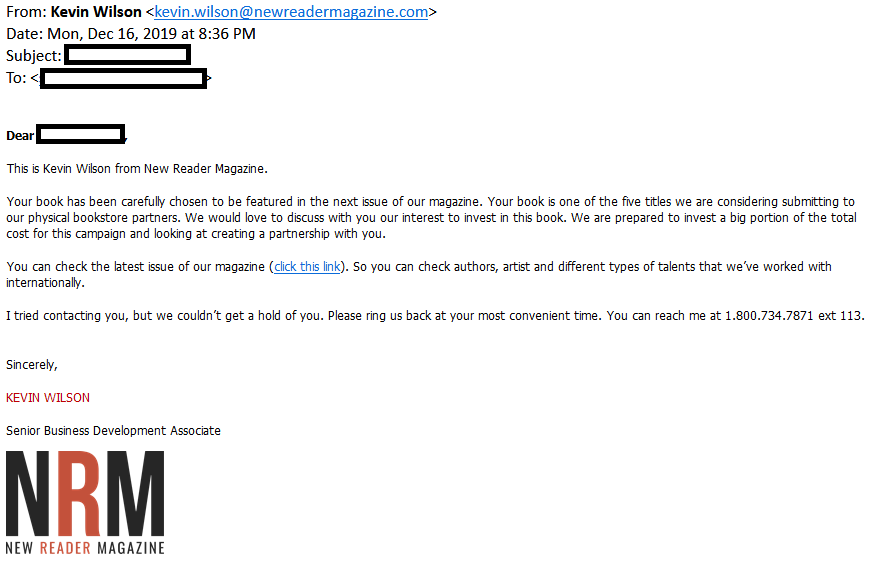
Or this one?
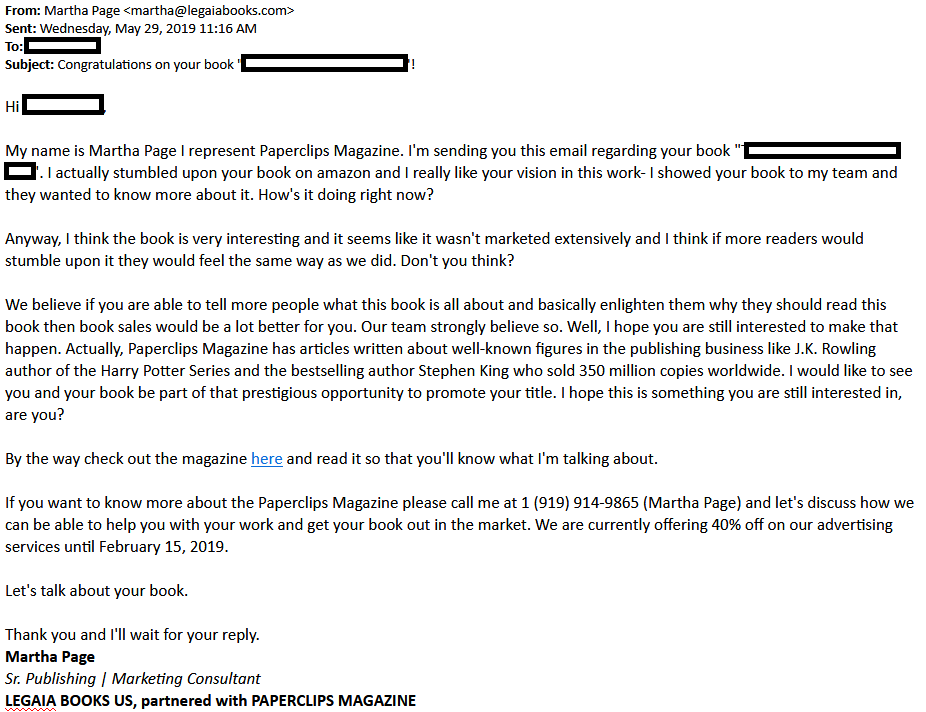
Or this one?
Of course the books haven't undergone "extensive evaluation", or been "carefully chosen", or showed to "a team" that "really like[s] your vision". Such solicitations are just spam, blasted out to addresses scraped from the internet or stolen from self-publishing company customer lists.

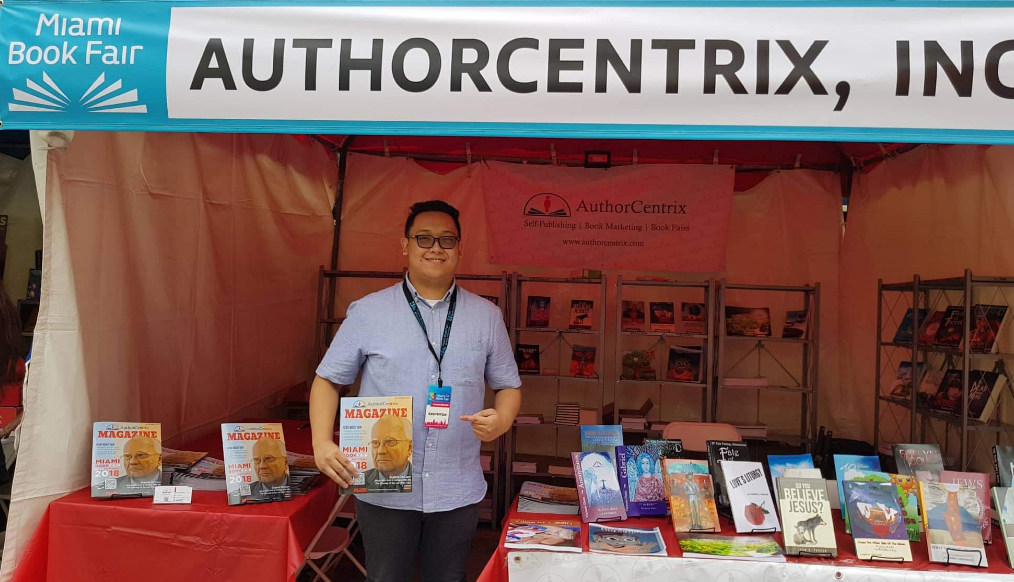
Nor are these real magazines, in the sense of publications that are widely available to the public. Instead, they're collections of ads, interviews, and "feature articles" sold to writers at huge prices, sometimes interspersed with general interest pieces (often really badly written) or, in the case of New Reader Magazine, with fiction, poetry, and art. These "publications" are never circulated in any meaningful sense; they may be posted online, but their primary mode of distribution is from tables in company booths at book fairs...where many of the authors buying ad or interview space have already paid a premium for display.


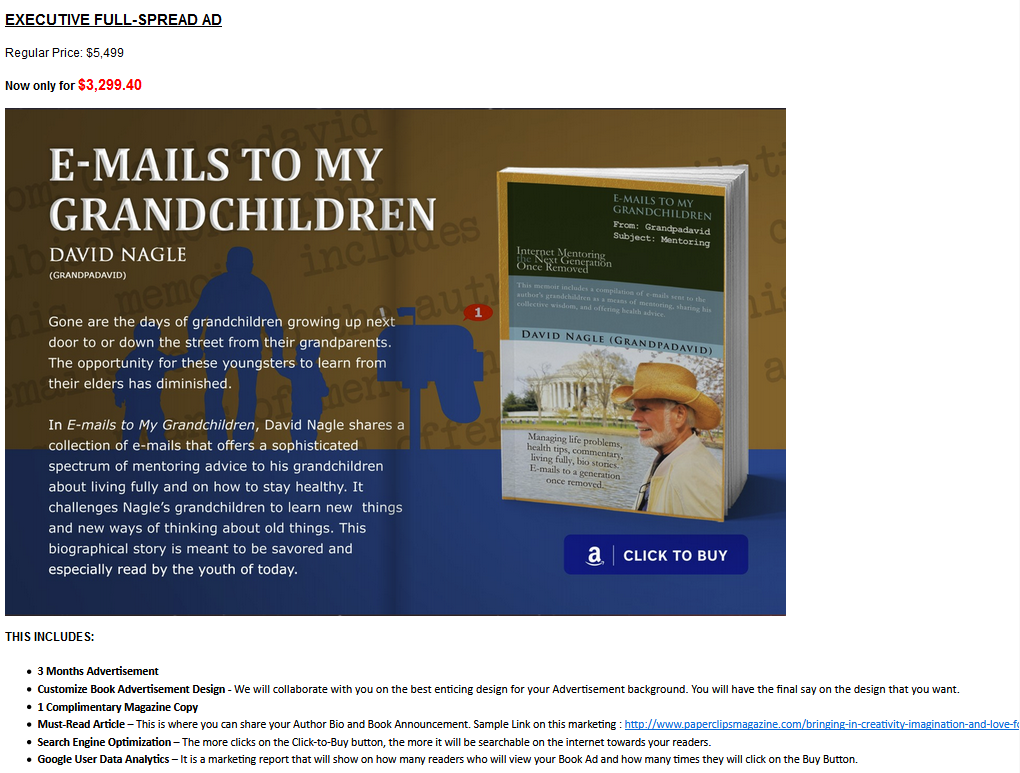
The prices the faux magazines charge for placement can be enormous. For instance, here's the  "Executive Full-Spread Ad" from Paperclips Magazine, which is owned by (not "partnered with" as claimed in its solicitation email) publishing and marketing scammer Legaia Books:


A "Showcase" full-page ad costs $3,698 ($2,218.80 on sale), and a "Premier" half-page ad clocks in at $2,599 ($1,299.50 on sale). Paperclips' parent company, Legaia Books, also sells publishing and marketing services at high prices, using deceptive sales tactics to target small press- and self-published authors.

Here's one writer's not very satisfactory experience with Paperclips. I've gotten emails from many others.

New Reader Magazine--which looks quite legit if you don't know better--is owned by New Reader Media. Though the magazine actually appears to provide small payments for content acquired via general submission, it charges anywhere from $5,000 and up for the magazine feature and "partnership" mentioned in its solicitation email. Like Legaia, New Reader Media also sells publishing and marketing services at gigantic prices, as well as book-to-screen services (always a scam).

New Reader has accumulated some online complaints due to its aggressive solicitation and poor performance. It has also been caught making false claims, such as that it was responsible for Christopher Paolini's bestselling novel Eragon being made into a movie.

The Christmas magazine that's the subject of EC Publishing's solicitation can be seen here (if you're brave, you can also check out the Las Vegas Edition, produced for the Las Vegas Book Festival). Like most of the pay-to-play magazines, it's a compilation of author-purchased ads and features, laughably badly-written general interest articles, and a smattering of actual advertising. Prices for inclusion range from a few hundred to several thousand dollars, depending on how much space is purchased.

Thanks to its aggressive soliciting, EC Publishing is the subject of a warning from the Australian Society of Authors.

Authors Press's Authorial magazine has its own website (note the "notice of non-affiliation and disclaimer" that pops up if you linger on the home page: the scammers read Writer Beware). Writers can buy a spot in the magazine, starting at fees of a few hundred dollars; ad space or "features" are also included in some of the more expensive promotional packages Authors Press offers.

Authorial's BEA 2019 issue consists of more than 75 pages of author ads, interviews, and excerpts. Just imagine the thousands of dollars in revenue generated by all those pages, some of which include ten or more ads. Also have a peek at Authorial's gallery page, which features photos of  the dozens of books displayed in Authors Press's BEA booth. In 2019, writers were being charged anywhere from $1,000 to $3,500 for presence in the booth, depending on what level of activity they chose. Now multiply all of this by the seven book fairs Authors Press attended in 2019. It's not chump change.
From URLink Print and Media comes Harbinger Post. Like the others, it's nearly all paid content, interspersed here and there with staff-written features. Here's an example of the caliber of that writing:


Other scammy publishing and marketing companies that sell space in proprietary magazines (I've received multiple complaints about all these companies):

Global Summit House: Global Summit House
Litfire Publishing: WayFairer
AuthorCentrix: AuthorCentrix Magazine
Stonewall Press (defunct): GoldCrest Magazine

Print advertising is expensive, and how useful it is for book marketing is an open question. But if it is to be effective at all, it must offer the possibility of being seen by a large audience of potentially interested readers and buyers.

That means circulation, subscriptions, and quality content beyond mere advertising--not ad-stuffed, error-ridden, proprietary publications whose only exposure to the public is a "free, take one" stack on a side table in a book fair booth. Even if the ad slots weren't insanely expensive--and even if writers didn't have to pay for what real magazines never charge for, such as interviews--buying space in these fake publications would be a waste of money.

Writer beware.

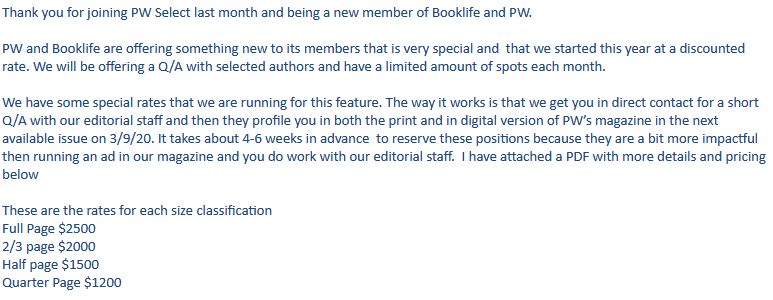
UPDATE 1/29/20: It's not just scammers that run this kind of racket. Via its PW Select - BookLife feature (which I discuss here and  here), industry magazine Publishers Weekly has begun to sell a "very special" service:


These prices rival the scammers'. And the promise of print exposure is not quite what it seems. Per PW's Q&A explainer, the interviews appear not in the body of the magazine, but in "PW’s BookLife supplement, which is published the last week of each month bound into that week’s issue of Publishers Weekly". In other words, easy for readers to ignore or skip over.

PW actually has the wide circulation and industry audience the scammers only pretend to. But given the huge fees and the segregation of the interviews in a separate supplement--not to mention the open question of how useful any kind of print advertising is for book marketing--there's more than a whiff of the same kind of exploitation here.