v

News: Guest Strip - Steve Conley

Scott R. Kurtz: Today's guest strip was created by none other than smilin' Steve Conley, and I adore his take on my characters. I've known Steve for years, and have wonderful memories of both SPX and the Baltimore Comicon hanging out after the show and talking shop. Steve was a pioneer in syndicating web-content and has always been a little bit ahead of the curve. I've always been impressed with his art, his writing, and his ability to discover new ways to distribute his comics. His current book, The Middle Age, continues this trend. It's hilarious, sweet and gorgeous. Steve is creating the entire book


v

You Have All The Time In The World

“There’s someone her to see you,” one of my volunteers, said.  “Who?” I said, not looking up from my paperwork. “A couple with two kids. They said they need to talk to you.” Even though Christmas is just under two months away, the food pantry I run is already busy preparing for the holidays. In […]

The post You Have All The Time In The World appeared first on Waiter Rant.


v

From the Philippines, Not With Love: A Plague of Publishing and Marketing Scams


Posted by Victoria Strauss for Writer Beware®

I've been expending a lot of words and time lately warning about the latest scam phenomenon to hit the writing world: fake publishing and marketing companies that, through outrageous prices and worthless services, extract enormous amounts of money from unwary writers.

Based in the Philippines (despite their apparent US addresses, phone numbers, and telemarketer names) and focusing primarily on small press and self-published authors (particularly authors who've published with one of the Author Solutions imprints), these companies recruit writers with relentless--and highly deceptive--phone and email solicitations. Some do provide the services authors pay for, albeit at seriously inflated prices and often of poor quality. Others just take the money and run. I'm hearing from a growing number of writers who've paid five figures in fees to one--or, in some cases, more than one--of these scams, with next to nothing to show for it.

Given how fast the scams are proliferating (I learn about a new one every few weeks), I thought it would be helpful to gather all the information I've put together about them in one place.

My posts about the scams--where they come from, how they work, and how to recognize them:

- Army of Clones: Author Solutions Spawns a Legion of Copycats
- Army of Clones Part 2: Twenty-One (More) Publishing and Marketing "Services" to Beware Of
- Solicitation Alert: LitFire Publishing
- Amelia Publishing and Amelia Book Company: Sons of LitFire Publishing
- Solicitation Alert: Book-Art Press Solutions and Window Press Club
- Solicitation (and Plagiarism) Alert: Legaia Books / Paperclips Magazine

Here's a list of the scams themselves--at least, the nearly 100 I've identified so far (the list is also posted in the sidebar of this blog). You'll note that a number of them operate under more than one name--I suspect the interconnection is much greater than this, but I've only indicated the additional names where I've been able to reliably document them.

Some have perished since I began the list--I've noted this, but left their names, for the sake of authors who may have been scammed while they were operational.

- Access Media Group (aka Quill Space Media)
- Ace Media Creative Publication / Ace Media International / APM Media Production (aka Pearson Media Groups)
- ADBooks Media (aka Coffee Press / Okir Publishing, which is defunct)
- Alpha Books Solutions
- Alpha Books United
- Amelia Publishing / Amelia Book Company (aka LitFire Publishing / GoToPublish)
- AnalytIQ
- Ascribed LLC (defunct)
- Author Aide
- Author Codex (aka BookSpine Press)
- Author Media Express
- Author Pro Creatives and Marketing (defunct) (still doing business as Matchstick Literary)
- Author Reputation Press
- Author University
- AuthorCentrix (formerly BookBlastPro)
- AuthorLair
- Author's Note 360
- Authors Press (aka Westwood Books Publishing [formerly Greenberry] / Creative Books)
- Beacon Books Agency
- Black Lacquer Press & Marketing
- BooConn Marketing
- Book Agency Plus (aka BookTrail Agency)
- Book Art Press Solutions (aka Window Press Club / Booktimes)
- Book Avenue Publishing (aka Nivra Press, which is defunct)
- Book Magnets
- Book Reads Publishing (defunct)
- BookSpine Press (aka Author Codex)
- Booktimes (aka Book Art Press Solutions / Window Press Club)
- BookTrail Agency (aka Book Agency Plus)
- Book Vine Press
- Books Scribe
- BookVenture Publishing
- BookWhip (aka Carter Press / PRM Solutions)
- Box Office Media Creatives (aka Buzz Media Creatives)
- Bright Lights Distribution
- Buzz Media Creatives (aka Box Office Media Creatives)
- Capstone Media Services (defunct) (now doing business as Stampa / Stampa Global)
- Carter Press (aka BookWhip / PRM Solutions)
- Chapters Media & Advertising (aka Techbooks Media)
- Coffee Press (aka ADBooks Media) (formerly Okir Publishing)
- Creative Books (aka Westwood Books Publishing / Authors Press)
- Creative Titles Media  (aka TrueMedia Creatives)
- Crest Media Distribution
- Diamond Media Press
- Dream Books Distribution
- EC Publishing
- Editor's Creative Media (aka Editor's Press and Media)
- Editor's Press and Media (aka Editor's Creative Media)
- Global Summit House
- Gold Touch Press
- Golden Ink Media Services
- Goldman Agency
- GoToPublish (aka LitFire Publishing / Amelia Publishing / Amelia Book Company)
- Happy Media Consulting
- Haynes Media Group
- IdeoPage Press Solutions (aka The Writer Central)
- Legaia Books
- Lettra Press
- LitFire Publishing (aka Amelia Publishing / Amelia Book Company / GoToPublish)
- Maple Leaf Publishing
- MatchStick Literary (aka Author Pro Creatives and Marketing --defunct)
- McNaughton Books / McNaughton Publishing (website is currently dead)
- Netsfilm & Media Press
- New Leaf Media
- New Reader Media
- Nivra Press (defunct) (still doing business as Book Avenue Publishing)
- Okir Publishing (defunct) (still doing business as ADbook Press / Coffee Press)
- Outstrip (defunct)
- PRM Solutions LLC (aka Carter Press / Bookwhip)
- Pacific Books
- PageClapp Media
- PageTurner, Press and Media
- Parchment Global Publishing
- Paradigm Print
- Paramount Books Media
- Pearson Media Groups (aka Ace Media Creative Publication / Ace Media International)
- Press To Impress Publishing
- Pubkits.com
- Quill Space Media (aka Access Media Group)
- Readers Magnet
- Royale House (defunct)
- Rushmore Press
- Sherlock Press (defunct)
- Silver Fox Media
- Stampa / Stampa Global (formerly Capstone Media Services)
- Stonewall Press (aka Uirtus Solutions) (both defunct)
- Stratton Press
- Techbooks Media (aka Chapters Media & Advertising)
- Toplink Publishing
- TrueMedia Creatives (aka Creative Titles Media)
- Uirtus Solutions (aka Stonewall Press) (both defunct)
- Universal Book Solutions
- URLink Print and Media
- Vivlio (a.k.a. Vivlio Hill, Vivlio Hill Publishing, Vivlio Solutions, Vivlio Marketing Solutions)
- WestPoint Print and Media
- Westwood Books Publishing (formerly Greenberry) (aka Authors Press / Creative Books)
- Window Press Club (aka Book Art Press Solutions / Booktimes)
- WorkBook Press
- The Writer Central (aka IdeoPage Press Solutions)
- YourOnlinePublicist
- Zeta Publishing

(I'm continuously updating this list--adding new companies as I discover them, noting the ones that disappear.)

I know my warnings are having an effect, not just because I'm hearing from writers who've found my posts or my list and have been able to avoid being ripped off, but because some of the scams are getting...a little defensive. Book-Art Press now includes this in its solicitation emails:
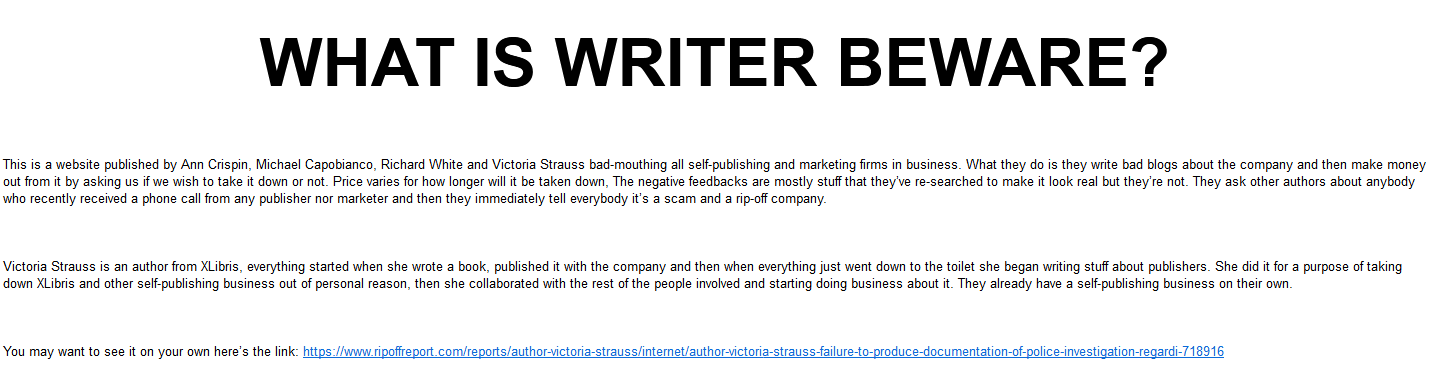
The links are to anti-Writer Beware screeds from people WB has exposed.

The grievance is definitely on display in this one, from MatchStick Literary (it also showcases the scams' trademark fractured English):

See ya at Writer Beware, scammers!

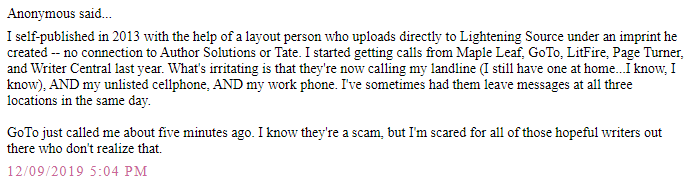
UPDATE 12/10/19: I want to highlight this recent comment, which illustrates how ubiquitous and persistent these scams are. Bottom line: if you self-publish, you can count on being solicited. Be on your guard. (By "GoTo", I'm assuming the commenter means GoToPublish.)


v

Universal Book Solutions: Anatomy of a Book-to-Screen Scam


Posted by Victoria Strauss for Writer Beware®

Selling film rights to Hollywood is among writers' most fevered dreams. And where there is something that writers want or need, there are always sharks waiting to take advantage.

The Hollywood book-to-screen "marketing" package was pioneered by Author Solutions, way back in the early 2000s. All the Author Solutions imprints offer it, including the imprints AS runs for publishers. Here's what the package looks like, from AS imprint Xlibris:
  • Hollywood Ticket: coverage by a "professional reader." Cost: $999.00.
  • Hollywood First Act: a synopsis, "critical analysis", and "45- 60-second teaser Book Video" for "catching film executives' attention". Cost: $2,999.00.
  • Hollywood Director's Cut: an 8-10 page treatment by a "professional screenwriter", plus "consideration" by Author Solutions' "first-look Hollywood partner". Cost: $3,899.00
  • Hollywood Producer's Pick: this is the big kahuna, a full screenplay written by a screenwriter, plus consideration by AS's first-look partner. Cost: $16,299.00. Note that the screenplay is based on "your approved Hollywood Treatment", which you must previously have purchased--so the real cost of this option is $20,198.00.
Although a handful of other assisted self-publishing companies have offered similar packages over the years (here's the one from Bookstand Publishing, for instance; Outskirts Press also had one for a time, though it seems to have been discontinued), Author Solutions hasn't faced a lot of competition in the high-priced Hollywood dream exploitation business--primarily, I'm guessing, because of the cost and coordination involved in providing the coverage, critiques, treatments, and screenplays to the authors who buy them.

That's changed recently, though.

An explosion of book-to-screen "services" has hit the internet, courtesy of the Author Solutions copycat scams that I've been writing about so much lately (there's a complete list in the sidebar). Author Reputation Press, Coffee Press, Dream Books Distribution, Media City Publishers, Paramount Books Media, Book Art Press, New Reader Media, BookVenture, Pearson Media Groups, MatchStick Literary, and more all offer some version of the Author Solutions book-to-screen package, either on their websites or in their (extremely aggressive) phone and email solicitations.

The value of any book-to-screen package is highly debatable, regardless of who provides it. Vendors of such "services" play on authors' dreams of making it big, while failing to provide any kind of realistic information about the extreme unlikelihood of success. Most books never sell or option film rights (they're among the subsidiary rights least likely to be exploited, even for successful authors with top-flight agents), and it's far harder to sell a screenplay than it is a book manuscript. For most authors, the most probable result of buying a book-to-screen package is a smaller bank account.

And that's assuming that the vendor actually provides the advertised services, and doesn't just take the money and run. Author Solutions, at least, does seem to produce the coverage, etc., it sells, in a reasonably literate manner (you'll see some examples if you read on)--though of course, like paid reviews, the critiques and coverage are likely to be customer-friendly--that is, unrealistically positive.

The copycats, on the other hand...they don't exactly have the greatest track records for quality, reliability, or service. Or honesty.

An example: Universal Book Solutions, which styles itself "a Book-to-Screen Marketing Professional, with years of experience in working for motion picture projects for producers, agents, directors, and major studios in Hollywood." As usual with the Author Solutions copycat scams, there's no information that would allow you to verify any of these claims--no list of owners or staff, no company history, no examples of successful projects. That's no accident, of course.

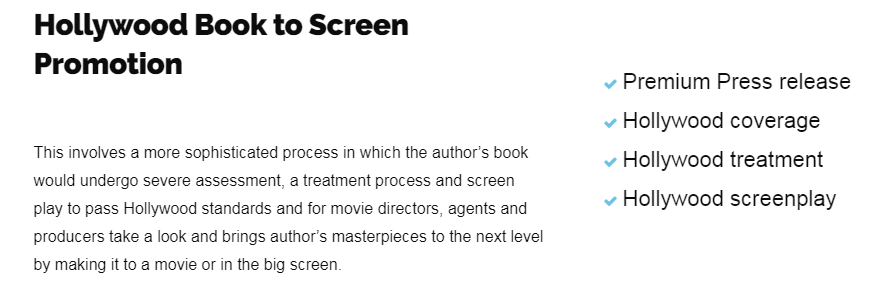
A sensible person might also wonder about the quality of written materials produced by a "Book-to-Screen Marketing Professional" that puts out website text like this (English-language lapses are one of the markers for the copycat scams):


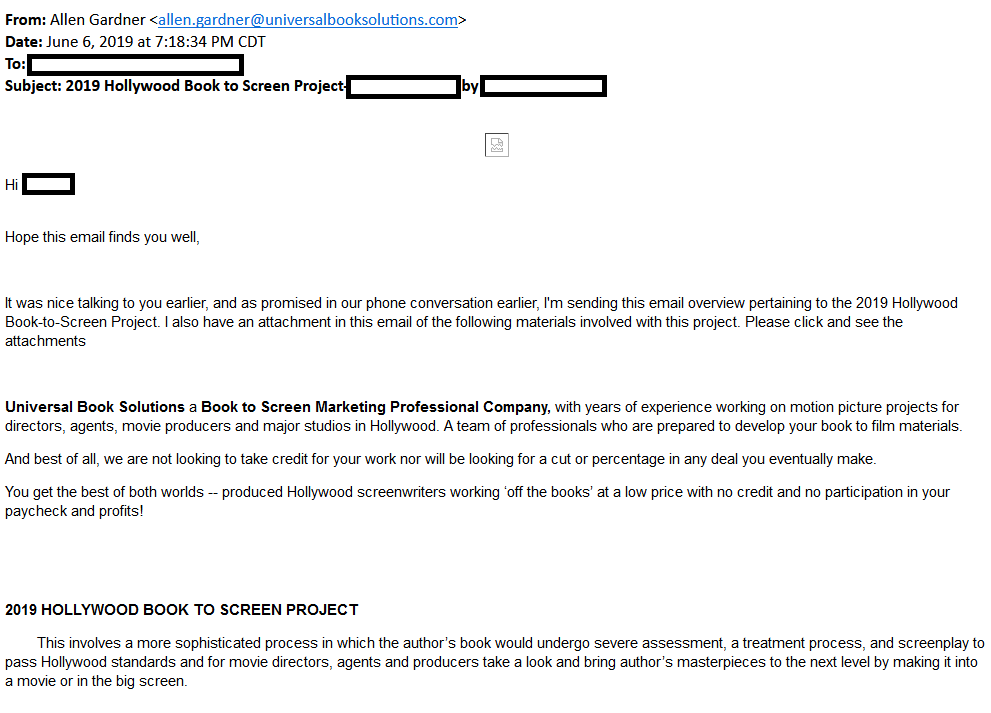
Here's how UBS's slightly more literate email pitch begins (I've seen two of these now, and they're identical):

The email goes on to detail the services on offer--news release, coverage, treatment, and screenplay--in language that has been lifted directly from the Xlibris (and other Author Solutions imprints) book-to-screen package. As further inducement, a bunch of glowing--and conveniently unverifiable--quotes are appended at the end. Turns out that these too have been lifted, though from a different (and, in its way, equally questionable) source.


Anonymous testimonials are the best kind, right?

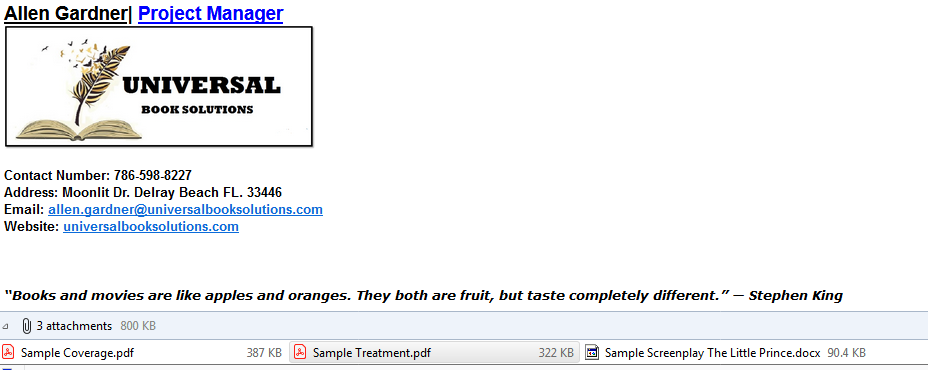
Last but not least, UBS includes several attachments--supposedly, examples of its work:


"Sample coverage" is this. Looks surprisingly literate and detailed, doesn't it? But wait. Here it is again...on the iUniverse website (the book was published by another Author Solutions imprint). Ditto for UBS's "sample treatment:" here's what UBS sent. Here it is at iUniverse (which also published the book in question).

(As for The Little Prince screenplay, I can't find any evidence of it online, but given all the other borrowing, it's sure to have been snitched from somewhere.)

So...a plagiarized book-to-screen package, promoted with plagiarized text, further promoted with plagiarized testimonials, and finished with sample documents produced by others and falsely presented as UBS's work. If you hand over your money to these folks (neither of the authors I heard from went far enough into the process to get a price), what do you think the odds are of getting any of the promised products?

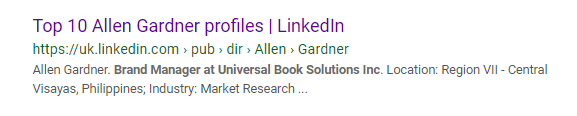
Universal Book Solutions claims a Florida address (per a Google search, it's a private residence in what looks like a condo community), but has no business registration in that state. Its web domain was registered just last February. As for Allen Gardner, Project Manager, guess where he's located.
UBS is an especially egregious example of this increasingly common scam. But as noted above, there are many others, and they are aggressively soliciting authors, especially those who have published with Author Solutions imprints, small presses, and pay-to-play companies like Christian Faith Publishing and Page Publishing. Be on your guard, and if you hear from a company that wants to take you to Hollywood--for a price--remember that if it sounds too good to be true, it probably is.

For a much more realistic discussion of the book-to-screen process, see Jane Friedman's excellent article, How a Book Becomes a Movie. Scroll down to the final comments to see one from a writer who was solicited by Universal Book Solutions.


v

Authors' Concern Grows Over Late Royalty Payments at Dreamspinner Press

&

Posted by Victoria Strauss for Writer Beware®

Scroll down for updates

On Wednesday, September 11, Publishers Lunch published an article by Erin Somers about payment issues at Dreamspinner Press, which I'm reprinting here with permission.
Dreamspinner Keeps Promising Authors to "Catch Up What Everyone Is Due" In Payments

Romance publisher Dreamspinner Press has not been paying royalties in timely fashion, authors have been reporting online, at least partially confirmed by emailed updates from the company that have been shared. Earlier this summer, authors posted on Twitter that the publisher had been inconsistent with payments for over a year, including delays in issuing both first quarter and second quarter 2019 royalties. In June, author TJ Klune posted, "Out of the last 8 quarters, this is the fourth time payments have been late, and the second in which I am owed penalties for said lateness." (Klune had said in March he would part ways with Dreamspinner after delivering three more books.) Author Suki Fleet posted, "I'm not waiting on a lot--but what I am waiting on is from foreign royalties paid to Dreamspinner this time *last* year, that I had to specifically ask for."

That month authors began announcing requests to revert their rights, a trend that continued over the course of the summer. There was some controversy within the romance community over whether authors withdrawing their work could cause the publisher to fail (or fail faster), in which case no one would get paid. Criticism extended to authors who supported the publisher as well, even though they were owed money.

Multiple agents PL spoke to said they were no longer doing business with Dreamspinner, except to negotiate their clients' rights back. They told us that acquisitions at the publisher had dwindled over the past year, confirmed by the sharp drop in PM deal reports, with Dreamspinner acquiring mostly from their existing authors, many of whom are unrepresented.

Dreamspinner provided authors a number of explanations in weekly emails, including writing that they had "not received payments from Amazon for UK or EU currencies," that they were awaiting deposits from "vendors," and that the late payments had been caused by a software glitch. In their latest update on September 4, the publisher said that they are anticipating a small business loan that will enable them to issue payments, and that they "can't offer a firm payment date to catch up what everyone is due." The email goes on, "With every set of deposits we receive, we've been sending payments, and we are continuing to respond as best we can to author requests." They added that they can't provide proof of the impending loan that authors have asked for because, "legal and banking documents are confidential and can't be posted online."

Meanwhile, authors including Indra Vaughn, Avon Gale, Jeff Adams, Will Knauss, CJane Elliott, Meredith Shayne, Tia Fielding, and many more have requested rights back. Fielding wrote on Facebook, "In the last year or so, they've repeatedly been more or less late in royalty payments." TJ Klune wrote in an email to the company that he posted on Twitter, that he is owed $27,448 in royalties and plans to involve a lawyer. A Facebook group of 75 former DSP authors has formed for people who have pulled their books or are considering it.

RWA has offered support for authors who have experienced trouble with Dreamspinner. They said in an August 21 statement: "We're aware of the situation, and members who need professional relations assistance, should contact memberadvocacy@rwa.org to reach our staff professional relations manager." Dreamspinner did not respond to PL's request for comment.
Writer Beware has been receiving similar complaints about late royalty and advance payments and confusing/conflicting explanations for the delays, with some authors saying they are owed four- and even five-figure amounts. According to a number of authors who contacted me, these problems have become more acute in the past few months, but they aren't new: periodic payment delays, with attendant excuses, began as much as two years ago.

Although Dreamspinner regularly sends out update emails (you can see an archive of these here), several authors told me they were having trouble getting responses from Dreamspinner CEO Elizabeth North.

Also of concern: in the midst of repeated payment delays, and despite its admissions of financial distress, Dreamspinner appears to be proceeding with sweeping expansion plans, including a shift to mass market paperback format, increasing the number of translations for the foreign market, and rolling out a new accounting and payment system (which several of the authors who contacted me told me they'd had trouble with). Multiple authors told me that they fear that author royalties, which Dreamspinner says go into an escrow account, are instead being used to finance company operations.

Authors' anger at the situation is growing. Meanwhile, Dreamspinner is still open for submissions. Writers who are considering approaching this publisher might want to hold off for the moment.

More information:

Tweets from authors Avon Gale, TJ Klune, Roan Parrish, KJ Charles (search "Dreamspinner" on Twitter to see many more).

Blog posts by authors Mary Winter, RJ Scott, Rhys Ford, TJ Klune.

Non-Dreamspinner author X. Marduk is compiling a Dreamspinner timeline, with lots of links to tweets and blog posts.

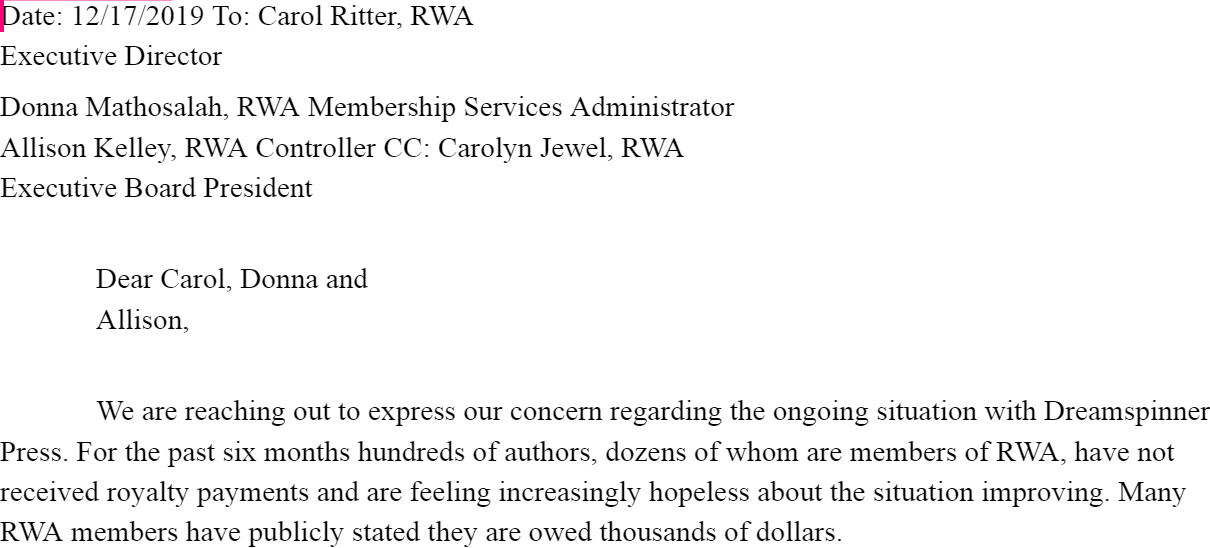
UPDATE 12/25/19: The payment problems at Dreamspinner appear to be ongoing. A group of Dreamspinner authors contacted RWA to request help:


You can read the entire letter here.

According to one of the letterwriters, RWA responded that there is nothing they can do. Dreamspinner's issues are now part of the implosion of Romance Writers of America, with writers increasingly furious over RWA's alleged foot-dragging in addressing complaints--not just about Dreamspinner, but generally.

UPDATE 12/28/19: Another of Dreamspinner's eminently reasonable-sounding but holy-crap-if-you-read-between-the-lines updates. (Summary, if you don't want to click on the tweet: they've hired a firm that specializes in financial restructuring to "develop a plan for 2020 and a structured repayment of all past due amounts." They promise to "be in touch with authors directly about their repayment schedule".)
When you have to explain yourself by saying "We want to make clear that this isn't bankruptcy", it's not generally a good sign.

UPDATE 1/16/20: I continue to hear from Dreamspinner authors who have not been paid. Some are owed thousands of dollars for the first three quarters of 2019, and have received no payment at all; some have gotten partial payment, or are owed for fewer quarters. Bottom line: Dreamspinner owes a crapload of money to its authors.

According to the latest update from Elizabeth North, "Payments for November have started posting. They will all be submitted through Tipalti [Dreamspinner's accounting software] by Friday, January 10." What this appears to mean--at least, as of this writing and based on the authors who have contacted me--isn't actual payment (as in, money in bank account), but a status change on Tipalti from "In Process" to "Submitted For Payment." Also, the payments are for November royalties only. Anything prior to that will be folded into the restructuring plan Dreamspinner says it is pursuing.

Other stuff:
  • Writers seem to be requesting rights reversion in droves. Many of them have multiple titles with Dreamspinner.
  • In some cases,Dreamspinner seems to be unilaterally charging certain fees or expenses or other amounts against what they owe individual writers--i.e., reducing royalties owed by whatever the amount of the expense is. I don't want to provide details here, because I don't want to risk identifying the writers.
  • The National Writers Union wants to hear from Dreamspinner authors who haven't been paid.
  • Dreamspinner is fully enmeshed in the implosion of RWA. Claire Ryan has an exhaustive timeline of the crisis that's tearing RWA apart, with references to RWA's anemic response to Dreamspinner authors' complaints, and allegations that recently-resigned RWA President and Dreamspinner author Damon Suede may not have been eligible for the office based on his actual publications.
One thing that's really striking to me in this whole mess is how, if you look at just one of Dreamspinner's announcements and updates, they sound so very businesslike and reasonable. It's only if you go back and read them all in sequence--as I just did--that the facade starts to crumble, with unmet deadlines, moving goalposts, and unfulfilled commitments.

Back in June, Dreamspinner was promising that "the remainder of outstanding royalties" were about to be released...but here we are in January 2020, and they still owe tens of thousands of dollars. In July, they promised that they were "in the final steps" with the Small Business Administration loan, and "estimated funding has been moved back to mid-August"...but as of January, the loan is still pending. Over the months from June through December, they promised repeatedly to get everyone paid (especially, again and again, royalties for Quarter 2)...and then, in December, they suddenly announced the hiring of a firm to re-structure the entire debt from October backward, with no details about the process, or even an end date for it. Presumably, this firm will want a fee...from a publisher that can't afford to pay its authors.

I get that it's tough out there for small presses. Things go wrong. Vendors are tardy. Loans fall through. Personal emergencies happen. But read from beginning to end, Dreamspinner's updates--so reasonable-seeming individually--start to feel like mere excuses. Together with authors' frustrations and complaints, they paint a really troubling picture.

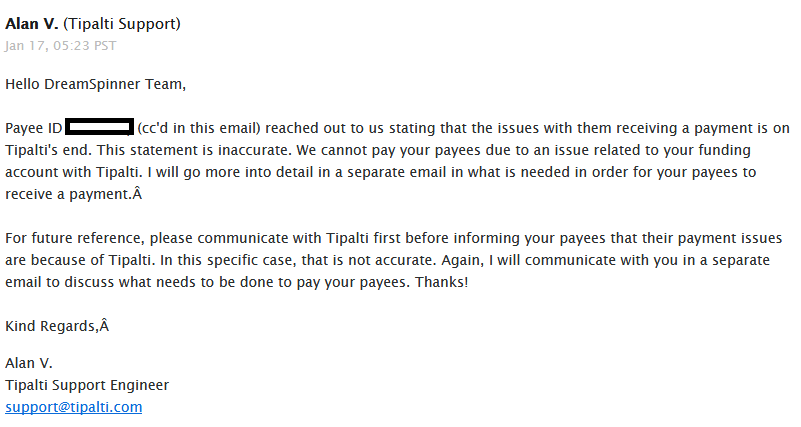
UPDATE 1/17/20: Re: all those November royalties that were to be released by January 10, and are currently listed in authors' Tipalti dashboards as "submitted" but not actually paid...this rather irate email from Tipalti to Dreamspinner in response to an author's inquiry about the delay suggests why nothing is landing in authors' bank accounts: Dreamspinner's payment account is not funded.


This is not good news. It's really starting to feel like there's some serious gaslighting going on here.

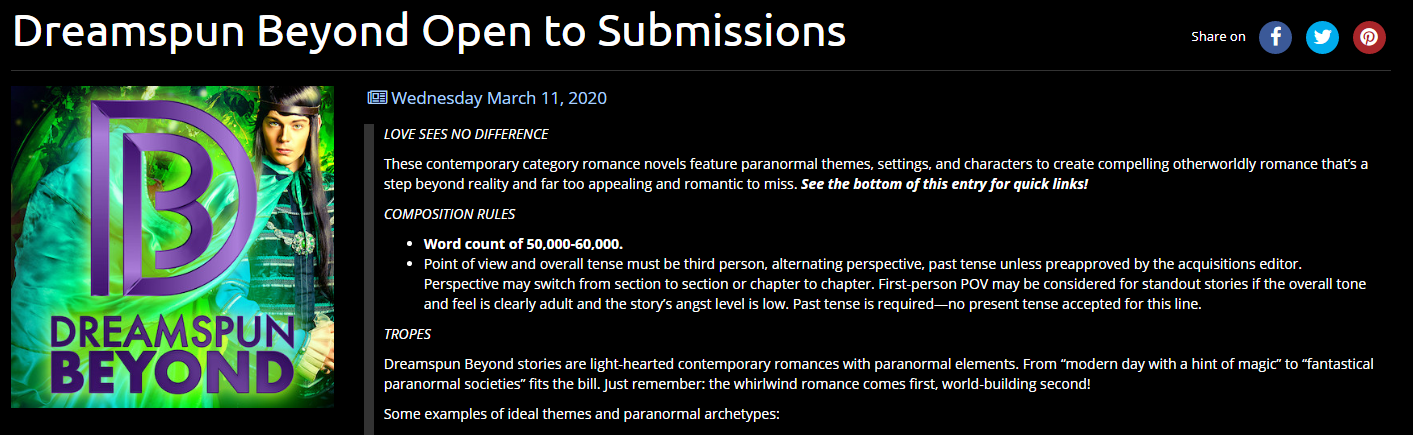
UPDATE 3/19/20: Dreamspinner has not provided an author update since January 7, and writers are still reporting that royalties are in arrears. Yet, amazingly, Dreamspinner is open to submissions:


Also seeking submissions: Dreamspun Desires.

Writer beware.


v

Vanity Radio: Why You Should Think Twice Before Paying For an Interview


Posted by Victoria Strauss for Writer Beware®

In a super-crowded, hyper-competitive marketplace, one of the main challenges for book authors is to stand out. And where there's a need, there are always unscrupulous operators waiting to take advantage. The internet is awash in worthless schemes and outright scams designed to profit from authors' hunger for publicity and exposure.

I've written about a number of these--Hollywood book-to-screen packages, the hugely marked-up PR options offered by Author Solutions, the plague of marketing scams originating in the Philippines. Others to watch out for include book fair display packages (publishing industry expert Jane Friedman has a good article on why these are not worth your money), pay-to-play book review services, and what I'm going to talk about in this post: vanity radio.

What's vanity radio? In the "writer beware" context, it's radio air time that you, the program guest, have to pay for. Such schemes have been around forever in various forms, aimed at experts and creatives of all kinds, from services that explicitly sell pay-to-play interviews, to show hosts that charge interview fees to defray the fees they themselves have to pay their platforms.

The main selling point is the promise that your interview will be heard by a large and eager audience, giving wide exposure to you and your book (see the pitches that I've pasted in below). But vanity radio is primarily online radio, delivered via platforms like Blog Talk Radio and Spreaker, and streaming services like iTunes, iHeart Radio, and SoundCloud. Online radio listenership is steadily rising, but unless there are subscriber lists (as on YouTube, for instance), there's usually no way to determine the audience for any given host or show--or to authenticate any listenership claims the show may make. Lots of people may be tuning in...or no one at all.

As a result, the only verifiable benefit authors may receive for their money is an audio or audio-and-video clip that they can post to their websites and social media accounts. Whether that's worth it when it costs $99 or $150 or $200 is debatable enough. But when the price tag is four figures?

As always in the realm of junk marketing aimed at writers, Author Solutions has been both the pioneer and the primary practitioner. All its imprints sell vanity radio in some form: here's AuthorHouse's offering, for instance (just $1,099!). iUniverse's is identical. Xlibris and Trafford currently sell teasers rather than interviews (for significantly more money), but through 2017 they too hawked interviews.

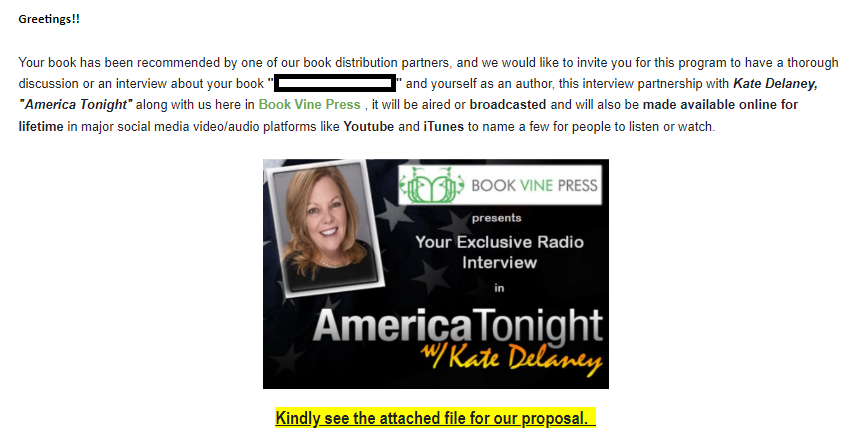
Recently, however, AS's leadership in the realm of predatory marketing services has been challenged by a flood of scammy imitators. These copycat ripoff factories have adopted vanity radio in a big way, and they aggressively hawk it to authors, both on its own and as part of costly publishing and marketing packages. Here, for instance, is an offer from Book Vine Press (cost: $1,500):

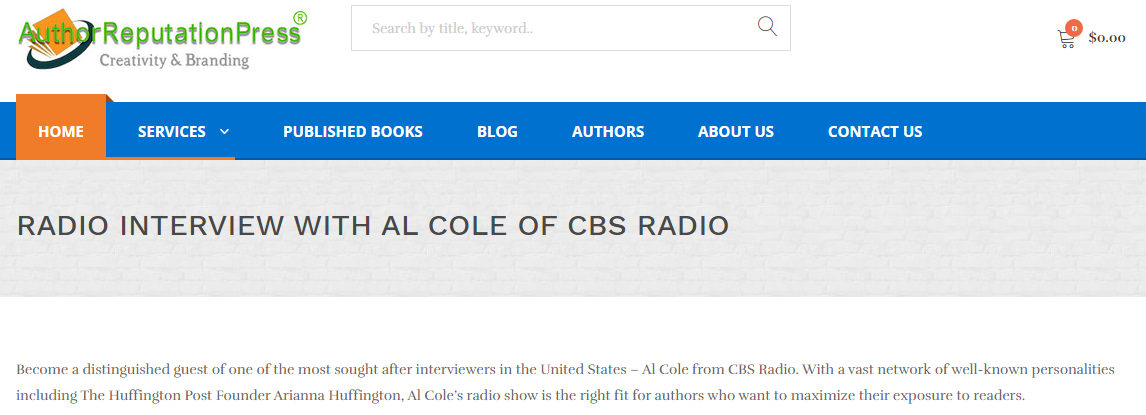
From Author Reputation Press (cost: £1,500):


From Parchment Global Publishing (cost: $1,499):


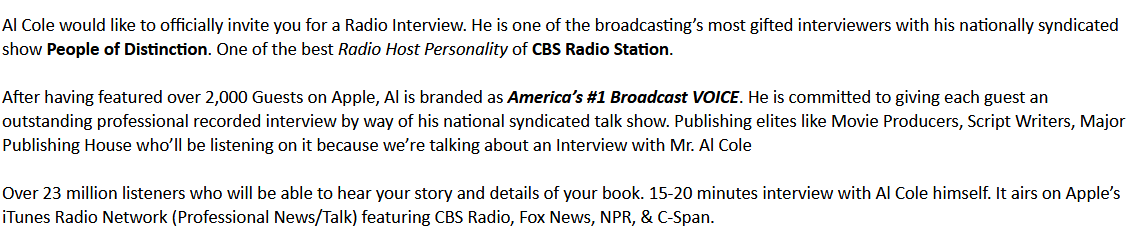
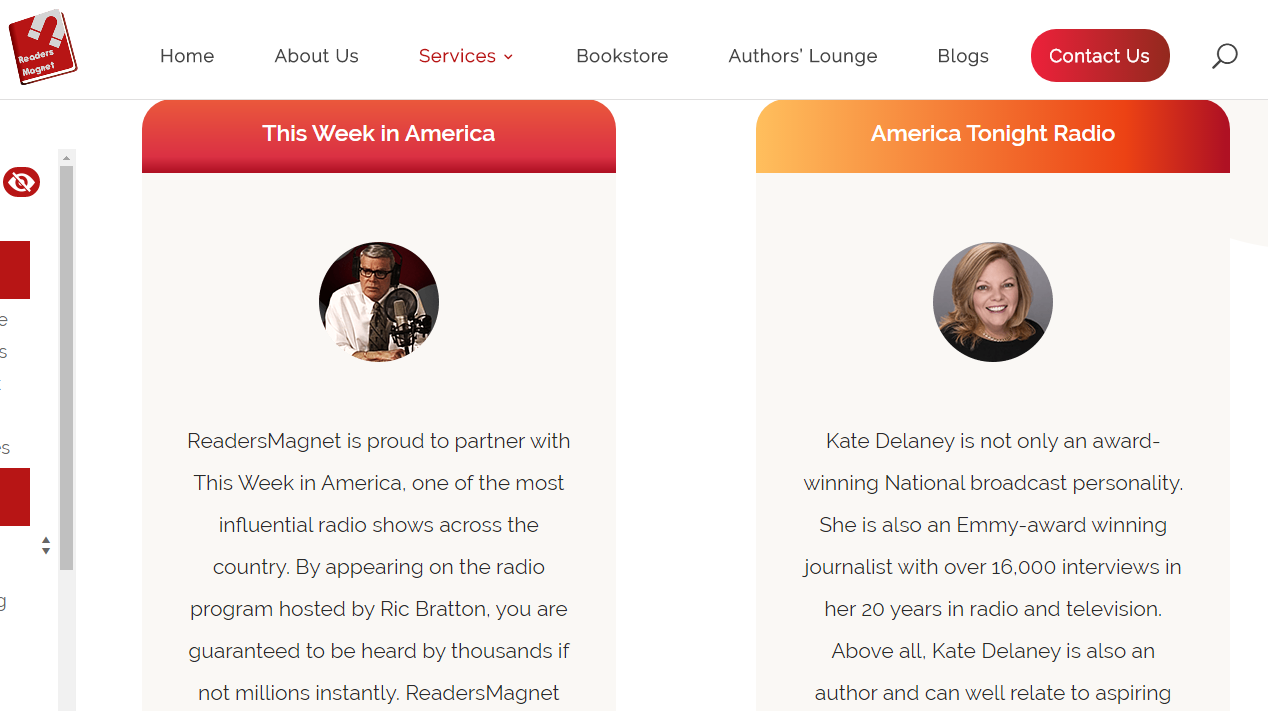
The copycats re-sell the services of a number of show hosts (there's a list below), but the three personalities noted above--Kate Delaney with America Tonight Radio, Ric Bratton with This Week in America, and Al Cole with People of Distinction--make the most frequent appearances on the copycats' websites and in their email solicitations. Delaney and Bratton have substantial, legit resumes in TV and radio; Cole is a bit harder to research, but he too seems to have a sizeable track record as a talk show host.

What, if anything, do they know of the reputation and tactics of the copycats that are re-selling their services? I contacted all three for comment last week. Cole's assistant responded in email that "Al Cole knew nothing about this....Our office will certainly look into this." As of this writing, I haven't heard back from Delaney or Bratton.

Given that the copycats routinely charge an enormous markup on products they re-sell (see, for instance, this warning from the Combined Book Exhibit, whose book fair exhibit packages many of the copycats re-sell for hugely inflated prices; the copycats also seriously jack up the fees for paid book reviews such as Kirkus Indie and BlueInk Reviews), it seems a fair bet that the interviews' hefty price tags are substantially inflated as well.

Apart from the question of such interviews' value for book promotion, that seems like reason enough to avoid them.

******

Author Solutions copycats that sell interviews from the individuals mentioned above:

BookVenture, ReadersMagnet, Maple Leaf Publishing, Parchment Global Publishing, Rustic Haws, Branding Nemo, Creative Titles Media, Paradigm Print, Stampa Global, Books Scribe, Matchstick Literary, PageTurner Press, EC Publishing, WestPoint Print and Media: Ric Bratton

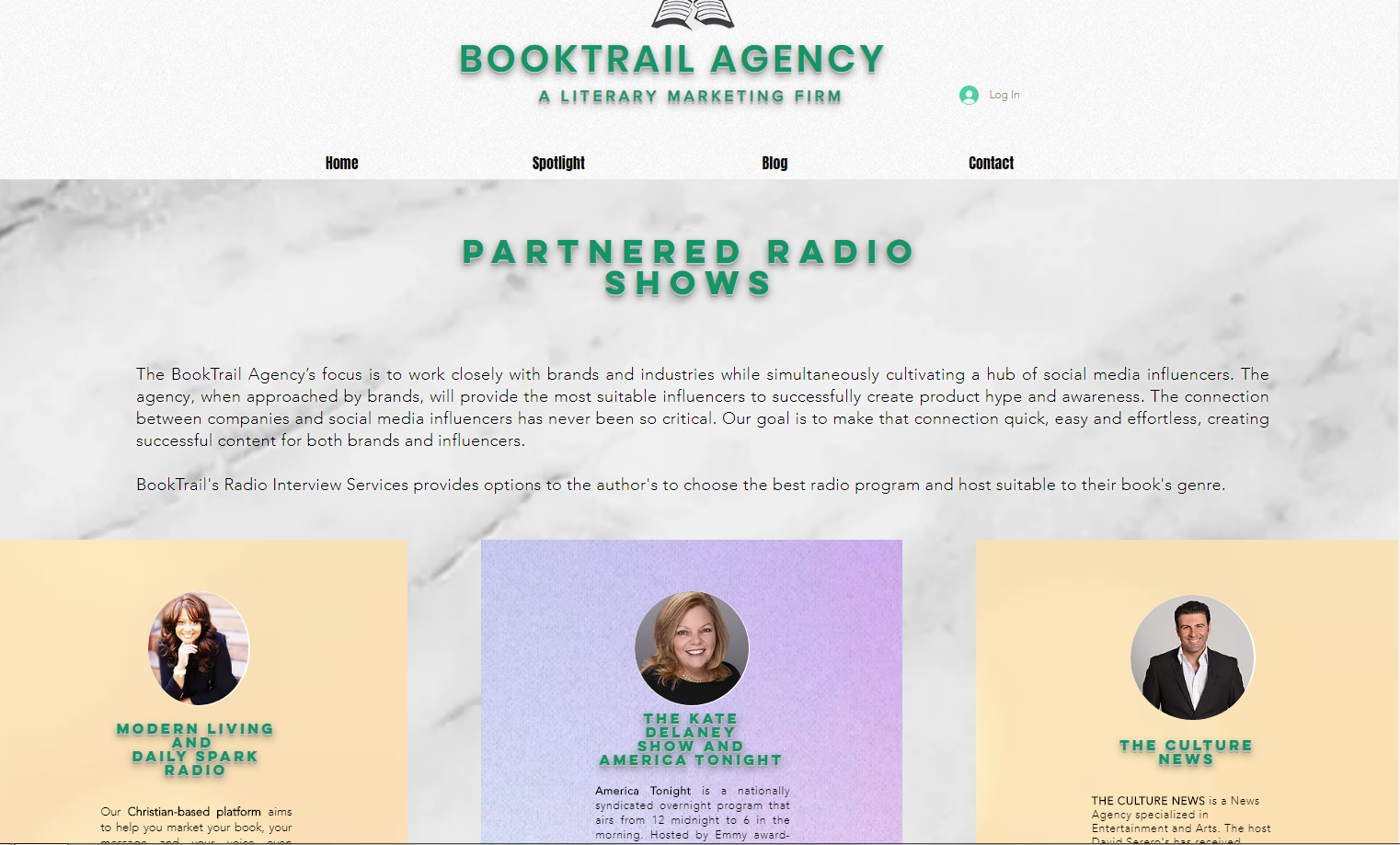
LitFire Publishing, Author Reputation Press, ReadersMagnet, BookTrail Agency, Book-Art Press, Box Office Media Creatives, IdeoPage Press, Book Agency Plus: Kate Delaney


ReadersMagnetAuthor Reputation Press, Rustik Haws, URLink Print & Media, Workbook PressParchment Global Publishing, BookWhip: Al Cole


BookTrail Agency: David Serero

BookTrail Agency, Book Agency Plus: Angela Chester


UPDATE 1/9/19: Parchment Global has added the disclaimer in red to its solicitations for Al Cole interviews (it might want to do some proofreading):


I don't know if this was at Mr. Cole's behest (remember, he's the only vanity radio host who responded--if not very expansively--to my request for comment) or is just CYA by Parchment Global itself, but hey--it lets me know that the scammers are still reading my blog.

Do I believe Parchment Global has stopped taking a cut? What do you think?


v

Writer Beware: 2019 in Review

Posted by Victoria Strauss for Writer Beware®

Happy New Year! It's that time again--time for a look back at the schemes, scams, and issues Writer Beware covered in 2019.

PUBLISHER TROUBLES

Sadly, there's never a shortage of stories like these.

Scandal Engulfs Independent Publisher ChiZine PublicationsArguably the biggest small press story of the year, the spectacular collapse of Canadian indie ChiZine Publications--amid allegations of non-payment, financial mismanagement, and a horrifically toxic work culture rife with bullying, sexual harassment, racism, and more--posed thorny questions for the small press community about cultures of silence, the treatment of whistleblowers, and the tacit enabling of unprofessional behavior.

Authors' Concern Grows Over Late Royalty Payments At Dreamspinner Press: Multiple author complaints of nonpayment and other problems, for which Dreamspinner has provided confusing and conflicting explanations. (Dreamspinner has become part of the implosion of Romance Writers of America, with RWA accused of failing to assist Dreamspinner authors who requested help.)

Fireside Press Cancels Multiple Contracts: Mass contract cancellations don't generally bode well for publisher health.

Complaints At Month9Books, Nonstandard Business Practices at Black Rose Writing: Long-standing issues, including late payments and bullying, appear to be ongoing at Month9. As for Black Rose, it presents as a "traditional" publisher but, vanity publisher-style, sells a large menu of marketing services to its authors.

Trouble at Dog Ear Publishing: Multiple, long-standing author complaints of nonpayment by this assisted self-publishing company (this publishing model is in trouble generally).

AWARDS TO AVOID

If you've been reading here for a while, you'll know that I'm no fan of contests and awards--not just because they often involve big entry fees (even the legit ones), but because they so often have author-unfriendly rules and guidelines. Here are a few I encountered in 2019.

Can We Get a Do-Over? What do you do when you get caught with predatory language in your contest guidelines? You hastily switch it out, of course. That's what Harper's Bazaar did when the copyright grab in its annual short story competition was outed on Twitter.

Rights Grabs by the Sunday Times Audible Short Story Award: Another prestigious (and rich: the winner gets £30,000) contest with a predatory rights grab.

The Pressfuls Short Story Contest: Why not to enter a contest that doesn't post rules and guidelines: you may discover, as writers who entered this contest did, that your work has been published without your permission.

SAVE YOUR CASH

The shady underbelly of the publishing world is chock-a-block with those who scheme to take authors' money, by fair means or foul. Here are some especially foul examples.

Seven Prolific Vanity Publishers: A look at the vanity publishers about which I get the most questions, including Austin Macauley, Page Publishing, and Christian Faith Publishing.

Anatomy of a Book-To-Screen Scam: One of the most unlikely outcomes of publishing a book is selling film rights. Book-to-screen scammers--who purport to turn your book into a screenplay, shop it to Hollywood, and more--don't want you to know that.

Vanity Radio: Why You Should Think Twice: Should you ever pay for a radio interview? Like paid book reviews, this is an iffy proposition--even if you're not being solicited by a scammer.

A Pack of Scammer Lies: Dissecting the highly deceptive pitch by one especially egregious publishing and marketing ripoff.

ADVICE YOU CAN USE

When a Publisher Claims Copyright on Edits: This predatory practice is a big publishing contract red flag.

How Predatory Companies Are Trying to Hijack Your Publisher Search: Among other sneaky techniques: fake publisher matching sites that purport to guide you to appropriate publishers but steer you to vanities and self-publishing companies; deceptive use of Google ads to do the same thing; fake facts and statistics about traditional publishing designed to make the vanity model seem preferable.

Awards Profiteers: How Writers Can Recognize Them and Why They Should be Avoided: Profiteering awards programs have a secret agenda: making money for the sponsor with huge entry fees. They're not about honoring writers.

GENERAL BEWARES

Be careful out there!

From the Philippines, Not With Love: A Plague of Publishing and Marketing Scams: This is one of the biggest new scam trends threatening self-pubbed and small press authors. Some background on how the scams came to be, plus a list of the nearly 70 scammers I've discovered so far.

Issues at Audible's ACX: Including attempted rights fraud and inexplicably withdrawn promo codes.

Caution: Turkish Publisher Mavifil Publishing (Mavifil Yayinlari): Old scammers never die; they just change their names. A non-paying publisher that stalked writers in 2011 returns to stalk them in 2019.

AMS Literary Agency: Approach With Caution: Old scammers never die; they just change their names. Whoops, didn't I just say that? The owner of one of the most notorious vanity publisher scams ever returns in the guise of a literary agent.

Beware: Wid Bastian aka Widtsoe T. Bastian/Genius Media Inc./Kairos Phoenix Company: A convicted felon, an ebook promo and box set scheme. What could go wrong?

Publishizer: Do Authors Really Need a Crowdfunding Literary Agency? Yet another of those reinvent-the-wheel attempts that are so common in publishing: a crowdfunding site for writers that claims to represent manuscripts to publishers, but is mostly used by vanities and other fee-chargers (some of them seriously questionable).


v

Writer Beware in the Time of Coronavirus

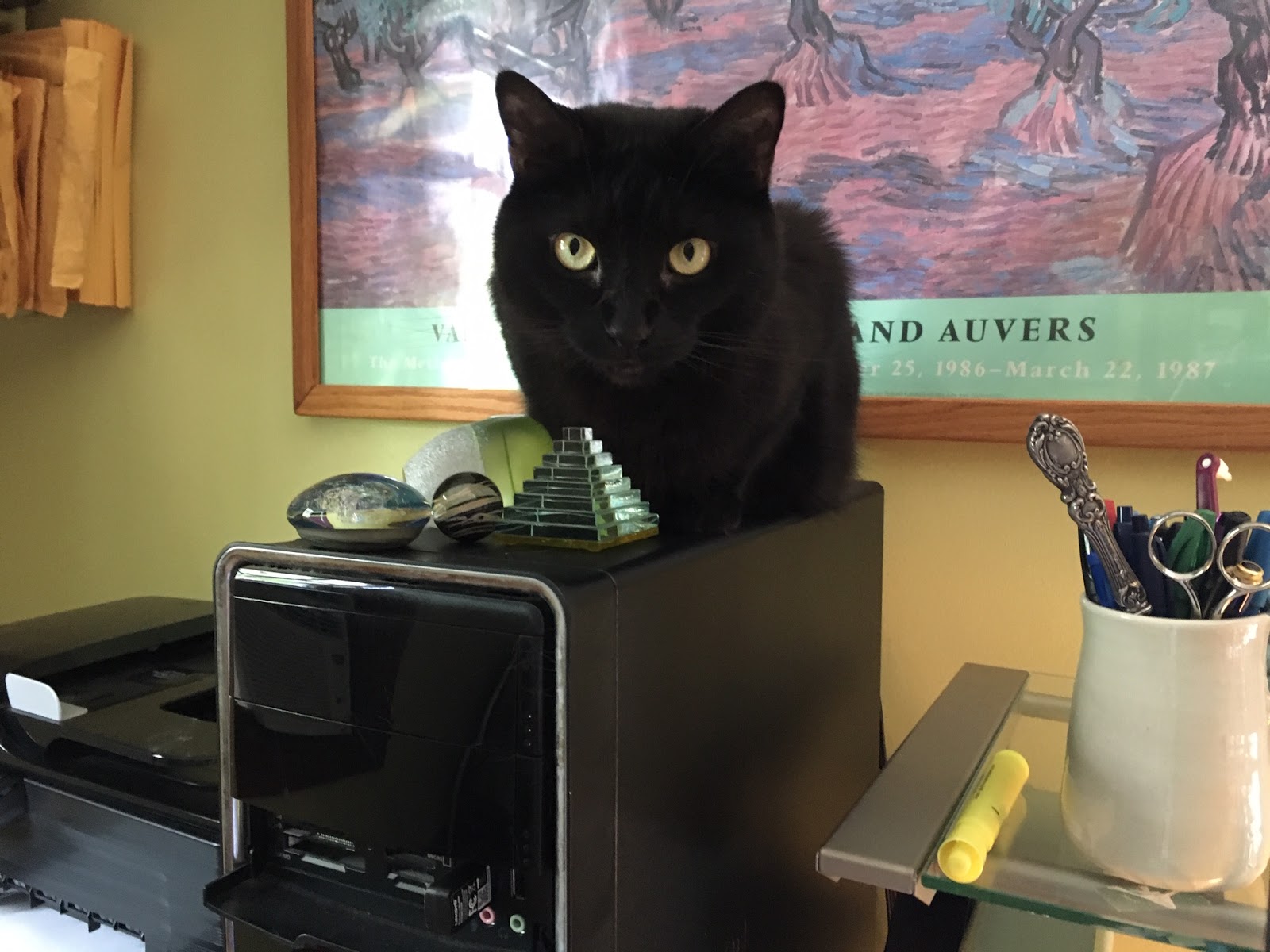
My home office, with feline assistant.
Posted by Victoria Strauss for Writer Beware®

I rarely make personal posts on this blog. But, as I don't need to remind anyone, these are scary times.

My husband and I are physically fit and in general good health, but we are both 64 and he has an underlying health condition. Based on everything we're seeing and reading, we've concluded that our best covid-19 strategy is either a) not to get sick, or b) to delay getting sick as long as possible in hopes of more treatment options or at least less hospital crush.

Our social distancing began last weekend. We've completely withdrawn from face-to-face social interaction, and are ordering non-perishables and household items online. No more routine doctor or dentist visits. No more stores, library, restaurants, or gym (we're in Massachusetts, where a lot of things are shut down anyway). I'm still on the fence about careful, non-peak hour grocery shopping for fresh produce--but I certainly won't be going while shelves are bare from people's absurd panic buying (some of the same people, probably, who are still having parties and crowding into bars *eyeroll*).

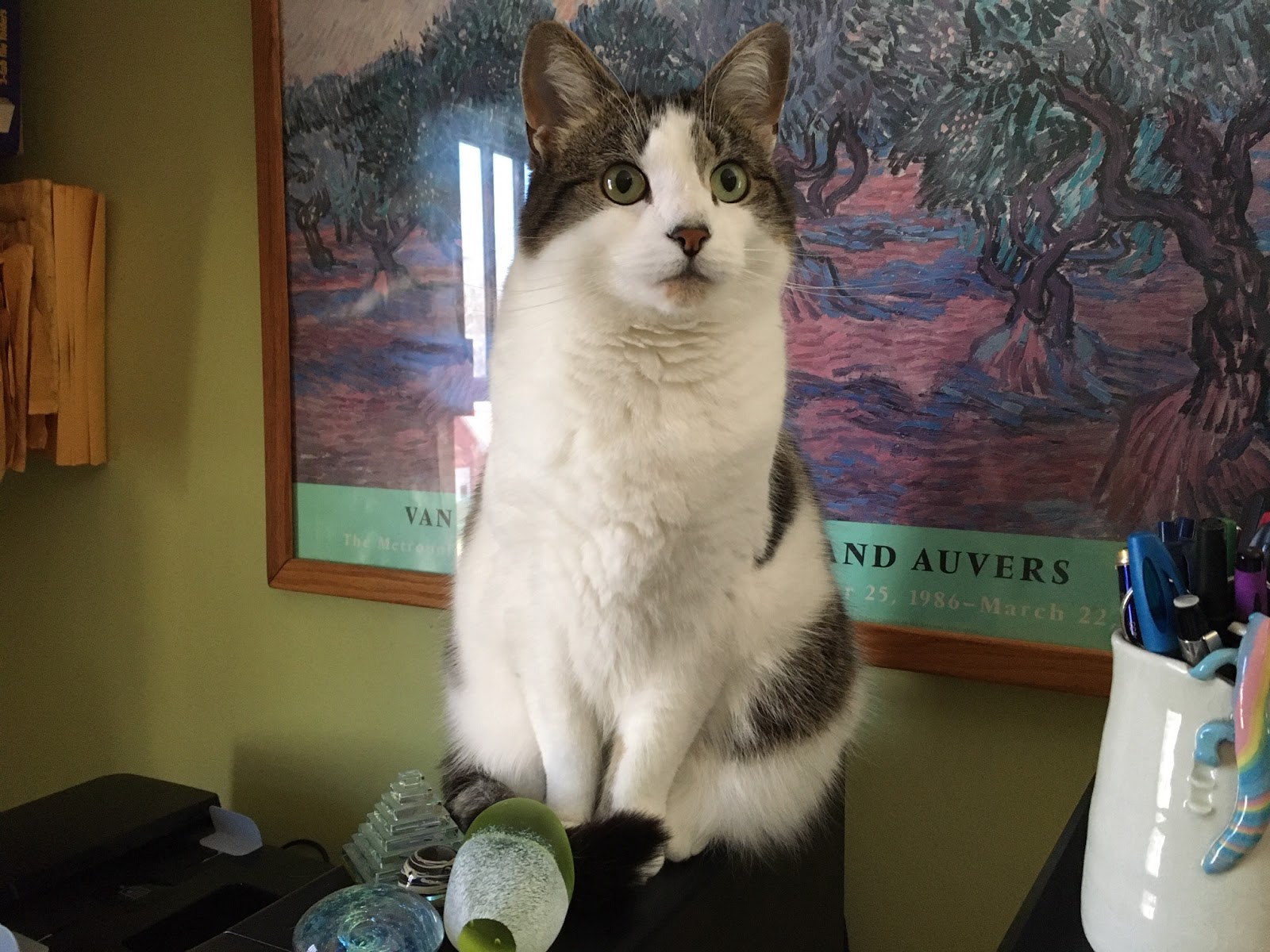
Sarah, my other assistant. Kittehs are a comfort.
We're acutely aware that this is MUCH easier for us than it is for most. We both already work from home. We have decent financial resources. We don't have kids. Elderly relatives are all dead. Family and many friends are geographically distant, so we're already socially distanced there. We can still go out for walks and runs. I can still garden (one of my major passions).

So the changes to our routine are relatively small, compared to many. It's tougher for my husband than for me--the majority of my social life is online, but he is a gregarious person with a wide circle of friends, colleagues, and peers. But there's always Zoom and Skype, and he's making use of both.

For us as for many, stress and fear are daily companions. This is not the zombie apocalypse; there will be a vaccine eventually, and civilization will survive, as it survived the flu pandemic of 1918. But...how bad will it get? How long will it last--will we have to live this way for a year? More? What will happen to friends and family? What will happen to the people who are thrown out of work by widespread (and, I'm guessing, soon nationwide) business closures? The people who have no insurance? The people in prisons and ICE jails, the immigrants packed together at the border? And what about the election? I didn't think, back in innocent December, that that could become more crucial. But, as I stand in horror before the shitshow happening in Washington, it's clear to me that it has.

These and other questions haunt me on a daily, sometimes an hourly, basis. I suffer from depression--have done since childhood--and one of my fears is that I'll sink into a clinical episode. I can feel that possibility stalking around the edges of everything now. I am doing my best to resist. My husband, thank goodness, is more resilient. We work to keep each other's spirits up.

At a time like this, ordinary activities--like maintaining this blog--start to feel irrelevant. But they're not. Life goes on, even in the face of catastrophe. I seriously doubt that covid-19 will put a dent in the volume of schemes and scams that target writers who will still be writing, still seeking agents, still publishing. And one of the most important strategies for resisting helplessness and depression is work, for those of us who are still lucky enough to be able to do it.

Emily: Why are you taking my picture _again_?
So Writer Beware will go on. I'll continue to be active on Facebook and Twitter. As much as possible, I'll post here as I usually do--not always weekly, but as often as I find things to write about. And I urge you to continue to email me with your questions, concerns, reports, and complaints. Please, keep the emails coming.

And: wash your hands.

Don't touch your face.

Cough or sneeze into your elbow,.

Keep your distance: 6 feet is optimal.

Stay home if you can, especially if you're sick (I know this is tough for many to do).

Check on your elderly neighbors (from a distance).

Resist panic buying.

Don't share health information unless you're sure it comes from a reputable source (Facebook, oh my God).

Be safe.

I'll be seeing you.


v

Copyright Violation Redux: The Internet Archive's National Emergency Library


Posted by Victoria Strauss for Writer Beware®

The enormous digital archive that is the Internet Archive encompasses many different initiatives and projects. One of these is the Open Library Project, a huge repository of scanned print books available for borrowing in various digital formats.

Unlike a regular library, the IA does not purchase these books, but relies on donations to build the collection. Nor are permissions sought from copyright holders before creating the new digital editions. And although the IA claims that the project includes primarily 20th century books that are no longer widely available either physically or digitally, the collection in fact includes large numbers of 21st century books that are in-copyright and commercially available--and whose sales the Open Library's unpermissioned versions have the potential to harm.

Most professional writers' groups consider the Open Library to be not library lending, but massive copyright violation. Many have issued alerts and warnings (you can see SFWA's alert here), and many authors have contacted the IA with takedown requests (to which the IA was not always terrific at responding; you can see my account of my own frustrating experience here).

In the fall of 2018, a novel (and disputed) legal theory was created to justify the Open Library and similar initiatives, called Controlled Digital Lending (CDL). CDL's adherents present it as "a good faith interpretation of US copyright law for American libraries" seeking to conduct mass digitization projects, and invoke as support the "exhaustion" principle of the first sale doctrine (the idea that an authorized transfer of a copyrighted work "exhausts" a copyright holder's ability to subsequently control the use and distribution of  that copy; this is what allows used book sales, for example) and the fair use doctrine (a complex principle that permits the copying of a copyrighted work as long as the copying is limited and transformative). As long as the library restricts its lending in ways similar to restrictions on the lending of physical books (for instance, allowing only one user at a time to access each digital format), CDL holds that creating new digital editions of in-copyright books and lending them out is fair use, and copyright holders' permission isn't necessary.

Libraries in particular have embraced CDL. Publishers' and writers' groups...not so much, especially in light of a recent legal decision that rejected both the first sale doctrine and fair use as basis for re-selling digital content. Here's the Authors Guild:
CDL relies on an incorrect interpretation of copyright’s “fair use” doctrine to give legal cover to Open Library and potentially other CDL users’ outright piracy—scanning books without permission and lending those copies via the internet. By restricting access to one user at a time for each copy that the library owns, the proponents analogize scanning and creating digital copies to physically lending a legally purchased book. Although it sounds like an appealing argument, the CDL concept is based on a faulty legal argument that has already been rejected by the U.S. courts.

In Capitol Records v. ReDigi, the Second Circuit held that reselling a digital file without the copyright holder’s permission is not fair use because the resales competed with the legitimate copyright holder’s sales. It found that market harm was likely because the lower-priced resales were sold to the same customers who would have otherwise purchased new licenses. In this regard, the court emphasized a crucial distinction between resales of physical media and resales of digital content, noting that unlike physical copies, digital content does not deteriorate from use and thus directly substitutes new licensed digital copies.

The same rationale applies to the unauthorized resale or lending of ebooks. Allowing libraries to digitize and circulate copies made from physical books in their collection without authorization, when the same books are available or potentially available on the market, directly competes with the market for legitimate ebook licenses, ultimately usurping a valuable piece of the market from authors and copyright holders.
For a more detailed deconstruction of CDL's arguments, see this statement from the Association of American Publishers.

Flash forward to 2020, and the coronavirus pandemic crisis. Last week, the IA announced the debut of the National Emergency Library--really just the Open Library, but with some new provisions.
To address our unprecedented global and immediate need for access to reading and research materials, as of today, March 24, 2020, the Internet Archive will suspend waitlists for the 1.4 million (and growing) books in our lending library by creating a National Emergency Library to serve the nation’s displaced learners. This suspension will run through June 30, 2020, or the end of the US national emergency, whichever is later.

During the waitlist suspension, users will be able to borrow books from the National Emergency Library without joining a waitlist, ensuring that students will have access to assigned readings and library materials that the Internet Archive has digitized for the remainder of the US academic calendar, and that people who cannot physically access their local libraries because of closure or self-quarantine can continue to read and thrive during this time of crisis, keeping themselves and others safe.
What this boils down to, under all the high-flying verbiage: the IA is ditching the one-user-at-a-time restriction that is one of the key justifications for the theory of controlled digital lending, and allowing unlimited numbers of users to access any digitized book in its collection.

The Authors Guild again, on how this harms authors:
IA is using a global crisis to advance a copyright ideology that violates current federal law and hurts most authors. It has misrepresented the nature and legality of the project through a deceptive publicity campaign. Despite giving off the impression that it is expanding access to older and public domain books, a large proportion of the books on Open Library are in fact recent in-copyright books that publishers and authors rely on for critical revenue. Acting as a piracy site—of which there already are too many—the Internet Archive tramples on authors’ rights by giving away their books to the world.
Here's just one concrete example. Katherine Harbour's Nettle King is available for borrowing in the National Emergency Library as a scan, an EPUB, and a PDF (the IA's EPUB versions are OCR conversions full of errors). Published in 2016, it's also "in print" and available on Amazon and other online retailers as an ebook, in addition to other formats. The IA, which never bought a digital license to Ms. Harbour's book and scanned and uploaded it without permission, now is proposing to allow unlimited numbers of users to access it, potentially impacting her sales. How is this any different from a pirate site?

Announcement of the National Emergency Library has been greeted rapturously by the press and by libraries. Less regarded has been the flood of protest and criticism from authors and professional groups. In situations like these, authors and publishers tend to be dismissed as greedy money-grubbers who are putting profits ahead of the march of progress and the noble dream of universal access to content...despite the fact that authors' right to make money from their work--and, just as important, to control the use of it--springs directly from the US Constitution, and has been enshrined in law since 1790.

In response to the outcry over the National Emergency Library, the IA has issued a justification of it, citing the "tremendous and historic outage" of COVID-19-related library closures, with "books that tax-paying citizens have paid to access...sitting on shelves in closed libraries, inaccessible to them." This noble-sounding purpose conveniently ignores the fact that those libraries' (legally-acquired and paid-for) digital collections are still fully available.

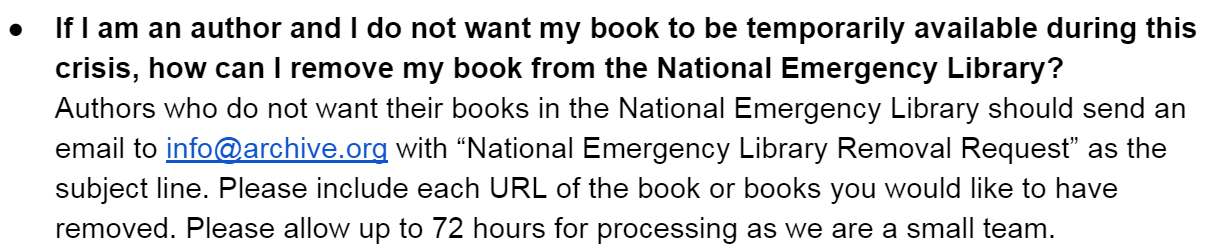
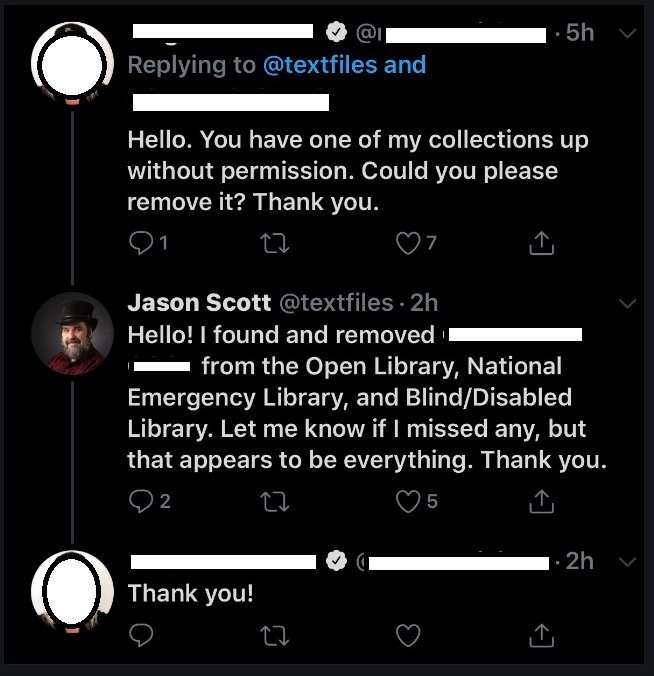
If your book is included in the National Emergency Library, and you don't want it there, the IA will graciously allow you to opt out (another inversion of copyright, which is an opt-in system).


Hopefully they'll be more responsive than they were in 2018, when I sent them DMCA notices that they ignored. Or later, when they began rejecting writers' takedown requests by claiming that the IA "operates consistently with the Controlled Digital Lending protocol.”

******************

I've covered this question above, but I want to highlight it again, because it's such a persistent objection when this kind of infringement occurs: Brick-and-mortar libraries lend out books for free, so how are the IA's "library" projects any different?

A few reasons.

- Brick-and-mortar libraries buy the books they lend, a separate purchase for each format (hardcover, paperback, ebook, audiobook, etc.). The author gets a royalty on these purchases. The IA seeks donations, and lends those. Authors get nothing.

- Brick-and-mortar libraries lend only the books they purchase. They don't use those books to create new or additional, un-permissioned lending formats. That's exactly what the IA does. Moreover, one of its additional lending formats is riddled with OCR errors that make them a chore to read. Apart from permission issues, this is not how authors want their books to be represented to the public.

- People who advocate for looser copyright laws often paint copyright defenders as greedy or mercenary, as if defending copyright were only about money. It's worth remembering another important principle of copyright: control. Copyright gives authors not just the right to profit from their intellectual property, but to control its use. That, as much as or even more than money, is the principle the IA is violating with its library projects.

UPDATE: It appears that the IA--on its own initiative--is removing not just illegally-created digital editions in response to authors' takedown requests, but legally-created DAISY editions as well, even where authors don't ask for this (DAISY is a format for the visually impaired, and like Braille, is an exception in copyright law and is also permissioned in publishing contracts).


It did the same thing in 2018, even where the takedown requests specifically exempted DAISY editions. I don't know if the current removals reflect expediency or possibly are just a kind of FU to writers (and, indirectly, to disabled readers), but if you send a removal request to the IA, you might consider specifically asking them not to remove any editions for the blind and disabled (which, again, are legal for the IA to distribute).

UPDATE 4/2/20: The Authors Guild has issued a statement encouraging writers to demand that the Internet Archive remove their books from its National Emergency Library. The statement includes instructions on what to do, along with a sample DMCA notice in the proper legal form.

UPDATE 4/8/20: SFWA has issued a statement on the National Emergency Library, describing the legal theory of Controlled Digital Lending as "unproven and dubious". (A link to SFWA's DMCA notice generator is included.)
[U]sing the Coronavirus pandemic as an excuse, the Archive has created the “National Emergency Library” and removed virtually all controls from the digital copies so that they can be viewed and downloaded by an infinite number of readers. The uncontrolled distribution of copyrighted material is an additional blow to authors who are already facing long-term disruption of their income because of the pandemic. Uncontrolled Digital Lending lacks any legal argument or justification.
UPDATE 4/9/20: The Chairman of the US Senate Subcommittee on Intellectual Property, Thom Tillis, has sent a letter to the Internet Archive, pointing out the many voluntary initiatives by authors, publishers, and libraries to expand access to copyrighted materials, and expressing concern that this be done within the law. 
I am not aware of any measure under copyright law that permits a user of copyrighted works to unilaterally create an emergency copyright act. Indeed, I am deeply concerned that your "Library" is operating outside the boundaries of the copyright law that Congress has enacted and alone has the jurisdiction to amend.
The letter ends by punting "discussion" until "some point when the global pandemic is behind us." So, basically, carry on and maybe at some point we'll talk.

UPDATE 4/15/20: Internet Archive founder Brewster Kahle has responded to Sen. Tillis's letter, claiming that the National Library is needed because "the entire physical library system is offline and unavailable" (even though libaries' legally acquired digital collections are still fully available) and that "the fair use doctrine, codified in the Copyright Act, provides flexibility to libraries and others to adjust to changing circumstances" (there's no such language in the actual Fair Use statute).

Kahle also notes:
In an early analysis of the use we are seeing what we expected: 90% of the books borrowed were published more than ten years ago, two-thirds were published during the twentieth century. The number of books being checked out and read is comparable to that of a town of about 30,000 people. Further, about 90% of people borrowing the book only looked at it for 30 minutes. These usage patterns suggest that perhaps that patrons may be using the checked-out book for fact checking or research, but we suspect a large number of people are browsing the book in a way similar to browsing library shelves.
But this is hardly a compelling argument. Large numbers of these books are certainly still in copyright, and many are likely still "in print" and commercially available (in digital form as well as hardcopy). Just because a book was published more than ten years ago or prior to 2000 doesn't magically cause it to become so hard to find it must be digitized without permission in order to save it. "But they're older books" sidesteps, rather than addresses, the thorny copyright issues raised by the IA's unpermissioned scanning and digitizing.

This passage also tacitly confirms the IA's abandonment of the one-user-at-a-time restriction that is a key feature of the rationale for the Controlled Digital Lending theory. If the basis for your enterprise is a legal theory whose strictures can be jettisoned at will, how credible is that theory really?

Kahle also claims that "No books published in the last five years are in the National Emergency Library". As it happens, the example I provide above (Katherine Harbour's Nettle King) handily disproves this statement: it was published in 2016, and was digitized by the IA in 2018 (you can see the scan here). I seriously doubt it's the only instance. Either Kahle is being disingenuous, or he doesn't know his own collection.

As a sop to creators, Kahle reiterates that concerned authors "need only to send us an email" and their books will be removed. As I've pointed out above, this is yet another inversion of copyright law, which explicitly gives creators control over the use of their work. In other words, it's the IA, not authors, who should be the petitioners here.

UPDATE 4/16/20: This terrific, comprehensive article from the NWU's Edward Hasbrouck examines the multiple ways the Internet Archive is distributing the page images from its unpermissioned scanning of print books--"[o]nly one of [which] fits the Internet Archive’s and its supporters’ description of so-called Controlled Digital Lending (CDL)."


v

#1504; The Confidence of One’s Convictions


v

Make your own 2020 calendar from past calendars! PLUS: Progressive calendar free download

Although there is no 2020 Wondermark calendar per se, observant Marksman Gary T. let me know that dedicated calendar fans can make a 2020 calendar at home with the aid of: • January–February: The 2014 Wondermark calendar • March–December: Either the 2009 or 2015 Wondermark calendar It’s Leap Day this year that throws things off. SO, […]


  • Blog
  • blog: stuff I made

v

New Wondermark book now available as hardcover and PDF download!

Above: A new sticker to accompany my new pin! For worthwhile and obvious reasons, Emerald City Comic Con was cancelled this past week. (It’s been tentatively rescheduled for August.) So, like many folks for whom that convention is a tentpole of their business year, I did all the usual prep for the show, but didn’t […]

  • Blog
  • blog: product announcements

v

#1513; One Flu Over the Chewie’s Nest


v

KervanSaray Bodrum - На Майские праздники в Турцию

Отдыхали в этом отеле с мужем в мае 2019 Источник: 100 Дорог